
755 vs 808 vs 1064 nm: Triple-Wavelength Lasers Explained
The numbers 755 nm, 808 nm and 1064 nm appear on many aesthetic-laser brochures. They are often presented as a simple ladder from shallow to deep, or as proof that a triple-wavelength machine must be more versatile than a single-wavelength device. That explanation is incomplete.
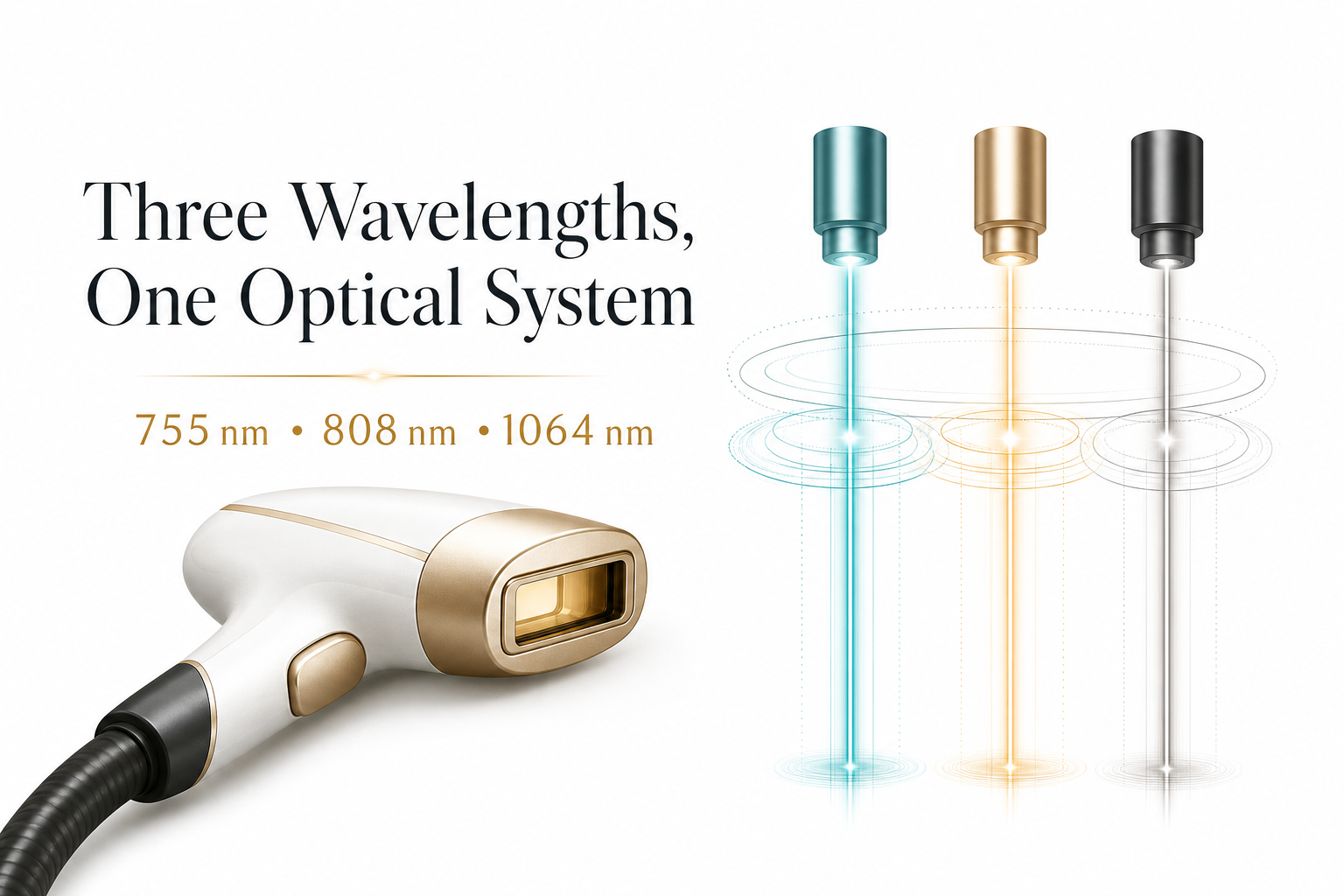
A wavelength affects how light is absorbed and scattered in tissue, but it does not define the complete device, treatment or permitted claim. A buyer must also verify the laser source, applicator, fluence, pulse duration, repetition rate, spot size, cooling, software, intended use and operator instructions.
What Does "nm" Mean?
"nm" means nanometre, a unit used to describe wavelength. Skin contains light-absorbing components called chromophores, including melanin, haemoglobin and water. Their absorption changes across the spectrum. Light is also scattered, reflected and transmitted, so actual energy distribution depends on tissue and device parameters, not wavelength alone.
In broad terms, melanin absorption declines as wavelength increases through the near-infrared range, while longer near-infrared wavelengths generally scatter less and can reach different tissue depths. This does not create three fixed depth shelves. Skin type, target, spot size, pulse duration, cooling and delivered energy all influence the clinical interaction.
Three Wavelengths, Different Optical Profiles
| Wavelength | General Optical Consideration | Buyer Caution |
|---|---|---|
| 755 nm | Relatively stronger melanin interaction than longer near-infrared wavelengths | Higher melanin interaction can also increase epidermal considerations, especially in more pigmented or recently tanned skin. |
| 808 nm | A common diode-laser wavelength balancing melanin interaction and penetration | "808 nm" appears on many hair-reduction systems, but the label does not prove that two machines share the same output or indication. |
| 1064 nm | Lower melanin absorption and lower scattering than shorter wavelengths in this group | It still requires suitable settings, cooling and target selection; "deeper" does not mean universally safer or better. |
These are general optical principles, not a treatment recipe. Operators must follow the exact device label and manufacturer training.
How Trinity Uses the Wavelength Combination
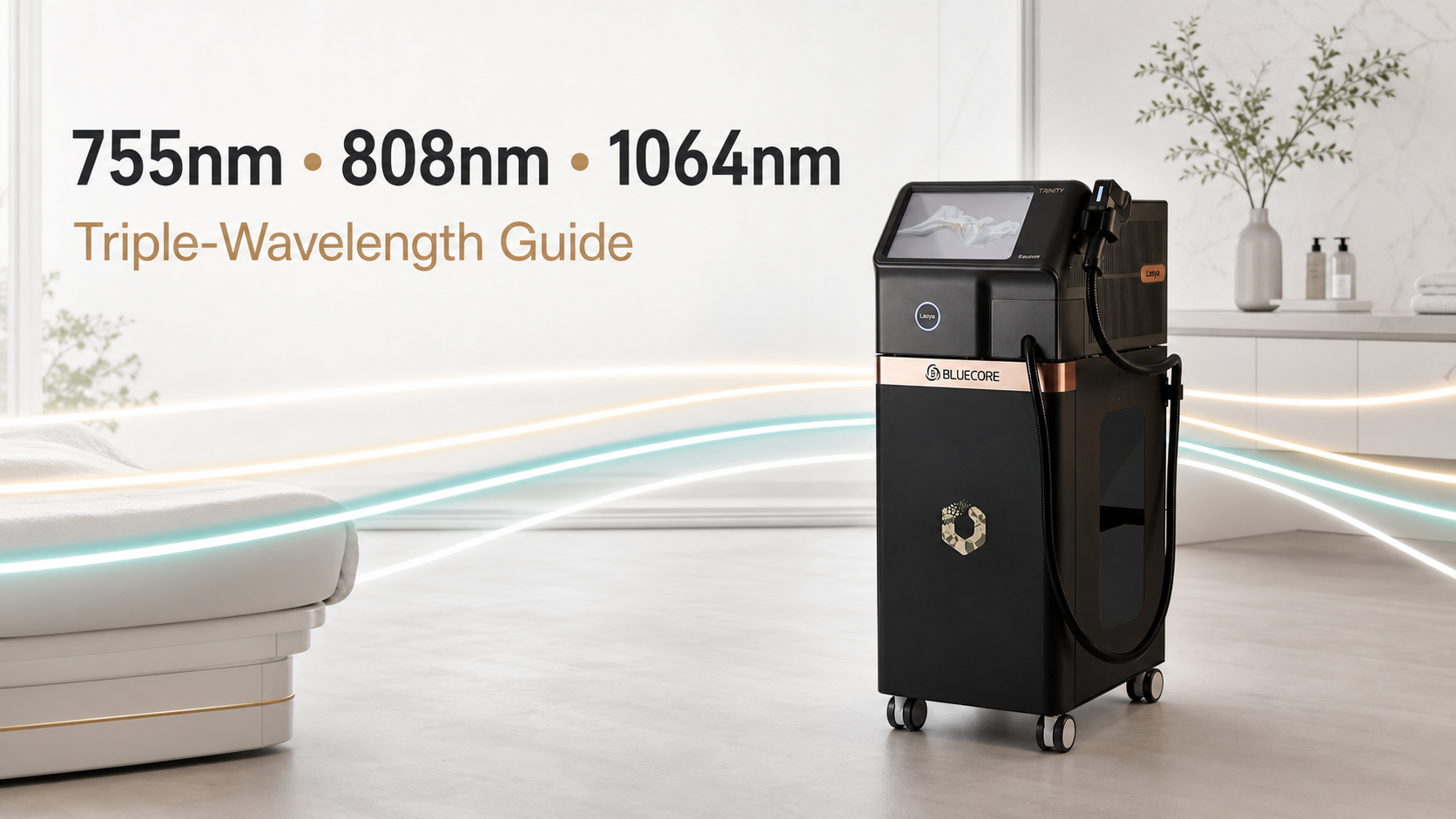
BLUECORE's current product page describes Trinity as a medical device that emits 755, 808 and 1064 nm simultaneously. It also lists a 12 x 20 mm contact area, three contact-cooling levels and three treatment modes. The public FDA summary for Lasya-Trinity K241951 describes a triple-wavelength applicator applying all three wavelengths simultaneously, plus a separate 808 nm applicator.
The FDA technical table lists the triple applicator at up to 60 J/cm2, 1 to 10 Hz, 5 to 200 ms pulse duration and a 2 cm2 spot. These figures help identify the cleared configuration, but they are not instructions for salon use. Actual parameters must come from the current product labelling and authorized training.
Why This Is Not Simply a Hair-Removal Article
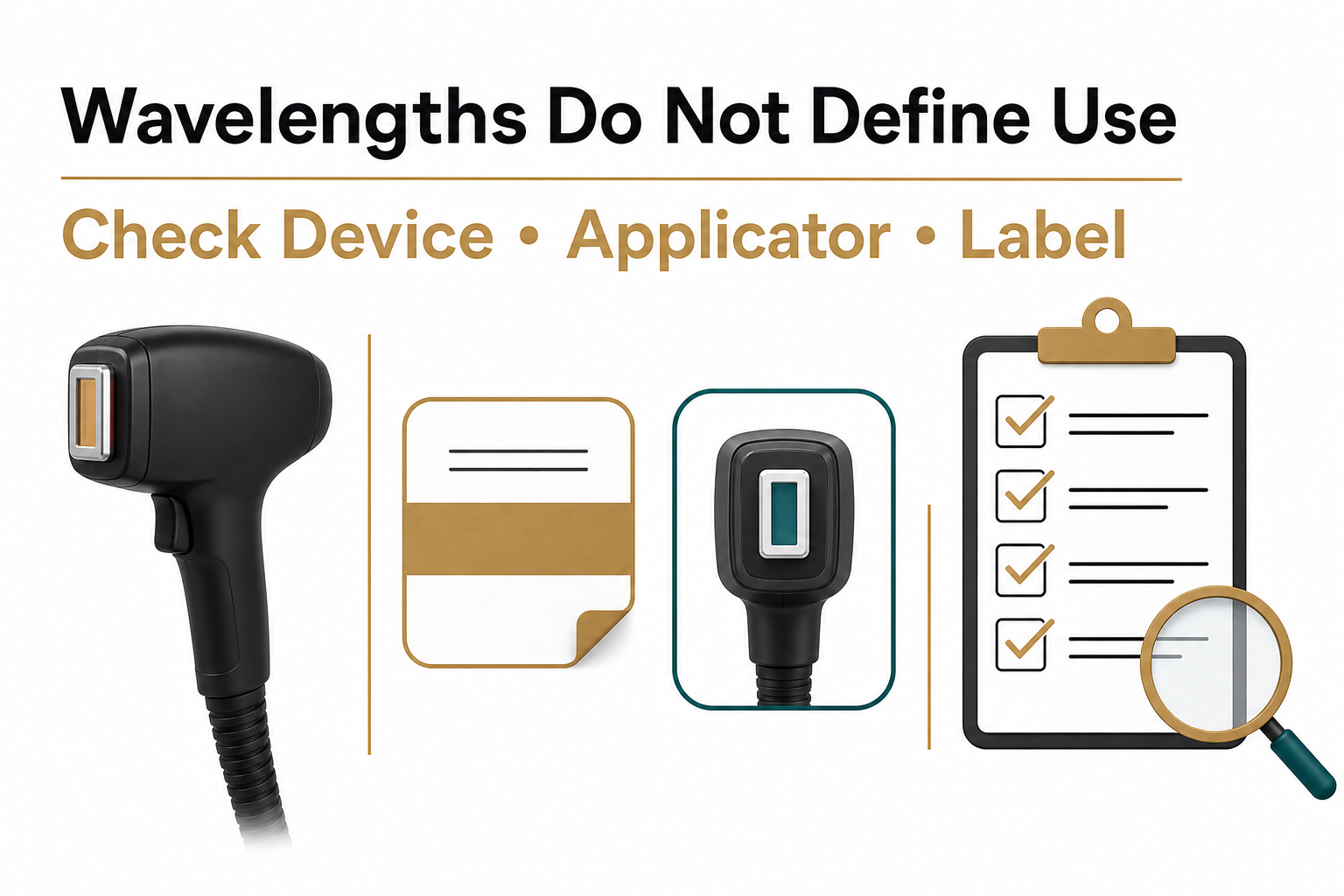
Searches for "755 808 1064" frequently return triple-wavelength hair-removal machines. That does not mean every platform using these numbers is identical, and it does not mean every applicator on one platform has the same purpose.
The Lasya-Trinity FDA record is a useful example:
- The triple-wavelength applicator is listed for benign vascular and vascular-dependent lesions.
- The separate 808 nm applicator is listed for permanent reduction in hair regrowth.
- The record does not list "lifting" or "brightening" as US-cleared indications.
This is why procurement teams must compare the exact device name, handpiece and indication. A marketing page, brand nickname or wavelength badge cannot replace regulatory labelling.
Wavelength Is Only One Row in the Specification Sheet
Fluence
Fluence describes energy delivered per area. The same wavelength at different fluence can produce a different tissue response and risk profile.
Pulse duration
Pulse duration affects how quickly energy is delivered relative to heat dissipation. It must be matched to the target, device design and protocol.
Repetition rate and movement
Frequency influences treatment speed and cumulative heating. A moving technique, stamping technique and repeated passes are not interchangeable.
Spot size and contact
Spot size affects coverage and optical behaviour. Consistent contact matters when a sapphire window is also providing cooling.
Cooling
Contact cooling can support comfort and epidermal protection, but it does not make poor assessment or excessive settings safe. The operator should check the handpiece, cooling performance and contact before treatment.
Software and applicator recognition
Software may limit ranges, store presets or recognize an applicator. Buyers should confirm version control, service access and whether a replacement handpiece requires calibration.
What a Buyer Should Request
- Exact legal manufacturer, device name, model and serial-number format.
- A list of included applicators and the wavelengths delivered by each one.
- Product-specific intended use and indications for the destination market.
- Current user manual, contraindications, warnings and cleaning instructions.
- Laser class, required eyewear and treatment-room controls.
- Output range, pulse range, repetition range, spot size and cooling description.
- Training syllabus, competency assessment and refresher arrangements.
- Warranty scope, handpiece coverage, cooling-system service and spare-parts route.
- Copies of certificates or database records that match the exact manufacturer and model.
- A written list of claims the supplier believes can be used in the buyer's market.
How to Verify an FDA Claim Correctly
Do not stop at a brochure logo. Search the FDA 510(k) database and compare:
- 510(k) number
- device trade name
- applicant or manufacturer
- product code and regulation number
- decision date
- indications for use
- applicators and key technical characteristics
For Trinity, the public record is K241951 for Lasya-Trinity, with a substantial-equivalence decision dated 10 October 2024. FDA clearance is not a global approval, and it does not authorize claims beyond the stated indications. Registration and listing also do not, by themselves, mean FDA approval.
Safety Questions for 755, 808 and 1064 nm Platforms
- How is skin type assessed and recorded?
- Is recent tanning or sunburn an exclusion?
- Which medicines or skincare products require review?
- How is a test area used, where appropriate under the manual?
- Which wavelength-rated eyewear is required for the client and operator?
- How is the treatment room controlled to prevent accidental exposure?
- What endpoint requires the operator to pause or stop?
- What aftercare and escalation instructions are supplied?
- How are redness, swelling, blistering, crusting, pigment change or prolonged discomfort documented and escalated?
Hong Kong's Electrical and Mechanical Services Department advises that higher-class laser products require suitable protective eyewear, warning notices, trained staff and adherence to the operating manual. Those controls remain relevant even when a device includes contact cooling.
Triple Wavelength Does Not Automatically Mean Better
A triple-wavelength platform may provide a designed blend of optical profiles through one applicator. Its value depends on whether the blend matches the intended target, whether output is well controlled, and whether the salon can operate and support the complete system.
A single-wavelength platform may be preferable when it has a precise, well-supported indication, simpler training, lower service complexity or a clearer treatment role. Buyers should compare the whole platform rather than awarding points for the number of wavelengths.
Common Marketing Claims to Rewrite
| Avoid | Use a Qualified Alternative |
|---|---|
| "Three depths guarantee complete lifting" | "The platform combines three wavelengths with different optical profiles; suitability depends on assessment and the permitted indication." |
| "Safe for everyone" | "Client eligibility, skin condition, settings and local professional requirements must be assessed." |
| "Completely painless" | "Contact cooling is designed to support comfort; sensation varies by client and settings." |
| "FDA approved for lifting" | "Verify the exact FDA record and stated indications for the Lasya-Trinity model." |
| "No risk of burns" | "Cooling and trained operation support risk management, but laser treatment still carries potential adverse effects." |
Frequently Asked Questions
Is 755 nm always shallow and 1064 nm always deep?
That shorthand is too simple. Wavelength affects absorption and scattering, but actual distribution also depends on skin, spot size, pulse, fluence and delivery method.
Are all 755/808/1064 machines the same?
No. They may differ in laser source, wavelength proportion, applicator, output, pulse range, cooling, software, intended use, evidence and manufacturing controls.
Is Trinity a hair-removal machine?
The US K241951 record includes a separate 808 nm applicator for permanent reduction in hair regrowth, while the triple-wavelength applicator has a different listed indication. Confirm the supplied configuration and local label.
Does cooling eliminate laser risk?
No. Cooling can support epidermal protection and comfort, but it does not replace client screening, correct settings, eye protection, contact and trained technique.
Where can buyers arrange a Trinity demonstration?
Buyers can review the Trinity product page and compare triple-wavelength and single-wavelength platforms before contacting Asia Pacific Beauty Group. The team can discuss product configuration, a Hong Kong demonstration, quotation, documentation, training and after-sales planning through the contact page. Exact availability and destination suitability must be confirmed before ordering.
This article explains general laser principles and procurement checks. It is not a treatment protocol, medical advice or authorization to use a device outside its labelling or local requirements.