
Beauty Equipment Payback Guide: How to Calculate Machine Price, Consumables, Servicing, Training and Return on Investment
When a salon buys beauty equipment, the most common way of working out payback is: "machine price divided by the price of a single treatment". That calculation is far too crude, and it may even mislead the purchasing decision. The real cost of a beauty device is not just the price of the main unit; it also includes consumables, handpieces, servicing, downtime, training, staffing, marketing, financing interest, booking rates and a risk buffer.
This article breaks down how return on investment for beauty equipment should be calculated, from the purchasing perspective of Hong Kong salons, spas and medical aesthetic centres. The point is not to provide fixed quotations, but to establish a commercial model you can apply to your own figures before buying a machine.

Why is the machine price not the total cost?
The quoted price of a beauty device is only one part of the total cost. If a salon looks only at the price of the main unit, it may underestimate the following costs:
- Handpieces, cartridges, filters, gels or single-use consumables.
- Repair charges after the warranty period.
- Treatment revenue lost during downtime.
- Therapist training and refresher training for new staff.
- Photography, advertising, trial treatments and launch promotion.
- Interest on instalments or equipment financing.
- Loss of utilisation caused by client no-shows, off-peak seasons and price wars.
A genuinely useful payback model should calculate how much net contribution each treatment generates, rather than looking only at the price list.
The six real costs
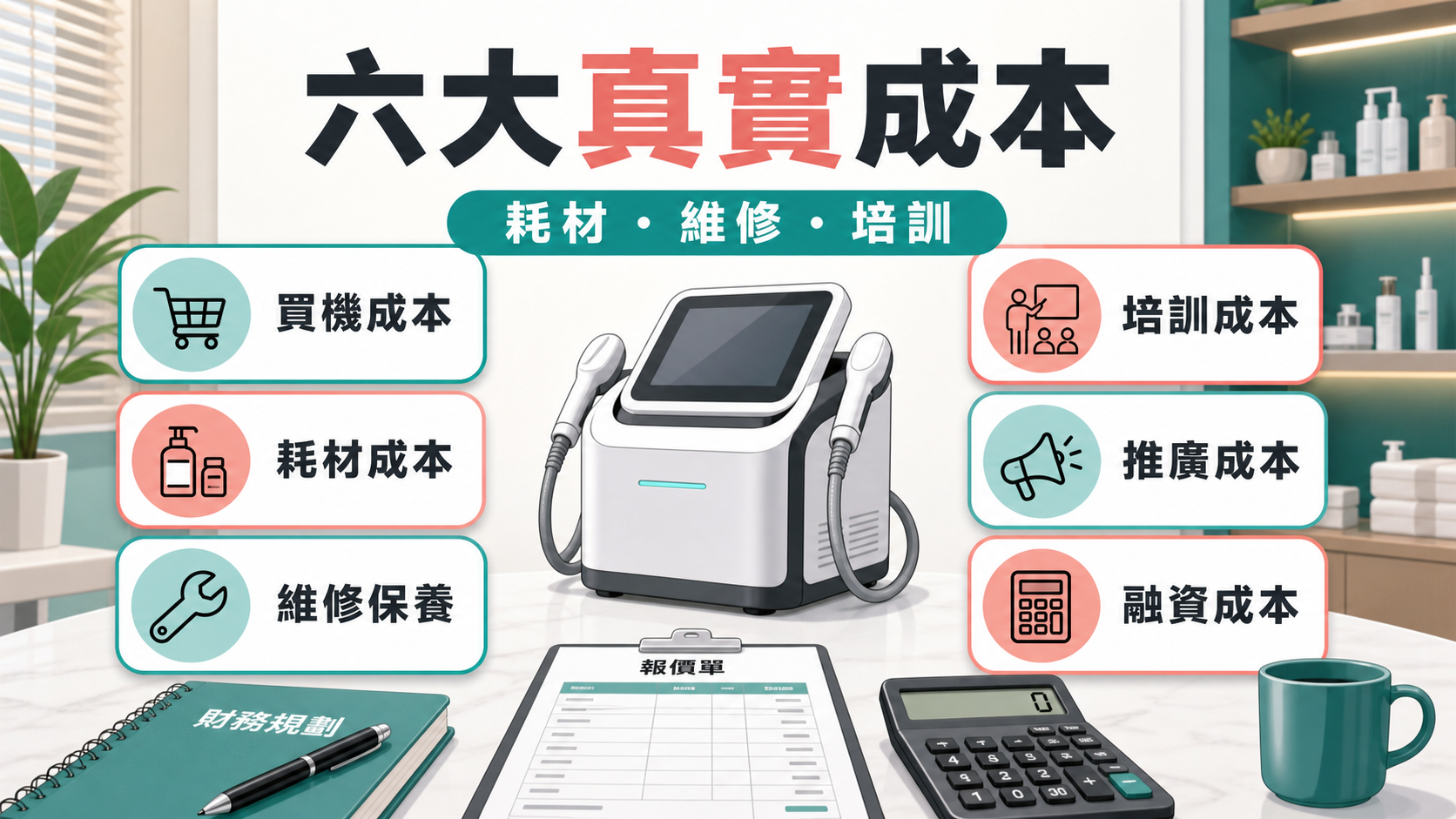
| Cost | Examples | Ask before purchase |
|---|---|---|
| Purchase cost | Main unit, handpieces, trolley, software | Does the quotation include all accessories? |
| Consumable cost | Handpieces, gel, filters, cartridges | How much do consumables cost per treatment? |
| Repair and maintenance | Parts, labour, on-site visits, calibration | What does the warranty cover? How are charges applied after it expires? |
| Training cost | Initial training, refresher training for new staff | Are SOPs and retraining provided? |
| Marketing cost | Advertising, photography, trial treatments, offers | How many clients are needed to reach payback? |
| Financing cost | Instalment interest, handling fees, early repayment costs | Is buying with cash or with financing more suitable? |
If a machine has a lower main unit price but high consumable, servicing and marketing costs, actual payback may not be faster. Conversely, a device with a higher price but transparent consumables, a higher average spend per customer (客單價), complete training and reliable servicing may be better suited to long-term operation.
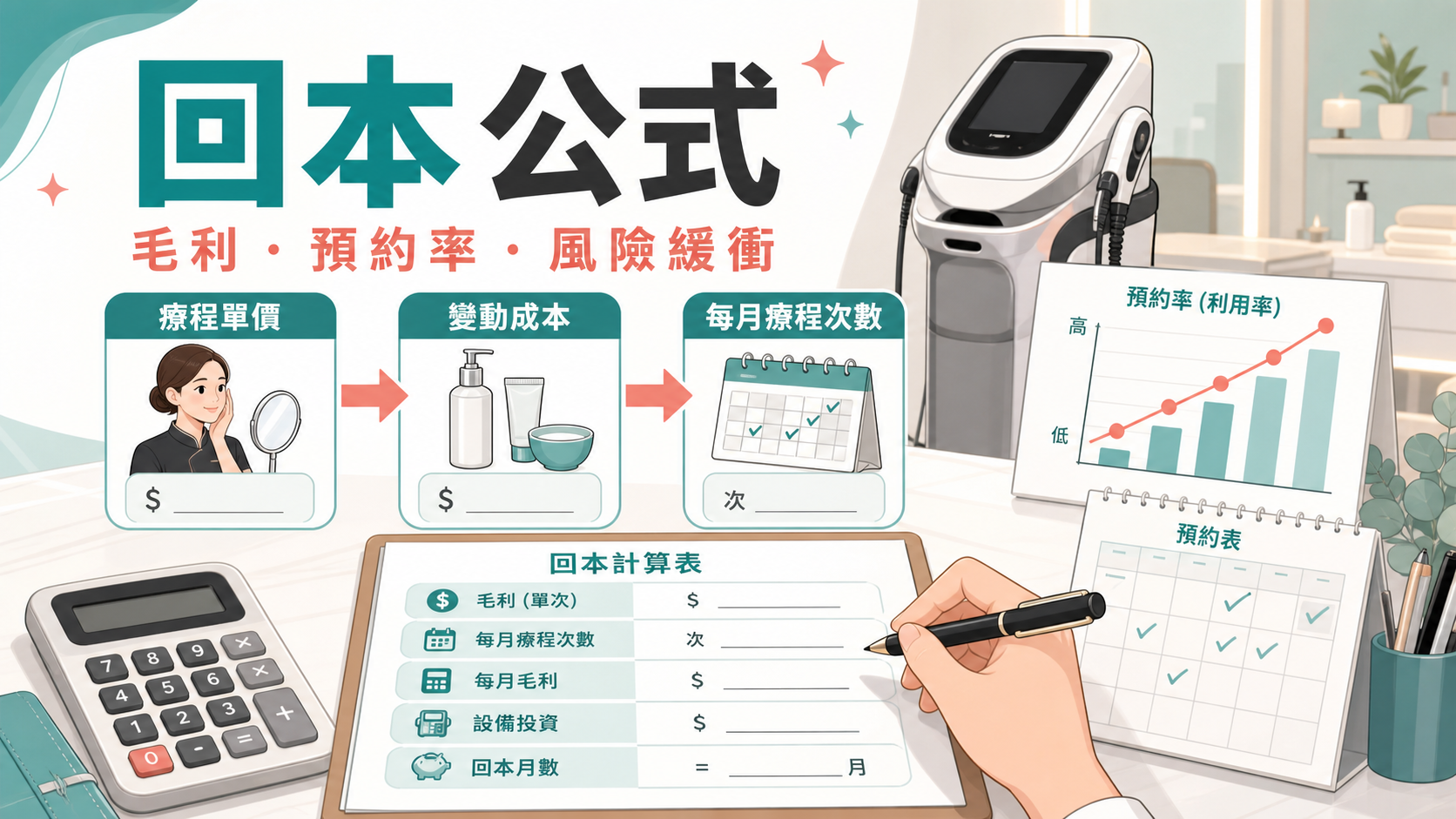
The basic payback formula
Salons can start by estimating with the following formulas:
| Item | Calculation |
|---|---|
| Net contribution per treatment | Revenue per treatment - consumables per treatment - therapist commission - other variable costs |
| Treatments required to reach payback | Total investment ÷ net contribution per treatment |
| Monthly payback rate | Treatments that can be completed each month × net contribution per treatment |
| Estimated payback period | Total investment ÷ monthly net contribution |
Here, "total investment" covers more than the price of the main unit; it should also include the first batch of consumables, training, marketing and financing costs. If instalments are used, interest and handling fees should also be added into the model.
Example one: high-ticket HIFU or MMFU equipment
Suppose a salon buys a lifting device with a total investment of HK$180,000, covering the main unit, the first batch of handpieces, training and launch promotion. The treatment is priced at HK$8,000 per session, handpiece consumables cost about HK$500 per session, and therapist commission plus other variable costs come to about HK$1,000.
| Item | Amount |
|---|---|
| Revenue per treatment | HK$8,000 |
| Consumable cost | HK$500 |
| Labour and variable costs | HK$1,000 |
| Net contribution per treatment | HK$6,500 |
| Treatments required to reach payback | About 28 sessions |
On the face of it, about 28 treatments are enough to reach payback. But high-ticket items usually require more consultation, education, trial treatments, pre-sale communication and client trust. If only four treatments a month can be completed consistently, the payback period is about seven months; if there are only two a month, the payback period comes close to 14 months.
The focus for high-ticket equipment is therefore the quality of the client base, consultation capability, aftercare and brand trust, not simply the gross margin per session.
Example two: mid-ticket RF or laser hair removal equipment
Suppose a salon buys an RF or hair removal device with a total investment of HK$80,000. The treatment is priced at HK$1,200 per session, consumables and variable costs together come to HK$200, and the net contribution per treatment is HK$1,000.
| Item | Amount |
|---|---|
| Total investment | HK$80,000 |
| Net contribution per treatment | HK$1,000 |
| Treatments required to reach payback | 80 sessions |
| At 20 treatments per month | Payback in about four months |
| At 10 treatments per month | Payback in about eight months |
Mid-ticket items may not have the highest gross margin per session, but it is usually easier to raise utilisation through packages, membership schemes and regular maintenance treatments. The keys to their success are steady bookings and a treatment flow that is easy to hand over between staff.
Example three: entry-level cleansing or infusion equipment
Entry-level devices such as hydro-oxygen, infusion, cleansing or LED support equipment may not command a high price per session, but the investment is lower and consumables are easier to control, which suits new salons building baseline cash flow.
The payback model for this type of equipment depends on two things:
- Whether it can be built into multiple packages, rather than sold only as a one-off trial.
- Whether it can be paired with skincare retail to lift the average spend per customer.
If a basic device can support deep cleansing, hydrating infusion, soothing repair and membership maintenance treatments, its value is not just one standalone treatment, but the entry point to an entire facial care system.
Utilisation matters more than the theoretical number of treatments
Many payback models are distorted because they assume the equipment is fully booked every day. In practice, salons need to allow for:
- Clients arriving late or not showing up.
- Treatment room cleaning and preparation time.
- Therapist leave or shift changes.
- Off-peak seasons and quiet weekday periods.
- Downtime for servicing or breakdowns.
- Client consultation time and post-treatment follow-up.
A more conservative approach is to reduce the maximum theoretical utilisation rate (稼動率) to 60% to 70%, then add a 20% risk buffer. Even if the supplier says "do a few clients a day and you will reach payback quickly", the salon should still recalculate using its own number of rooms, number of staff and real client base.
Treatment pricing should be determined by cost and client base together
Pricing should not simply follow the lowest price in the market, nor should it be a mark-up on the machine price alone. More reasonable pricing takes all of the following into account at the same time:
| Pricing factor | Question |
|---|---|
| Cost | How much are consumables, labour, depreciation and marketing costs per session? |
| Client base | Can your clients accept a high ticket price? |
| Differentiation | Is there brand, training, a repair regimen and an after-sales experience? |
| Competition | What are similar treatments charging in the same district? |
| Risk | Are there high-risk procedures, longer consultations or after-sales demands? |
If a salon relies only on low prices to attract clients, it may have to perform a large number of treatments to reach payback, and therapist workload increases. If the equipment, repair products, home care and follow-up services can be integrated into a more complete solution, there is usually healthier room on price.
Financing or instalment payments must include interest
Some salons use equipment financing or instalment payments to reduce the pressure of the initial outlay. This can help cash flow, but it does not mean the cost disappears. Before purchasing, ask:
- What is the effective annual interest rate?
- How long is the repayment period?
- Are there handling fees?
- Is there a penalty for early repayment?
- If the equipment does not generate revenue as expected, will the monthly repayment squeeze cash flow?
If a machine has to be paid for out of monthly revenue, the salon should be even more conservative in estimating utilisation and off-peak income, rather than calculating payback using peak-season figures alone.
The hidden risks of counterfeit, knock-off and low-price equipment
Extremely low-priced equipment is the most attractive, but it is also the most likely to conceal risk. Salons that purchase devices of unclear origin, with confusing branding, unclear authorisation or suspected to be counterfeit may face:
- No route to repair.
- Unstable energy output.
- Client injury or complaints.
- Issues involving false trade descriptions or brand infringement.
- Difficulty handling insurance or claims.
- Negative exposure on social media.
A low price is not the problem; the problem is a low price combined with the absence of documentation, authorisation, warranty, consumables, training and support. If a supplier cannot prove origin and responsibility, the device should not be put into your formal treatment menu no matter how cheap it is.
A return-on-investment checklist before buying
| Question | Purpose |
|---|---|
| What is the total investment? | Including the main unit, consumables, training, marketing and financing |
| What is the net contribution per treatment? | The amount genuinely available to go towards payback |
| What is the conservative number of treatments per month? | Based on real booking capacity, not a fantasy of a full diary |
| What is the worst-case payback period? | Factoring in off-peak seasons, downtime and a 20% buffer |
| Are consumables and servicing transparent? | To avoid costs running out of control after the purchase |
| Can the supplier support marketing? | Once bought, the equipment still has to be sold to clients |
| Is there a repair and home-care package? | Raises the average spend per customer and treatment completion rates |
Frequently asked questions
How long a payback period for beauty equipment is reasonable?
There is no fixed answer. Entry-level equipment may reach payback within a few months, while high-ticket, high-investment equipment may take six months to over a year. The key is to calculate using conservative utilisation and real costs, rather than relying only on the supplier's examples.
Does a high price per treatment necessarily mean faster payback?
Not necessarily. High-ticket treatments usually involve higher client acquisition costs, longer consultation times, higher training requirements and more complete aftercare. If the monthly number of treatments is insufficient, the payback period will also lengthen.
How should consumable costs be calculated?
You can work out the cost per session as "consumable price ÷ number of uses or shots available", then add gel, single-use items, therapist commission and other variable costs. For equipment with high consumable usage, replenishment prices and lead times must be clarified before placing an order.
Is financing a better way to buy a machine?
Financing can ease the cash flow pressure of the initial payment, but it adds interest and the pressure of a fixed monthly repayment. Salons should use conservative revenue estimates and confirm that repayments can still be met during off-peak seasons.
Can the payback case studies provided by suppliers be trusted directly?
They can be used as a reference, but should not be applied as they stand. Supplier case studies are usually calculated using relatively ideal client flow and pricing. Salons should recalculate based on their own number of rooms, therapists, footfall, client base and marketing capability.
Conclusion: beauty equipment payback should be calculated with an operating model, not a fantasy of a full diary
Beauty equipment can help salons raise the average spend per customer and the depth of their services, but it is only genuinely suitable for purchase when costs, consumables, training, servicing, marketing and cash flow have all been worked out clearly. The lowest machine price is not necessarily the best, and the fastest payback is not necessarily the most stable. Equipment that is genuinely worth buying should fit into your treatment system, support therapists in operating it consistently, and allow clients to understand its value.
If you are evaluating beauty equipment payback, purchasing budgets or treatment pricing, you can browse the beauty equipment range, or contact the Asia Pacific Beauty team to discuss a purchasing plan based on your salon's circumstances.
References
- Medical Device Division, Department of Health, Hong Kong: Medical Device Administrative Control System
- Department of Health, Hong Kong: Differentiating medical procedures from beauty services
- Hong Kong Customs and Excise Department: Trade Descriptions Ordinance consumer protection information
- ORIX Hong Kong: Equipment finance
- Hong Kong Consumer Council: Recommendations on the regulation of medical beauty services