
How to Choose a Beauty Equipment Supplier: A Complete Framework for Salons to Evaluate Agents, Training and After-Sales Support
When a salon chooses a beauty equipment supplier, the most common mistake is to compare machine prices only. What really affects long-term operations is not simply “is this machine cheap or not”, but whether the supplier can deliver a complete, sustainable package of services: clear sourcing, verifiable authorisation, demonstrations that can be arranged, training that works on the floor, complete safety documentation, sustainable replenishment of consumables, repairs with a defined response time, and marketing materials that will not lead the salon into exaggerated or medicalised claims.
This article sets out a beauty equipment supplier evaluation framework from the perspective of Hong Kong salons, spas, medical aesthetic centres and beauty industry procurement managers. It does not rank any brand; rather, it helps you weigh risk, cost and after-sales capability against the same yardstick when you are comparing two to four suppliers.
Supplier, Agent, Wholesaler: What Is the Difference?
“Beauty equipment supplier” is the broadest term, and it can cover agents, distributors, wholesalers, manufacturer representatives, repair service providers and even marketplace sellers. When purchasing, a salon should first be clear about which role the other party occupies; otherwise it is very easy to conflate different promises.
| Type | Typical positioning | What the salon should ask |
|---|---|---|
| Supplier | Whether they can supply the goods and provide an overall solution | Whether sourcing, training, repairs and consumables are complete |
| Agent | Whether they hold brand authorisation and manufacturer support | Whether the authorisation letter, authorised territory and manufacturer documentation can be verified |
| Wholesaler | Whether they offer multiple categories and bulk supply | Whether consumables, salon fit-out, start-up packages and after-sales support are included |
| Manufacturer representative | Whether they connect directly to the manufacturing side | How parts, technical updates, warranty and upgrades are arranged |
| Online seller | Convenient for price comparison and initial research | Whether there is a Hong Kong company, demonstrations, training and repair responsibility |
If a company describes itself as a “one-stop beauty equipment supplier”, it should be able to answer most of the questions above. If it can only quote a low price but cannot account for sourcing, documentation, consumables and repairs, it is not suitable as a long-term partner for high-ticket equipment.
What Should a Professional Beauty Equipment Supplier Provide?
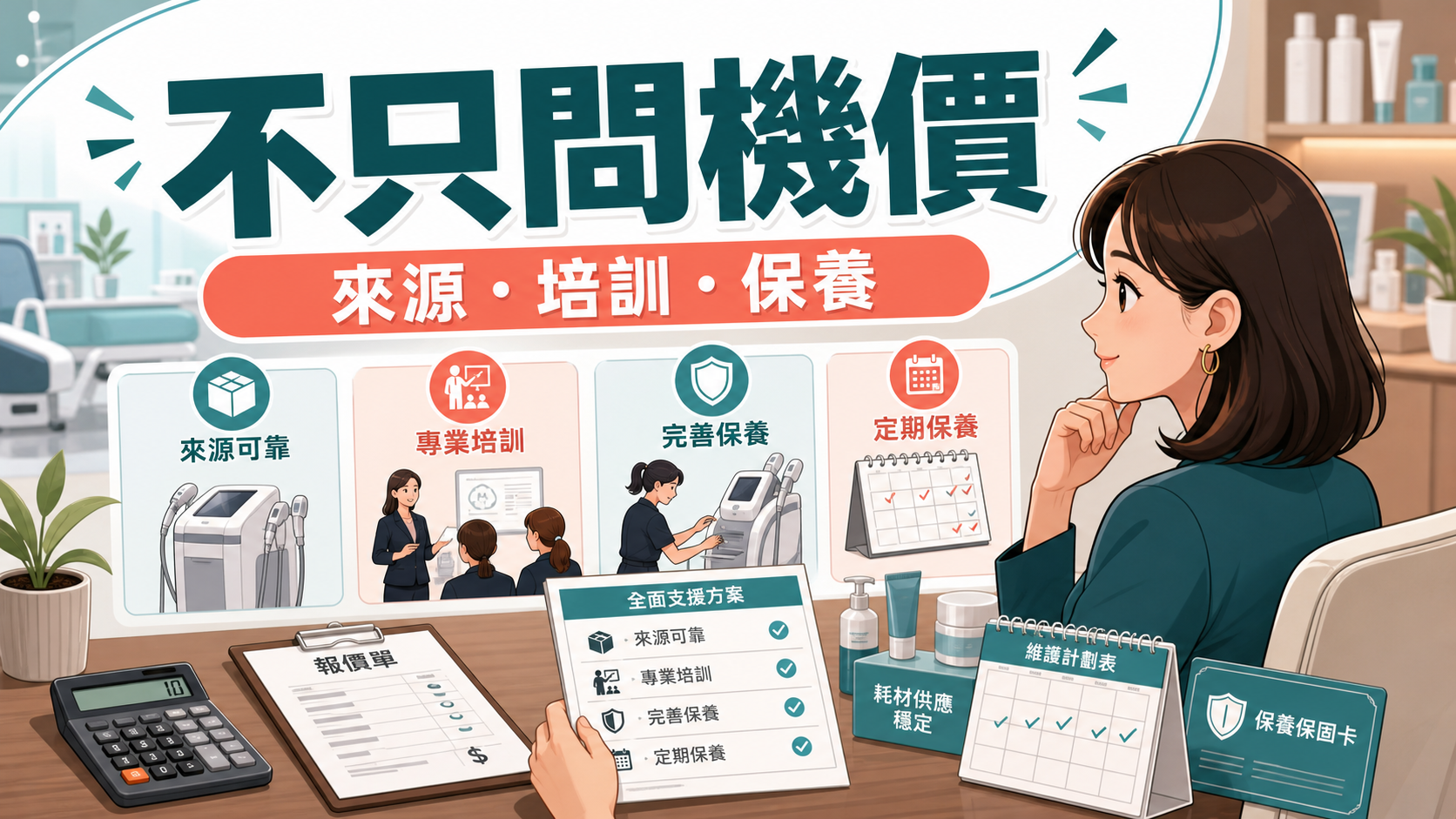
A professional supplier should not simply deliver the machine to your door. For a salon, a more complete delivery should cover five layers:
- Traceable sourcing and authorisation.
- Practical demonstrations, model selection and treatment configuration advice.
- Workable training, contraindications and risk management.
- Predictable repairs, warranty, consumables and parts supply.
- Marketing, client Q&A and promotional support that can be used safely.
In Hong Kong, medical devices are still governed mainly by the voluntary MDACS listing scheme, and beauty industry training likewise has no comprehensive mandatory unified framework. Salons therefore need all the more to carry out their own due diligence, converting a supplier’s service capability into documents that can be checked and terms that are set out in writing.
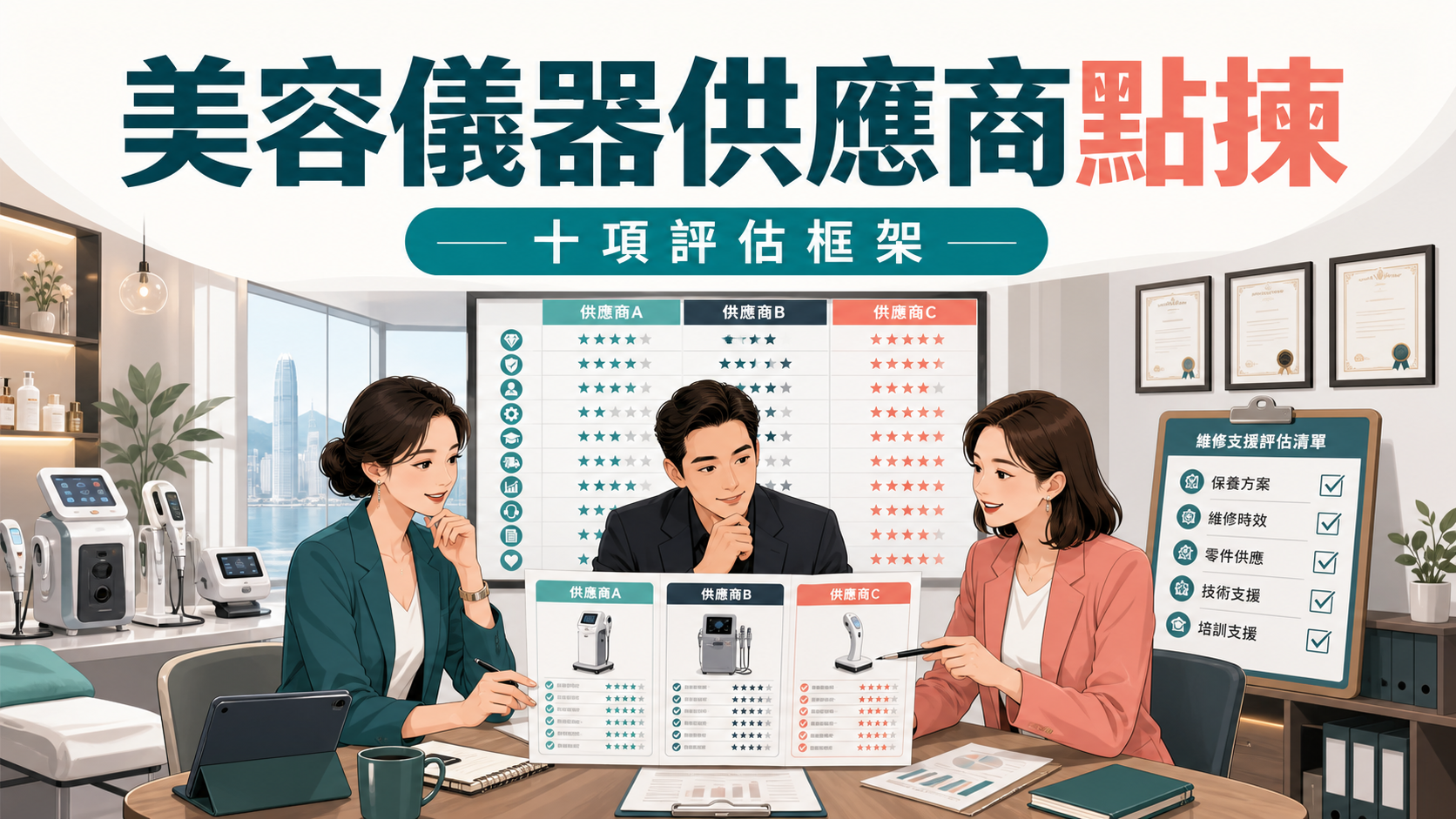
A Ten-Point Supplier Evaluation Framework
The checklist below can be used directly in price comparison meetings, in preparation before a demonstration, or in procurement approval.
| Evaluation item | What the salon should ask | Acceptable signals | Common red flags |
|---|---|---|---|
| Product sourcing | Who is the manufacturer? What is the place of origin and the model? | Brand, model, serial number and manufacturer documentation are available | Only says “Korean machine” or “European machine”, with no model documentation |
| Authorisation status | Are they an official agent or an authorised distributor? | A manufacturer authorisation letter, the manufacturer’s website or documents can be verified | Claims to be the sole agent verbally only |
| Demonstration | Can a demo and a walkthrough of the operating procedure be arranged? | A trial is possible, with parameters, contraindications, consumables and cleaning procedures explained | Only provides before-and-after photos or short videos |
| Training arrangements | How many training sessions? Is there refresher training? | SOPs, a training outline and sign-off records exist | Only teaches how to switch the machine on, with no safety procedures |
| Safety documentation | Are manuals, test reports, maintenance and contraindication information available? | The documents correspond to the same model and the same intended use | Only lists a string of certification buzzwords |
| Risk disclosure | Are unsuitable individuals and the handling procedure set out? | A contraindication list, client screening and adverse-event handling are in place | Says it is suitable for everyone, with zero risk |
| Consumables and parts | How are probes, filters, handpieces and gel replenished? | Prices, lead times, stock and parts arrangements are available | The main unit is cheap but the consumables terms are unclear |
| Repairs and warranty | How long is the warranty? How quickly do they respond to a breakdown? | Warranty scope, response time and engineering support are defined | Only a salesperson’s personal phone number |
| Marketing support | Are there official posters, videos and Q&A materials? | Compliant materials can be supplied, along with reminders about advertising restrictions | The materials are full of exaggerated efficacy wording |
| Response speed | Do they reply consistently after quoting and after the sale? | A fixed customer service contact, a repair procedure and support hours exist | Instant replies before the order is signed, then unreachable afterwards |
Evaluation One: Is the Sourcing and Authorisation Traceable?
The clearer the sourcing of a beauty device, the easier it is later to pursue warranty, parts, recalls and liability. At the point of purchase you should at least ask for:
- The manufacturer’s name
- The brand and model
- The serial number or batch number format
- Manufacturer authorisation or proof of distributorship
- Shipping documents or supply chain records
- The Hong Kong company and local contact details
If the device has the character of a medical device, or the supplier uses medical-use claims, you should further find out whether it can be checked publicly against MDACS, LRP, local importer or distributor records. Not being listed does not necessarily mean it cannot be bought, but no sourcing, no authorisation and no after-sales responsibility is a real operational risk.
Evaluation Two: A Demonstration Is About Operation, Not Just Results
A demonstration is not a sales show. When a salon arranges a demo, it should not only watch whether there is “any immediate sensation” after the demonstrator has finished one side of the face; it should observe the following:
| What to observe during the demo | Why it matters |
|---|---|
| Operating interface | Whether therapists can learn it easily, and whether it is easy to press the wrong button |
| Parameter logic | How settings are adjusted for different areas, skin conditions and client groups |
| Consumable replacement | Whether probes, handpieces, gel or filters are easy to manage |
| Cleaning procedure | Whether it fits in-salon hygiene practice and room turnaround |
| Adverse-event handling | How to deal with a device error, a client feeling unwell, or overheating |
| Treatment time | Whether it can fit into the actual appointment schedule |
A genuinely reliable supplier should be willing to spell out both the strengths and the limitations. A demonstration that stresses results only, without covering contraindications and repairs, is of limited reference value.
Evaluation Three: Are Training and SOPs Enough to Support Staff Handover?
The situation salons most often meet is not that the first therapist cannot use the device, but that six months later — when a new member of staff joins, the original person in charge leaves, or the treatment packaging changes — the salon has no training material it can carry forward. Training therefore comes down to three things:
- Whether there are written SOPs and a contraindication list.
- Whether there is hands-on training and scenario handling.
- Whether refresher training or catch-up training for new staff is arranged.
High-energy, microneedling, RF, lifting, laser or transdermal delivery equipment should not rely on “watch it once and you know it”. A supplier that can provide operating log sheets, client assessment forms, cleaning and maintenance sheets and adverse-event handling procedures is more valuable than one that simply hands over a certificate.
Evaluation Four: Assess Safety Documents and Marketing Materials Separately
Many suppliers display terms such as CE, ISO, FDA, MFDS, KFDA and SGS on their sales pages. This information should not be ignored, but neither should it be lumped together. Salons should require every document to correspond to the same model and the same intended use, and should understand whether it represents quality management, electrical safety, market access, a test report or product registration.
At the same time, marketing materials should be reviewed separately. If the posters or social media posts provided by the supplier contain wording such as “permanent”, “guaranteed”, “zero risk”, “treats disease” or “suitable for everyone”, the salon should not use them directly. Safer materials should focus on skin condition management, appearance improvement, maintenance packages, client screening and individual variation in results.
Evaluation Five: Consumables, Parts and Warranty Determine the Real Cost
The total cost of a beauty device is usually made up of the price of the main unit, consumables, parts, repairs, downtime, training and promotion. When taking a quotation, press specifically on:
- What is the lifespan of the probe or handpiece?
- Roughly how much cost does a single treatment consume?
- Is there a minimum order quantity?
- How long does replenishment of consumables take?
- Do parts have to be sent back overseas?
- How are repairs charged after the warranty period?
- Is a replacement unit or priority support available during downtime?
If a supplier says “consumables are very cheap”, “the warranty is nothing to worry about” or “repairs are very fast”, but is unwilling to write this into the quotation or the contract, it is still only sales talk.
Common Trust Signals and Red Flags
Trust signals are not a guarantee of quality, but they can serve as an initial screen.
| Trust signal | What it indicates | What still needs to be asked |
|---|---|---|
| A Hong Kong showroom or office | There is at least a local point of contact | Whether there is a repair facility and engineering support |
| Demonstrations can be arranged | Willing to let the buyer test in person | Whether the demo includes an explanation of risks and consumables |
| Manufacturer authorisation is held | Sourcing is more traceable | Whether the scope, validity period and territory of the authorisation are clear |
| Training is arranged | The relationship does not stop at delivery | Whether there is refresher training and written SOPs |
| Warranty terms are provided | There is an after-sales commitment | Whether parts, labour, on-site visits and the start date are covered |
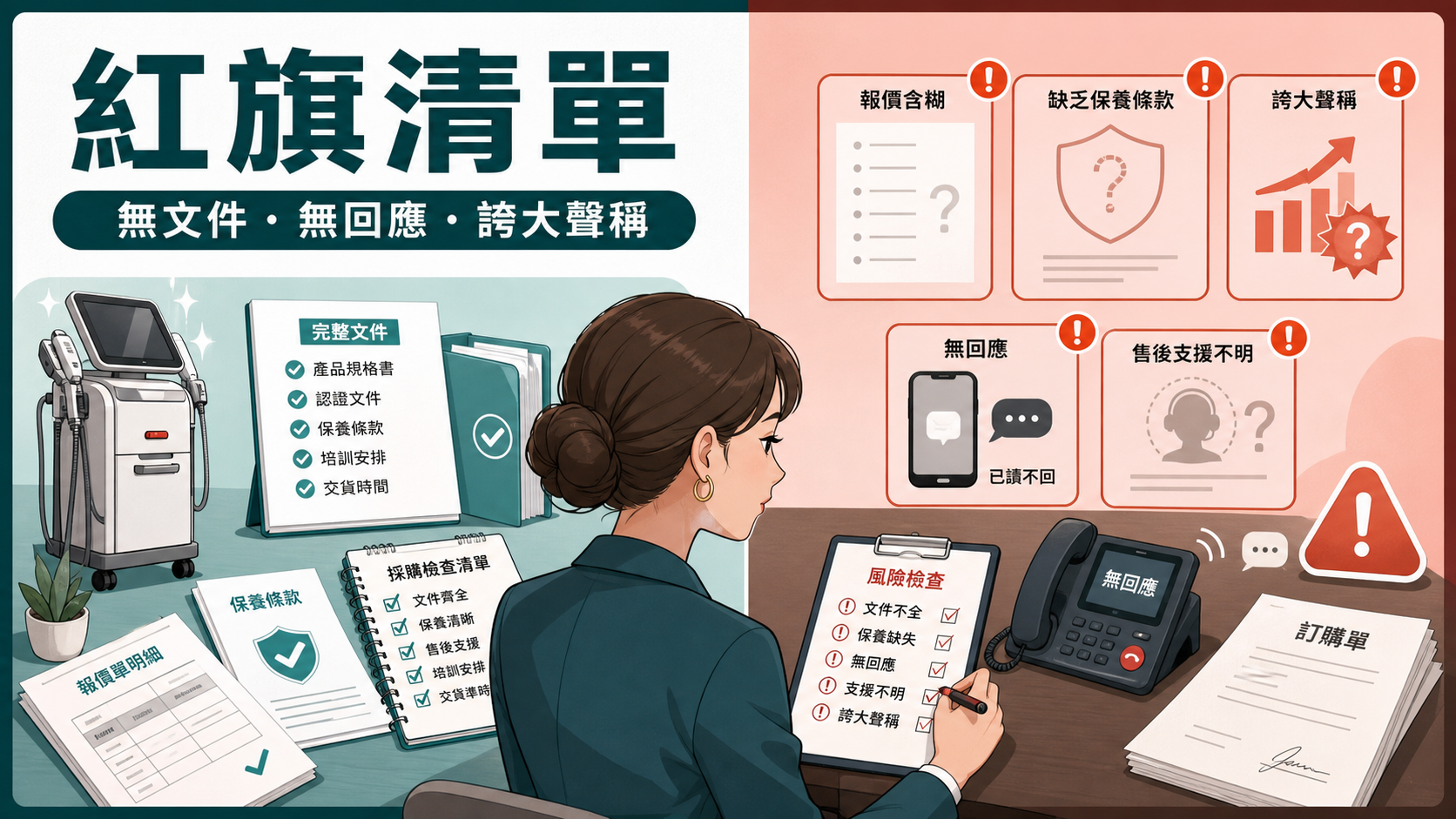
Common red flags include:
- Unclear sourcing, with nothing said beyond “made in a certain country”.
- Claiming to be an agent but holding no authorisation documents.
- An extremely low quotation, but no details on consumables and warranty.
- Marketing materials that make heavy use of guaranteed-result and medicalised wording.
- After-sales handled only through a salesperson’s personal phone number.
- Unwillingness to arrange a demonstration, or refusal to let the buyer see the operating procedure.
- No contraindication list, with claims that any client is suitable.
How Should a Salon Turn the Evaluation into a Purchasing Decision?
It is recommended that each supplier be assessed against five scores:
| Scoring area | Evaluation focus |
|---|---|
| Sourcing and authorisation | Whether the documents are traceable |
| Operation and training | Whether therapists can use it consistently |
| Cost and consumables | Whether the payback model can be calculated clearly |
| Warranty and repairs | Whether downtime risk is controllable |
| Marketing and compliance | Whether the wording used with clients is safe |
If one supplier has the lowest machine price but is the weakest on documentation, training and repairs, it is not necessarily the cheapest choice. Conversely, a supplier that quotes higher but can provide local demonstrations, training, consumables, repairs and compliant materials may be better suited to a salon that wants to operate for the long term.
Frequently Asked Questions
What is the difference between a beauty equipment supplier and an agent?
Supplier is a broad term, and the focus is on whether they can supply and support. An agent, by contrast, involves brand authorisation and manufacturer responsibility. Salons should ask the other party to produce authorisation documents, model information, warranty terms and local support arrangements.
When buying beauty equipment in Hong Kong, do you always have to check MDACS?
If the equipment has the character of a medical device, involves medical-use claims or higher-risk energy output, it is worth checking. MDACS is at present a voluntary listing scheme and cannot be reduced to statutory approval, but it can still serve as an important risk-checking tool.
If a supplier says it has FDA registration, does that mean it is safe and effective?
The two should not be equated directly. Different FDA-related terms mean different things; registration, clearance and approval, for example, each differ. Salons should ask for the specific document, model and intended use, and should not write “registration” up as “guaranteed efficacy”.
What questions should you bring to a demonstration?
Six categories of question are recommended: operating procedure, contraindication list, consumable cost, cleaning and maintenance, adverse-event handling and treatment time. The aim of a demonstration is to assess whether the device can work in day-to-day operations, not merely to look at the results shown in the demo.
If the supplier has not set out the warranty scope, can you place the order first?
Not recommended. At a minimum, the warranty period, the start date, whether parts and labour are included, on-site arrangements, response time and whether consumables are charged separately should first be set out clearly. For high-value equipment in particular, verbal promises alone should not be relied upon.
Conclusion: A Good Supplier Is a Salon’s Long-Term Operating Partner
Choosing a beauty equipment supplier is not about choosing the one that sells hardest, nor the one with the lowest machine price, but about choosing a partner that can help the salon deliver consistent treatments over the long term. A supplier genuinely worth working with should be able to set out sourcing, authorisation, demonstrations, training, safety documentation, consumables, warranty, repairs, marketing support and response time clearly.
If you are comparing beauty equipment suppliers, agents or wholesale packages, first put together your salon’s floor area, budget, existing client base, therapist capability and the treatments you want to lead with, then contact the Asia Pacific Beauty team to arrange a demonstration and purchasing advice.
References
- Medical Device Division, Department of Health, Hong Kong: Medical Device Administrative Control System
- Medical Device Division, Department of Health, Hong Kong: Frequently Asked Questions
- Department of Health, Hong Kong: Distinguishing Medical Procedures from Beauty Services
- Hong Kong Customs and Excise Department: Trade Descriptions Ordinance consumer protection information
- Electrical and Mechanical Services Department: Safety of Household Electrical Products
- ISO: ISO 13485 Medical devices quality management systems