
Beauty Salon Treatment Marketing Compliance Guide | How to Avoid the Pitfalls in Social Media, Before-and-After Images and Efficacy Wording
For a beauty salon, the hardest part of treatment marketing is not “whether the copy is attractive enough”, but how to keep results, pricing, limitations, risks and the handling of customer data clearly stated while working at the pace of social media. Hong Kong’s beauty market is fiercely competitive: IG short videos, Facebook ads, KOL trials, limited-time offers and before-and-after images can all generate enquiries, but the same set of materials may also trigger the Trade Descriptions Ordinance, medical advertising restrictions or privacy risks.
This guide is written for Hong Kong salon owners, marketing managers, treatment consultants and beauty operations teams. The aim is not to teach you to write more conservative copy, but to build a workable review framework: which wording to avoid, how to use before-and-after images safely, how KOL collaborations should be approved, and how the conditions attached to promotional prices should be set out.
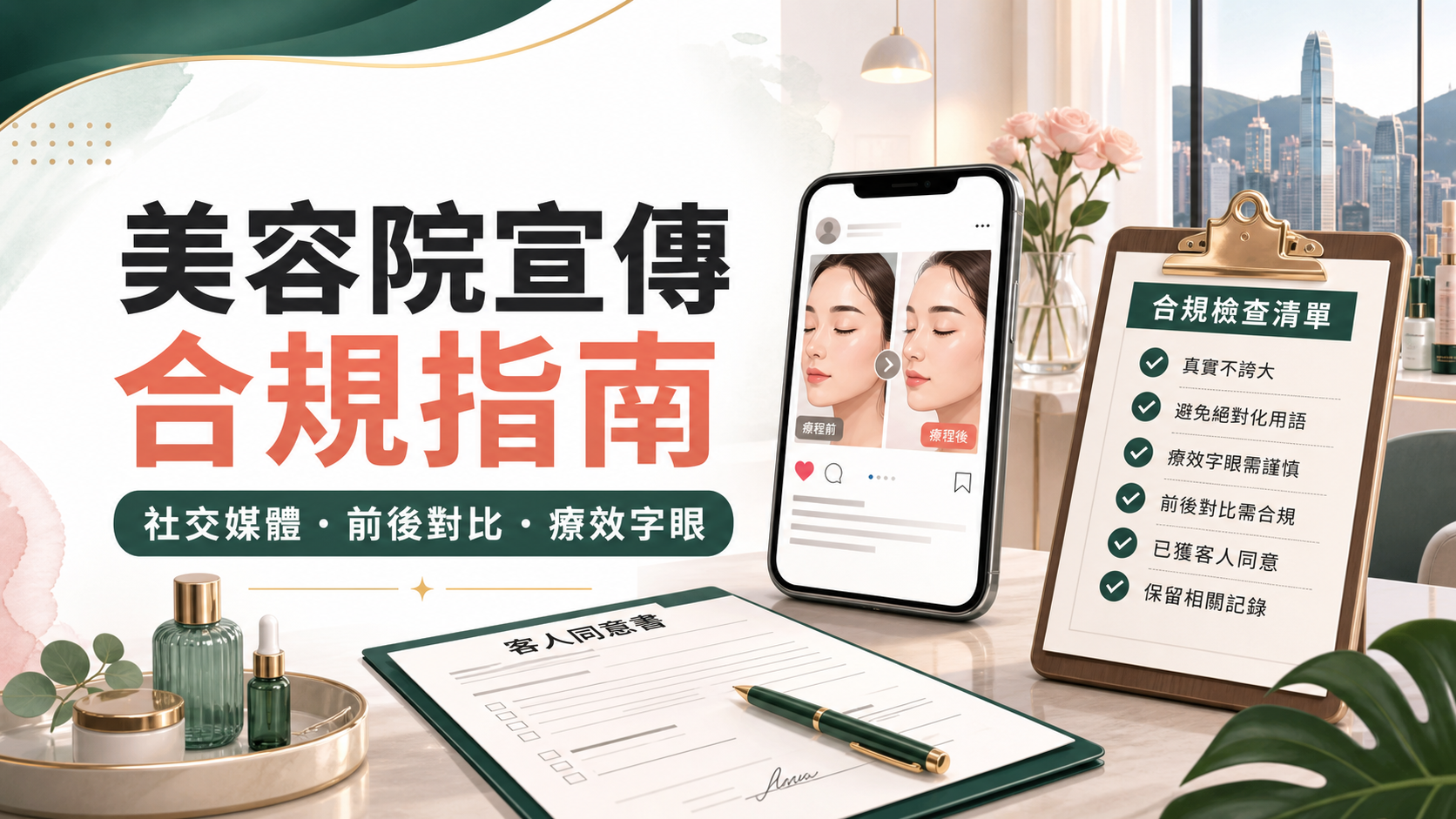
Why must beauty salons take marketing compliance seriously?
Salon marketing is usually not a single advertisement but a complete sales chain: a social media post attracts an enquiry, WhatsApp follow-up, booking a trial treatment, an in-store consultation, an introduction to prepaid treatment packages (套票) in the treatment room, and then payment and further promotion. Compliance risk also appears along that chain.
Common risks include:
- Promising results with absolute wording such as “guaranteed results”, “permanent” or “zero risk”.
- Using wording such as “treat”, “cure” or “medical grade” to package a beauty service as a medical service.
- Advertising a trial price without clearly setting out the conditions on new customers, time slots, quotas or additional spend.
- Using before-and-after images without the customer’s express consent, or presenting an individual case as a general outcome.
- KOL content that looks like an ordinary customer’s experience when it is in fact a sponsored collaboration that is not clearly disclosed.
- Collecting phone numbers, WhatsApp contacts or photographs without clearly explaining the direct marketing purpose.
If a salon wants to build long-term trust, its marketing copy cannot chase immediate conversion alone. The higher the ticket value, and the closer an item sits to prepayment, packages, equipment or the medical-beauty borderline, the more clearly the information needs to be stated, so that a marketing selling point does not turn into a complaint or an enforcement risk.
Three legal red lines for beauty marketing in Hong Kong
1. Hong Kong Customs: the five marketing traps under the Trade Descriptions Ordinance
The Hong Kong Customs and Excise Department is responsible for enforcing the Trade Descriptions Ordinance (Cap. 362) and the related unfair trade practices provisions. For a salon, the risk does not arise only over “whether a product is genuine”; it also covers service descriptions, price indications, selling methods and payment arrangements.
The following five categories are the ones most worth repeating in internal salon training.
| Unfair trade practice | Common salon scenario | Safer approach |
|---|---|---|
| Misleading omissions | The advertisement says “$98 trial”, but the important restrictions are put in very small print or mentioned only by private message | State new-customer status, time slots, quotas, additional spend and the validity period clearly in the main copy |
| Aggressive commercial practices | A customer with a mask on, partially undressed, or kept in the room for a long time, is worked on in turn by several staff to buy a package | Allow the customer to decline freely, read the terms calmly, and keep their own payment instruments |
| Bait advertising | Advertising a low-priced treatment continuously when the actual booking quota is very small or almost impossible to arrange | Ensure a reasonable capacity to supply, and state the quota and booking conditions clearly |
| Bait and switch | Attracting customers in store with a low-priced treatment, then refusing to provide it on various grounds and switching them to an expensive item | If the treatment needs to be changed, it should be based on a genuine assessment, clearly explained, and the original option retained |
| Wrongly accepting payment | Pushing long-term prepaid packages hard while knowing the service cannot be provided as promised | Sell only services that can reasonably be delivered, and set out the service period, refund and transfer terms clearly |
Salons should manage “advertising” and “in-store selling” together. Even if the social media copy itself is unobjectionable, using high-pressure tactics to force a sale in store, alarming customers about their health, or dealing with payment instruments without authorisation may still expose the brand to serious legal and reputational risk.
2. Department of Health and the Drug Office: the line between medical advertising and beauty services
The core purpose of the Undesirable Medical Advertisements Ordinance (Cap. 231) is to prevent members of the public from delaying proper medical treatment because of advertising claims. When promoting treatments, equipment or skincare packages, salons should avoid describing beauty care as the prevention, diagnosis or treatment of disease.
High-risk wording includes “treats eczema”, “cures acne inflammation”, “anti-tumour”, “heals skin disease” and “prevents severe hair loss”. Even where a treatment is positioned around skin management, the copy should focus on appearance, care and a soothing experience rather than on dealing with disease.
The other boundary is between medical procedures and beauty services. The Department of Health’s material on differentiating medical procedures from beauty services is a reminder that items involving injection, skin puncture, deeper peeling, certain high-risk procedures, or matters requiring medical judgement, should not be played down by an ordinary salon in the tone of a routine beauty service. Where the premises have no registered medical practitioner or corresponding professional arrangement, it is all the less advisable to use freely wording such as “doctor grade”, “medical grade” or “therapeutic grade” in marketing, as it may mislead consumers.
Safer phrasings include:
- “Improves skin hydration and radiance”
- “Helps to condition the oil and moisture balance”
- “Visually softens uneven skin tone”
- “Carried out following an assessment by a professional consultant”
- “Actual results vary according to individual constitution, skin condition and lifestyle”
3. The Privacy Commissioner’s Office: customer lists, photographs and direct marketing
When salons run social media promotions, they often collect names, phone numbers, WhatsApp contacts, Instagram accounts, skin photographs, before-and-after photographs and purchase records at the same time. This information is not merely a sales lead; it is personal data, and its use requires a clear purpose and a basis of consent.
If a salon wishes to use customer data for direct marketing — for example promoting a new treatment over WhatsApp, telephoning customers to renew a package, or passing customer data to a partner brand or to a new company taking over the operation — the purpose should be clearly explained at the point of collection and the customer’s explicit consent obtained. Tick boxes should not be pre-ticked, and different purposes should not all be bundled into a single vague sentence.
Before-and-after photographs should also be handled separately. It is recommended that, in addition to the treatment consent form, a separate “photographs for marketing use” consent be set up, stating the channels in which they may be used, whether identifying features will be obscured, whether they may be used in paid advertising, whether there is a withdrawal arrangement, and whether the photographs may be used alongside a case description.
Social media marketing in practice: before/after, KOLs and limited-time offers
Rules for publishing before/after images
A before-and-after image is not necessarily a breach in itself; what is genuinely high-risk is the absence of consent, an unfair comparison, excessive retouching, inconsistent angles and lighting, or packaging an individual case as a guaranteed result.
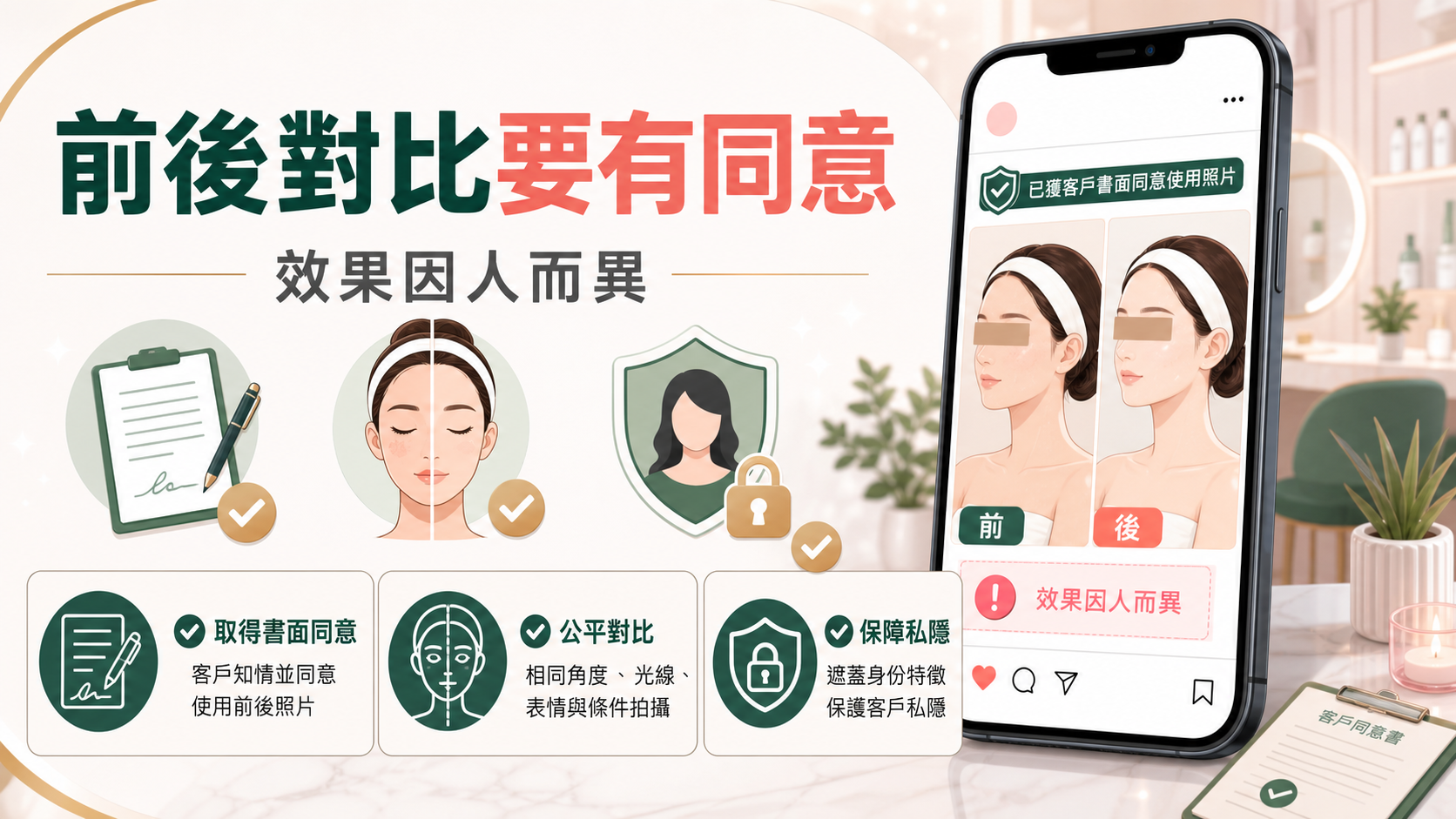
Before publishing a before-and-after image, a salon can use the following checklist to approve it:
| Checkpoint | Recommended approach |
|---|---|
| Customer consent | Obtain written consent, setting out the channels and purposes of use |
| Identity protection | Unless necessary, obscure identifiable features or avoid showing full names |
| Comparison conditions | Keep the angle, lighting, expression, distance and camera equipment the same as far as possible |
| Caption limits | Avoid “results after a single session”, “the same result guaranteed” and “permanent improvement” |
| Labelling wording | “Before care / after care” is safer than “pre-operative / post-operative” |
| Disclaimer reminder | Add “results vary according to individual constitution, skin condition and lifestyle” |
An example of a disclaimer that can be used:
“This photograph is published with the consent of the person concerned. Actual care results vary according to individual constitution, skin condition and lifestyle, and it is not guaranteed that every customer will achieve exactly the same outcome.”
Working with KOLs and influencers: the advertiser must control the script
When a salon invites a KOL to try a treatment, it should not simply send over the treatment information and let them improvise. If the content contains exaggerated efficacy, medical claims, an undisclosed sponsorship relationship or inaccurate price information, the brand as the advertiser may equally bear the risk.
A safer KOL process includes:
- Setting out before the collaboration that disclosure such as “paid partnership”, “sponsored content” or similar wording is mandatory.
- Reviewing the caption, video subtitles, Stories text and voice-over script before publication.
- Asking the KOL to share subjective impressions — such as the service flow, comfort, the feeling of hydration or the environment — rather than promising efficacy.
- Prohibiting wording such as “guaranteed to slim down”, “ten years younger”, “no rebound” and “doctor-grade treatment”.
- Keeping the final published version, screenshots, the contract and the approval records.
The most valuable KOL content is usually genuine experience and brand trust, not efficacy promises made on the salon’s behalf that go beyond the evidence.
Price transparency: trial prices, original prices and package conditions
Promotional pricing is a common traffic-driving tool for salons, but it is also a major source of complaints. If an advertisement says “was $5,000, today $299”, the salon should be able to explain whether the original price is genuine, what restrictions apply to the trial price, whether it is limited to new customers, whether booking is required, and whether an additional product or package purchase is compulsory.
It is recommended that every promotional post sets out at least:
- The service content and duration included in the price.
- Whether it is limited to new customers, designated branches, designated time slots or a designated quota.
- Whether consumables, consultation fees, product fees or a deposit must be paid separately.
- The validity period, booking method, and cancellation or rescheduling arrangements.
- Whether a package must be purchased after the trial in order to enjoy the offer.
The terms should not all be placed in a corner of an image in tiny print that nobody will read. If a restriction is significant enough to affect whether a consumer buys, it should be set out in the main copy or in a prominent position on the image.
High-risk efficacy wording vs a safe alternative vocabulary
Beauty copy does not have to lose all of its appeal, but “absolute promises” need to be rewritten into expressions that are descriptive, explicable and closer to a skincare context.
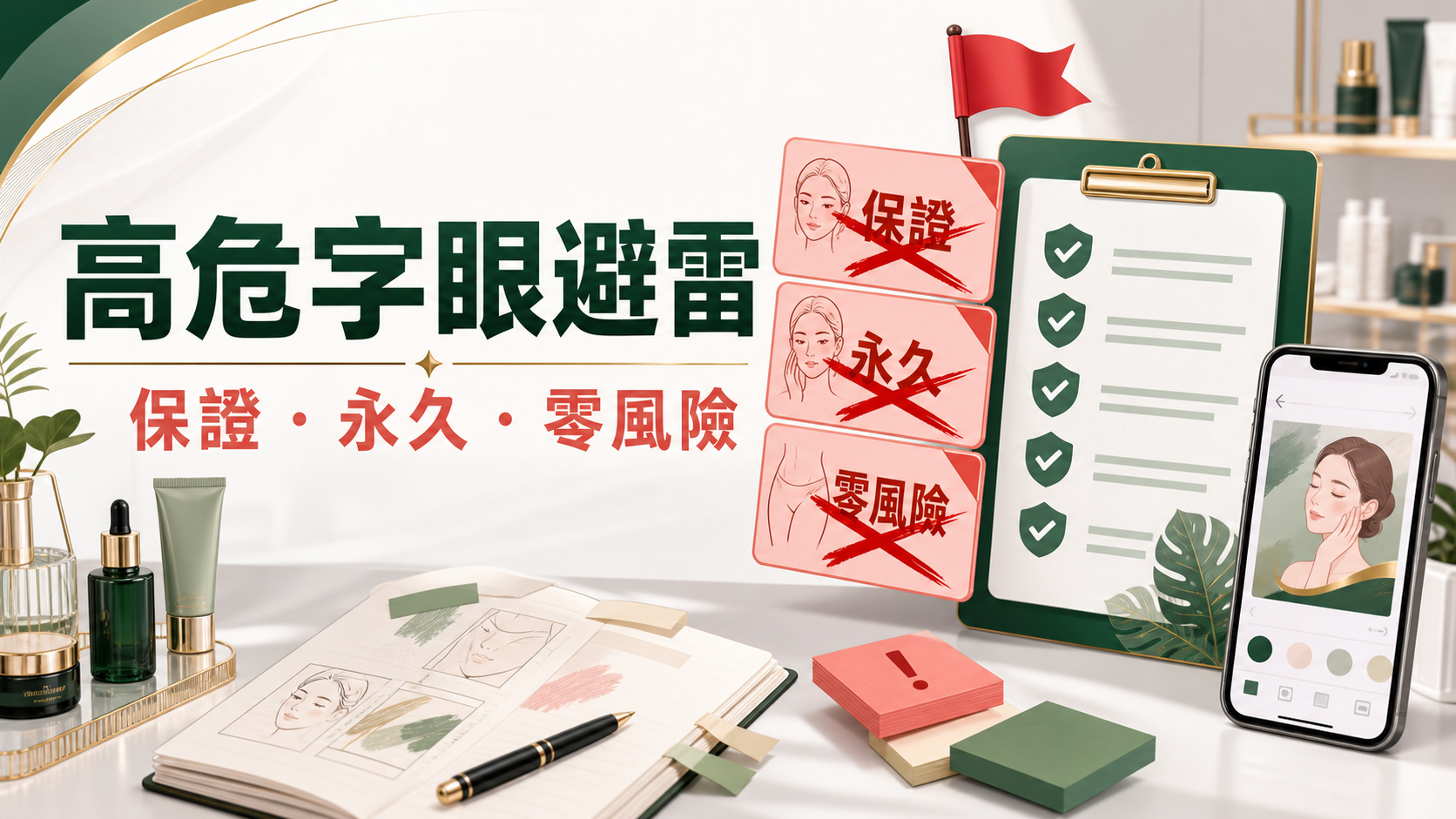
| Marketing category | High-risk wording | Why it is risky | Safer alternative |
|---|---|---|---|
| Efficacy promises | 100% effective, guaranteed pigmentation removal, permanent hair removal, zero rebound | Absolute results are usually difficult to prove for everyone | Noticeable improvement, visually softened, lasting reduction, results vary from person to person |
| Disease treatment | Treats eczema, cures acne, anti-inflammatory and bactericidal, heals skin disease | May involve a medical or disease claim | Soothes the discomfort caused by dryness, purifies pores, balances oil, skin care |
| Safety risk | Zero risk, absolutely safe, completely free of side effects, suitable for anyone | May overlook contraindications and differences in individual constitution | Carried out after assessment, non-invasive care, a relatively comfortable process, subject to assessment of skin condition |
| Professional credentials | Doctor grade, medical grade, therapeutic grade, clinical grade | May mislead consumers about the salon’s credentials or the nature of the service | Advanced beauty care, delivered by trained beauticians, together with an assessment by a professional consultant |
| Market position | Number one in Hong Kong, the only one, the best, the most professional | Requires objective, verifiable and representative evidence | Signature treatment, popular care, the brand’s featured item, focused on skin management |
One question to ask when reviewing copy: if Customs, a customer or a platform asked for proof of this sentence, could the salon provide objective evidence? If not, it is best rewritten.
An internal copy approval SOP for salons
Salons should not wait until a complaint has been made before putting things right. The more mature approach is to build the compliance check into the everyday posting workflow.
A recommended SOP is as follows:
- Marketing first prepares the post, images, offer terms and landing page.
- The person responsible for the treatment checks the service content, restrictions, contraindications, price and the quota that can be supplied.
- The salon manager or management checks for high-risk wording, medical claims or misleading omissions.
- Where customer photographs are involved, confirm that written consent has been obtained and which channels may be used.
- Where a KOL is involved, approve the final copy, subtitles, voice-over script and disclosure wording before publication.
- After publication, keep screenshots, dates, offer terms, customer consents and approval records.
For chains or salons with multiple branches, it is recommended to build an “approved wording list” and a “prohibited wording list”. Frontline staff should not invent efficacy promises on the spot, and sales scripts should also be consistent with public advertising, avoiding a situation where “one thing is written online and another is said in store”.
Frequently asked questions
Is a salon breaking the law by publishing before/after photographs on Instagram?
Publishing before-and-after photographs is not necessarily unlawful in itself, but the express consent of the person in the photograph must be obtained, and exaggerated efficacy or medicalised claims avoided. It is recommended to use “before care / after care”, to keep the shooting conditions consistent, and to add “results vary according to individual constitution, skin condition and lifestyle”.
The equipment has overseas certification — can we write “medical-grade treatment”?
Writing it that way directly is not recommended. Overseas safety, quality or market-access documents do not mean that a salon may claim to ordinary consumers that it provides a medical service. Where the premises have no corresponding medical professional arrangement, using wording such as “medical grade” or “doctor grade” may give rise to misunderstanding. More objective expressions such as “advanced beauty care equipment” or “recognised against international specifications” can be used instead.
Does promoting a package during a facial count as an aggressive commercial practice?
Introducing services in the normal way is not a breach. What matters is the method and the setting: whether the customer is able to decline freely, whether they are worn down over a long period, whether they are alarmed about their health, and whether they are pressed to pay immediately. If the customer is in a state where leaving is inconvenient or clear judgement is difficult, the selling approach needs to be especially restrained.
The advertisement says a $98 trial, but in store we switch to a $3,000 treatment — is that acceptable?
If the salon never had any genuine intention of providing the $98 treatment, and merely used the low price to draw customers in store before switching them to a higher-priced service, that may amount to a bait-and-switch risk. Where a change of item is recommended on the basis of a genuine assessment of skin condition, the reasons should still be clearly explained, the original offer option retained, and the customer left free to decide.
When a salon is transferred (頂讓), can the customer list be handed straight to the incoming company?
It should not be transferred directly. Customers originally provided their data, generally so that the original salon could provide services or follow up. If the data is to be transferred to another company for the continuation of services or for direct marketing, customers should first be clearly notified and appropriate consent obtained. Where money is involved or the purpose is direct marketing, the handling needs to be stricter still.
Conclusion: compliance is not about selling less, but about selling more securely
Salon marketing needs to convert, and it also has to withstand scrutiny. Copy that is genuinely sustainable does not attract customers with “guaranteed”, “permanent”, “medical grade” or vague offer terms; it states the scope of service, the price conditions, customer consent, the variability of results and the boundaries of risk clearly.
If your team is currently working through treatment copy, KOL collaboration materials, before-and-after images or promotional pages, this article can be used as an initial internal checklist. If you also need to plan beauty equipment, skincare ranges or treatment positioning, see this site’s beauty equipment supplier evaluation framework and skincare wholesale and equipment pairing guide, or contact the Asia Pacific Beauty team to discuss a more complete plan for your salon.
This article is provided for beauty salon marketing and operational management reference only and does not constitute formal legal advice, medical advice or advice on any individual case. For specific legal, privacy or medical regulatory questions, you should consult a Hong Kong practising solicitor, the relevant professionals or the competent authority.
References
- Hong Kong Customs and Excise Department: Trade Descriptions Ordinance consumer protection information
- Hong Kong Customs and Excise Department: Unfair Trade Practices
- Department of Health Drug Office: information on the Undesirable Medical Advertisements Ordinance
- Hong Kong Department of Health: differentiating medical procedures from beauty services
- Office of the Privacy Commissioner for Personal Data: New Guidance on Direct Marketing
- Consumer Council: medical beauty incidents continue, and the potential risks must not be overlooked