
Fascia Release vs Laxity: SMAS, Facial Sagging and Safer Salon Claims Explained
All four images in this article are original editorial concepts. They are not real clients, treatment results, a named device or diagnostic anatomy images.
Fascia release, fascial laxity and SMAS often appear in the same beauty-treatment description, but they are not interchangeable medical terms. Salons should first establish whether a client is describing a feeling of tightness, visible skin laxity, a contour concern or persistent pain. That distinction helps set realistic expectations and prevents comfort care from being presented as diagnosis or treatment.
Five concepts that should not be merged
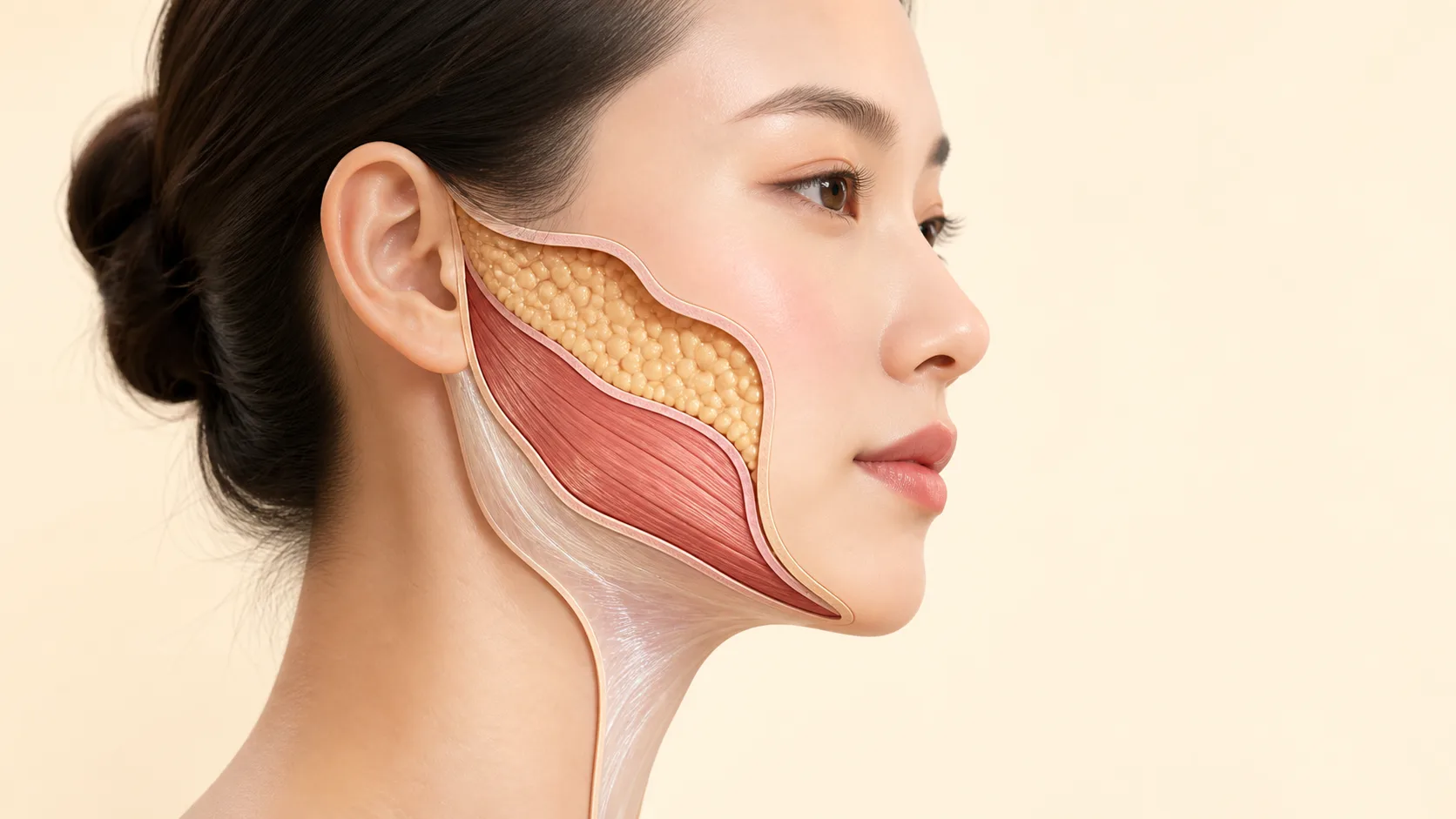
Fascia, muscle, skin and SMAS are related but distinct concepts. A market name alone cannot establish treatment depth or effect.
Term | More precise meaning | What it does not prove |
|---|---|---|
Fascia | Connective-tissue structures linking different tissues; professional literature distinguishes a defined fascia from the broader fascial system | That every tight, painful or visible concern comes from fascia |
Fascia or myofascial release | A label used for manual, rolling or device-assisted techniques and the associated comfort experience | That adhesions can be seen or permanently broken apart |
Fascial laxity | A common market or consumer phrase, not a sufficiently precise diagnosis of facial or body condition | That pressure on one point restores a fixed structure |
Skin laxity | Visible appearance may reflect skin, fat distribution, supporting structures, muscle activity, age and other factors | That the fascia alone is loose or that every device is suitable |
SMAS | A superficial musculoaponeurotic system concept used in facial anatomy and surgery; morphology and descriptions vary by region and across publications | That surface massage is equivalent to a surgical-plane intervention |
A Delphi consensus process was developed to address inconsistent fascia terminology and proposed separate definitions for a fascia and the wider fascial system. If professional literature requires careful scope, salon marketing should not use fascia as a catch-all explanation for every structure, symptom and promised result.
Myofascial-release evidence is not proof of a cosmetic lift
Research on myofascial release mainly examines sports performance, joint range of motion or musculoskeletal pain. A 2024 systematic review of randomized trials in athletes found a moderate overall effect on range of motion. A review of chronic mechanical neck pain reported improvements in some pressure-pain-threshold outcomes, while pain, mobility and disability findings were not significant; the evidence was rated low to moderate.
These findings do not show that salon care permanently lifts the face, removes fat, repositions SMAS, repairs visceral fascia or treats chronic pain. The population, technique, body area, comparator and measured outcome all need to match the actual claim. One study containing the word fascia cannot substantiate every fascia-branded product.
What should a salon ask when a client says their fascia is loose?

Clarify the client's main concern, current condition and expectations before deciding whether general beauty and comfort care is appropriate.
Is the main concern a feeling or an appearance? Examples include everyday tightness, facial contour, skin feel or persistent pain.
Where and when did it start? Is it brief, recurring or sudden, and is there numbness, weakness, marked swelling or heat?
Were there recent procedures? Ask about surgery, injections, threads, energy devices, injuries or other procedures requiring recovery.
Is the skin and treatment area intact? Do not press ahead over wounds, blisters, marked inflammation, possible infection or unexplained bruising.
Does current product documentation cover the use? Areas, media, energy, contraindications, stop criteria and operator training should follow the current model's formal instructions.
Persistent or worsening pain, numbness, weakness, sudden marked swelling, redness and heat, suspected infection, symptoms after trauma or an unassessed medical concern warrant postponing the beauty procedure and recommending assessment by a qualified healthcare professional.
A safer fascia-inspired salon workflow

Consultation, area checks, appropriate operation, real-time observation and complete records support a consistent service.
Record the client's main goal, relevant health information and recent procedures.
Check the area and confirm suitability against product documentation.
Frame the goal within comfort, skin feel or visible line management.
Choose a manual or device-assisted process according to formal training, including the medium, pressure, temperature, suction or energy setting.
Monitor comfort throughout and stop for unexpected pain, dizziness, burning, numbness or skin reactions.
Record the area, duration, mode, immediate response and aftercare. Avoid blindly stacking procedures over the same area.
When assessing HEALTH TONE, obtain the complete Hong Kong configuration, formal product documentation, contraindications, training and after-sales information before adding it to a menu. For the operational positioning of the three treatment heads, see the HEALTH TONE fascia-inspired treatment guide.
Safer salon wording and claims to remove
More defensible beauty-service wording | Claims needing specific evidence and compliance review, or wording to avoid |
|---|---|
Fascia-inspired comfort care | Repairs fascia or breaks apart adhesions |
Works with massage steps to address everyday feelings of tightness | Treats neck, shoulder, back or myofascial pain |
Facial or body-line care designed around individual condition | Repositions SMAS, realigns fascia or produces a permanent lift |
Sensations and visible changes vary by individual | One-session result, zero risk or suitable for everyone |
Use follows current product documents and training | Penetrates visceral fascia, detoxes, drains water, burns fat or reduces weight |
A Hong Kong Department of Health working-group report listed radiofrequency, suction massage and multiple external-energy procedures among cosmetic procedures with potential safety concerns and emphasized assessing the actual technology and risk. Hong Kong's Undesirable Medical Advertisements Ordinance also restricts advertisements for specified diseases, conditions and treatment purposes. This does not mean every use of the word fascia is prohibited. It means operators should check the real procedure, risk, evidence and legal scope instead of disguising an ordinary beauty service in medical language.
Frequently asked questions
Does stronger pressure produce better fascia release?
No such rule can be assumed. Pressure, speed, area, medium and individual tolerance all affect the experience. Severe pain is not proof of effectiveness. Follow a defined process, acceptable comfort and clear stop criteria.
Can facial massage directly lift the SMAS?
Existing myofascial-release research does not support that broad claim. SMAS is a specific facial-anatomy and surgical concept; ordinary surface care should not be presented as equivalent to a surgical-plane procedure.
Does fascial laxity simply mean ageing?
It is not a sufficiently precise conclusion. Facial appearance can reflect skin, fat distribution, supporting structures, muscle activity, bone, lifestyle and photography conditions. A photograph or a single fascia label is not a diagnosis.
Can fascia care treat pain?
Salons may provide comfort care, but persistent, recurring, sudden or neurological pain requires medical assessment. Clinical or physiotherapy research cannot automatically be transferred to an ordinary salon service or named device.
How should salons document visible results?
If before-and-after records are used, standardize lighting, angle, expression, distance and timing, disclose the conditions and obtain appropriate consent. Do not edit images to manufacture a difference or present one client's change as a guaranteed result.
Conclusion: define the terms before designing the treatment
Fascia-related wording can start a customer conversation, but it is not the conclusion. A professional salon separates tightness, skin laxity, facial contour, SMAS and pain, then uses product documentation, training, consultation and records to build a repeatable service. That is more credible than promising repair, realignment, detoxification or a permanent lift.
To review the current HEALTH TONE configuration, training and treatment combinations, contact the Asia Pacific Beauty team for documentation and a demonstration.
This article is for salon operations, client communication and general education only. It is not medical diagnosis, treatment advice, legal advice or a guarantee of product performance. Areas of use, contraindications, operator requirements and risk controls must be determined from applicable Hong Kong requirements, current product documentation and qualified professional advice.
Main sources
Sports: Systematic review and meta-analysis of myofascial release and range of motion in athletes
Clinical Rehabilitation: Systematic review of myofascial release for chronic mechanical neck pain
The Superficial Musculoaponeurotic System of the Face: A Model Explored
Hong Kong Department of Health working-group report on medical procedures and beauty services
Hong Kong Drug Office: Undesirable Medical Advertisements Ordinance
Hong Kong Consumer Council: medical beauty service consumer protection study