
Should Your Beauty Salon Invest in HEALTH TONE? Cost, Pricing, Training and ROI Checklist
Introducing a new beauty device does not mean a beauty salon will automatically increase its revenue.
Whether the device is suitable for the salon depends on the existing customer base, treatment positioning, staff operating ability, pricing strategy, consumable costs, and supplier support.
If a beauty salon only focuses on the immediate results shown during a device demonstration, without first assessing how the treatment will be sold, how staff will operate it, and how faults will be handled, the new device may easily become idle after the promotional period ends.
Therefore, before introducing HEALTH TONE, the salon owner needs to answer the following questions:
Is it suitable for existing customers?
Which existing treatments can it be added to?
What is the cost per session?
How many sessions are needed to recover the investment?
What training do beauticians need?
Which customers may not be suitable for the treatment?
Can the supplier provide ongoing maintenance and operational support?
This article reviews the key points that beauty salons should assess before introducing HEALTH TONE, from an operational perspective.
1. First Confirm Whether HEALTH TONE Is Suitable for Your Beauty Salon

Not every beauty salon needs to add a new beauty device immediately.
HEALTH TONE is more suitable for the following types of beauty salons.
1. Salons with a Stable Facial Treatment Customer Base
If the salon already has stable customers for facials, hydration, or anti-aging treatments, facial contouring or shoulder and neck comfort care can be added to the existing process to create room for upgrades and add-on sales.
2. Salons Already Offering Massage or Body Management Services
If the salon already offers shoulder and neck massage, back care, waist and abdomen management, or thigh contouring, HEALTH TONE can help the salon establish a more consistent device-based treatment process.
3. Salons That Want to Improve Treatment Package Completeness
The salon can combine facial, shoulder and neck, and targeted body treatments into different packages, avoiding reliance on only one facial or massage service.
4. Salons Able to Carry Out Training and Operation Records
A new device requires staff to complete training, practice, and assessment. If staff turnover is high, or if the salon does not have a fixed treatment record system, internal workflow issues should be addressed first.
If the salon currently has insufficient customer traffic, low room utilization, or has not yet established basic consultation and aftercare processes, it should assess more carefully before introducing the device.
2. How Should the Device Be Added to Existing Treatments?
After introducing HEALTH TONE, it is not recommended to launch a large number of new treatments all at once.
A more stable approach is to first select one or two directions that best suit existing customers and test them.
For facial treatment salons, you may first launch:
Facial contour management
Facial plus shoulder and neck treatment
Pre-wedding or special occasion treatment
Targeted facial upgrade service
For body treatment salons, you may first launch:
Warming comfort care for shoulders and neck
Back and waist care
Waist and abdomen contour management
Targeted thigh or arm treatment
For comprehensive beauty centers, you may launch:
Facial plus shoulder and neck combination
Facial and waist-abdomen dual-area treatment
Multi-session staged contour management package
Full-body comfort care plan
Treatment design should be based on the salon’s existing customer base, rather than simply copying package names provided by the supplier.
3. How Should Treatments Be Priced?
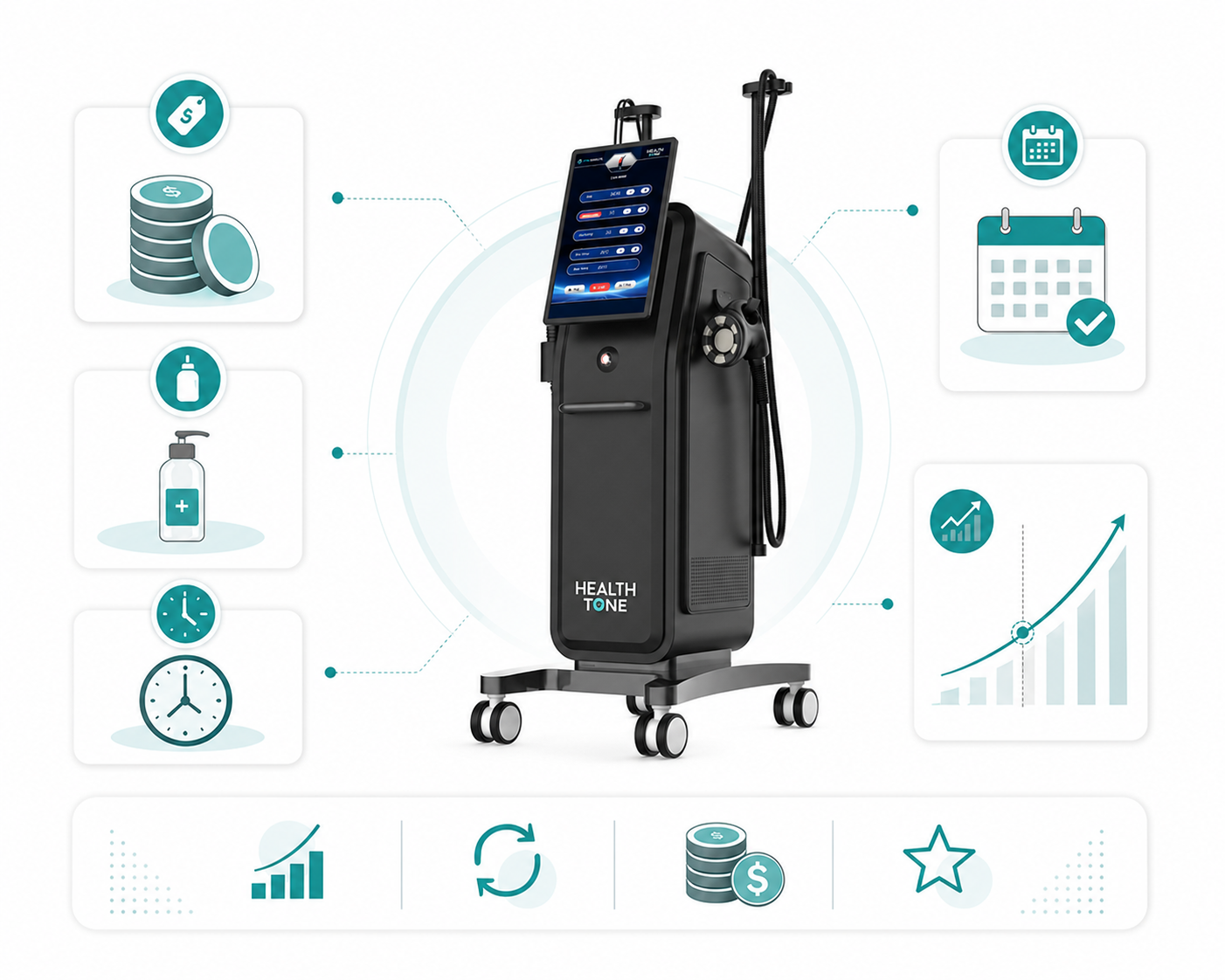
Treatment pricing should not only refer to nearby beauty salons, nor should it be calculated only based on the purchase price of the device.
The salon should first understand the full cost of each treatment session.
Common costs per session include:
Beautician operation time
Gel, massage oil, or other consumables
Towels, bed sheets, and cleaning supplies
Room and bed usage costs
Staff commission
Credit card or payment platform fees
Promotional discounts and trial costs
Provision for device maintenance and depreciation
The gross profit per session can be preliminarily calculated as follows:
Treatment price minus consumable costs minus beautician direct labor minus commission and promotional costs equals gross profit per session.
Example:
Item | Amount |
|---|---|
Treatment price | HK$1,280 |
Consumables and cleaning supplies | HK$80 |
Beautician direct labor | HK$250 |
Commission and promotional costs | HK$150 |
Gross profit per session | HK$800 |
This example is for calculation demonstration only. Actual pricing should be adjusted according to the salon’s rent, customer base, treatment duration, and market positioning.
4. How to Estimate the Payback Period
The salon owner can first calculate the total initial investment, including:
Device purchase price or rental fee
Training fees
First batch of consumables
Promotional materials
Staff practice time
Opening or promotional offer costs
The basic number of treatments needed to recover the investment can be estimated as follows:
Total initial investment divided by gross profit per session equals the number of sessions required.
Assume:
Total initial investment is HK$100,000
Gross profit per session is HK$600
In theory, around 167 sessions are needed to cover the initial investment.
However, this number does not include:
Free demonstrations
Trial discounts
Complimentary sessions in packages
Device maintenance
Room idle time
Refunds or customer cancellations
Seasonal fluctuations in customer traffic
Therefore, it is not advisable to base a purchase decision only on the idea that “serving two customers per day will recover the cost in a few months.”
A beauty salon should ideally establish three scenarios:
Scenario | Monthly Treatment Sessions | Purpose |
|---|---|---|
Conservative scenario | 20 sessions | Assess pressure when customer volume is insufficient |
Normal scenario | 40 sessions | Assess reasonable operating performance |
Ideal scenario | 60 sessions or more | Assess payback speed after successful promotion |
The salon owner can then estimate the payback period under different scenarios based on actual gross profit.
5. Should You Offer Single Sessions or Packages?
A single trial session can lower the barrier for new customers to try the treatment for the first time, but the salon should not rely on excessively low trial prices for the long term.
A more stable pricing structure may include:
Introductory Trial
A single area and simpler process, allowing customers to understand how the device feels.
Regular Single Treatment
Includes full consultation, device operation, manual massage, and soothing care.
Short-Term Package
For example, three to four sessions, allowing customers to receive staged care with a lower level of commitment.
Complete Management Package
May include different treatment areas, photo records, and regular reviews.
Packages should not attract customers only through “buy ten, get ten free.” They should clearly explain:
What each session includes
Treatment area
Recommended interval
Package validity period
Whether treatment areas can be changed
Cancellation and rescheduling arrangements
6. What Training Do Beauticians Need?
Whether a device treatment can operate consistently depends on staff training, not just the device itself.
Before introducing HEALTH TONE, the salon should confirm whether the supplier provides the following training content.
Device Basics
Functional positioning of each treatment head
Suitable treatment areas
Operating modes and settings
Device startup and shutdown procedures
Common error alerts
Practical Operation
Operating direction
Pressure and speed
Recommended time for each area
Temperature or other setting controls
How to use massage mediums
How to observe customers’ immediate reactions
Safety and Risk Management
Contraindication screening
Pre-treatment consultation
Situations where operation should be stopped
Procedures for handling abnormal skin reactions
Device cleaning and disinfection
Reporting methods for abnormal situations
Customer Communication
How to introduce the treatment
How to set reasonable expectations for results
How to avoid medicalized wording
How to answer customer questions about sensations, number of sessions, and packages
Every beautician should complete hands-on practice and internal assessment before officially serving customers.
7. Why Is It Necessary to Establish Operation Records?
If beauticians rely only on memory, settings, timing, and techniques can easily become inconsistent.
The salon can establish a standardized HEALTH TONE treatment record form, including:
Customer’s main needs
Treatment area
Treatment head used
Device mode
Time and settings
Massage medium used
Customer’s immediate sensation
Skin reaction
Post-treatment recommendations
Adjustments needed for the next session
If the salon takes before-and-after photos, it should also standardize:
Shooting angle
Lighting
Customer posture
Camera distance
Whether filters are used
Shooting time
This avoids differences in lighting, angle, or facial expression causing people to mistakenly think the photos exaggerate the results.
8. Which Customers May Not Be Suitable for the Treatment?

Formal contraindications and precautions must be based on HEALTH TONE’s product manual, supplier training, and local regulations.
In general, before operating beauty devices with warming, electrical current, magnetic energy, or suction functions, a complete consultation should be conducted.
The following customers usually require special caution, and in some cases may not be suitable for related treatments:
People who are pregnant or may be pregnant
People with pacemakers or other implanted electronic devices
People with wounds, infections, severe inflammation, or acute skin problems in the treatment area
People who have recently undergone surgery, injections, or other medical aesthetic procedures
People with metal implants in the treatment area
People with abnormal responses to heat, pressure, or touch
People with cardiovascular, neurological, or blood clotting conditions requiring medical monitoring
People taking medications that may affect blood clotting, skin reactions, or sensory function
People who cannot clearly express discomfort or cooperate with the operation
Beauticians should not diagnose diseases themselves, nor should they guarantee that a customer with a certain health condition is definitely suitable for the treatment.
If a customer has uncertain health concerns, they should first consult a qualified medical professional.
9. What Should Be Confirmed with the Supplier Before Introduction?
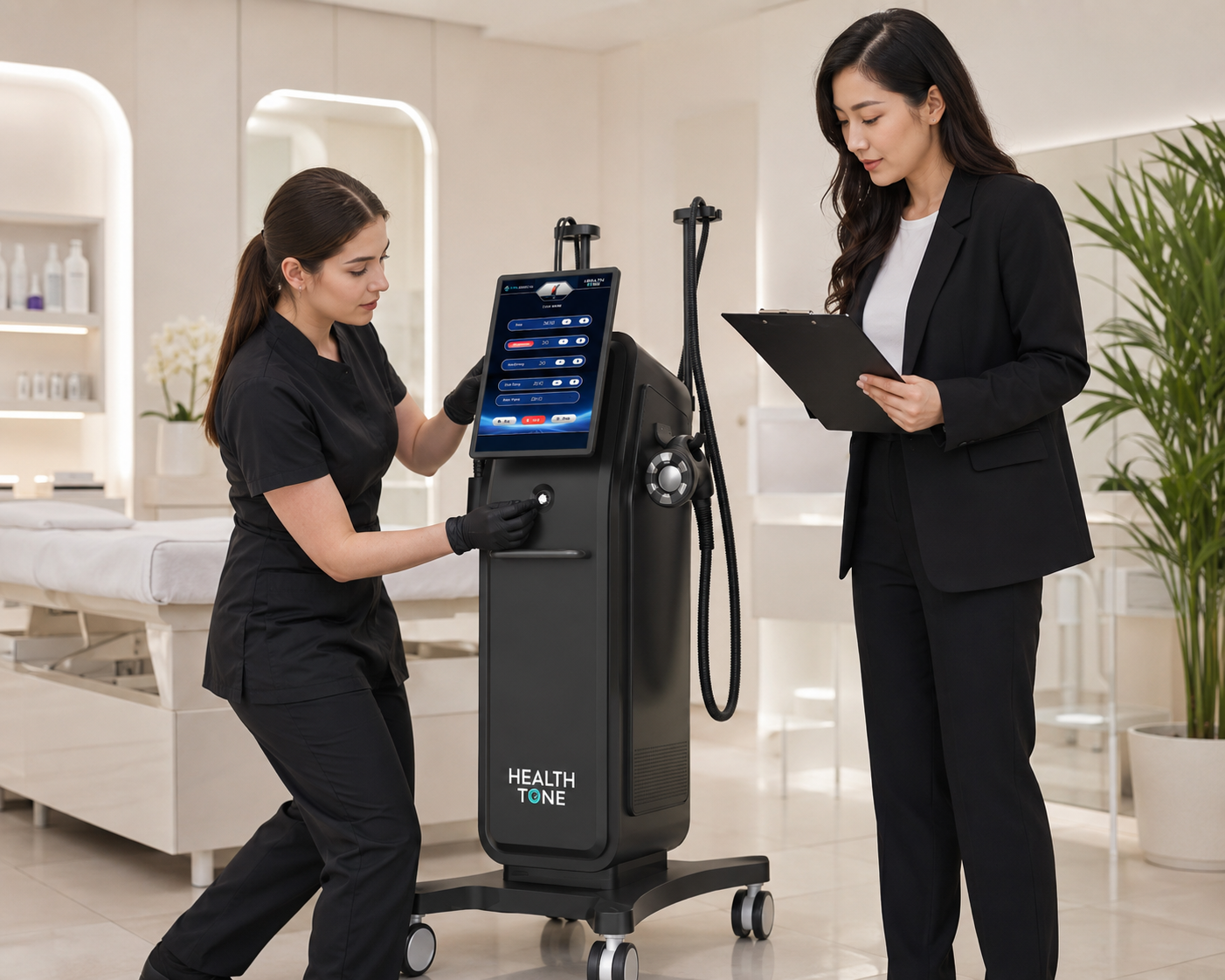
Before signing a contract or making payment, the salon owner can use the following checklist.
Product Documents
Is an official product manual provided?
Are the functions, applicable scope, and limitations clear?
Are there test or compliance documents available for review?
Can promotional images and copy be officially used?
Does the device comply with relevant requirements in the local region?
Training Arrangements
Does training include live operation demonstrations?
Who is responsible for training?
Are basic and advanced courses available?
Can new staff attend make-up training later?
Is operational assessment or training certification provided?
Is ongoing technical consultation available after training?
Consumables and Ongoing Costs
Are designated consumables required?
What is the average consumable cost per session?
Do treatment heads have a usage lifespan?
Do accessories need to be replaced regularly?
Are software updates or advanced functions charged separately?
Maintenance and After-Sales Support
How long is the warranty period?
What situations are not covered by the warranty?
What is the inspection and repair time after a fault occurs?
Is a backup device available during repairs?
Is local maintenance or technical support available?
Is there an additional charge for on-site inspection?
Operational and Marketing Support
Are treatment process templates provided?
Are consultation forms and operation records provided?
Are promotional images and videos available?
Can the supplier help design trial prices and packages?
Can certified demonstration points or actual trial experiences be arranged?
10. Common Risks When Introducing the Device
Only Looking at Demonstration Results, Not Actual Customers
The condition of the demonstration model does not necessarily represent the needs of the salon’s existing customers.
Pricing Too Low
Excessively low trial prices may attract many customers who only want discounts, but may not convert into regular-price package customers.
Insufficient Staff Training
When different staff operate the device, large differences in sensation and process can easily affect customer confidence.
Overpromising Results
Claims such as “visible results after one session,” “permanent maintenance,” or “solves the root cause” can easily lead to complaints and compliance risks.
No Provision for Maintenance Costs
A new device involves more than just the purchase cost. Accessories, maintenance, faults, and downtime all need to be calculated.
No Follow-Up Process
If the salon does not follow up, record details, and provide treatment recommendations after a customer completes one trial session, the conversion rate is usually lower.
Conclusion: Calculate the Operating Model First, Then Decide Whether to Introduce It
Whether HEALTH TONE is worth introducing should not be judged only by how many functions the device has.
What truly needs to be assessed is:
Whether it suits the salon’s existing customer base
Which mature existing treatments it can be added to
Whether staff can operate it safely and consistently
Whether each treatment session has reasonable gross profit
Whether the payback estimate includes actual operating costs
Whether the supplier can provide long-term training, maintenance, and technical support
A device only has the chance to become a long-term service item for a beauty salon when it is used continuously, priced clearly, and managed properly. Otherwise, it may simply become idle equipment after the promotional period ends.
To learn more about HEALTH TONE’s technical specifications, treatment head configuration, training content, consumable costs, and after-sales arrangements, please visit our HEALTH TONE product website for detailed information or contact us to book a demonstration experience, then evaluate it according to your salon’s customer base and operating model.
This article is for general reference on beauty salon operations and treatment planning only. It does not constitute medical, legal, or financial advice. Product functions, applicable scope, contraindications, and operating requirements should be based on official product documents, supplier training, and relevant local regulations. All costs, prices, and payback calculations are examples only. Actual results will vary depending on the salon’s operating conditions.