
Hong Kong Beauty Equipment Wholesale Procurement Process | Quotation, Trial, Training and Warranty at a Glance
When Hong Kong salons buy beauty equipment, the easiest mistake is to imagine the process is simple: ask the price, trial the machine, place the order, take delivery. In reality, B2B beauty equipment wholesale is not a one-off purchase but a long-term investment that affects cash flow, treatment safety, staff training, customer complaints, consumables resupply and repair downtime.
This article sets out a beauty equipment wholesale procurement process suited to Hong Kong salons, spas, medical aesthetic centres and beauty industry start-ups. The focus is not on recommending any one machine, but on helping buyers lower risk step by step, from needs clarification, supplier checks, quotation, machine trial (試機), contract and acceptance through to training and warranty.
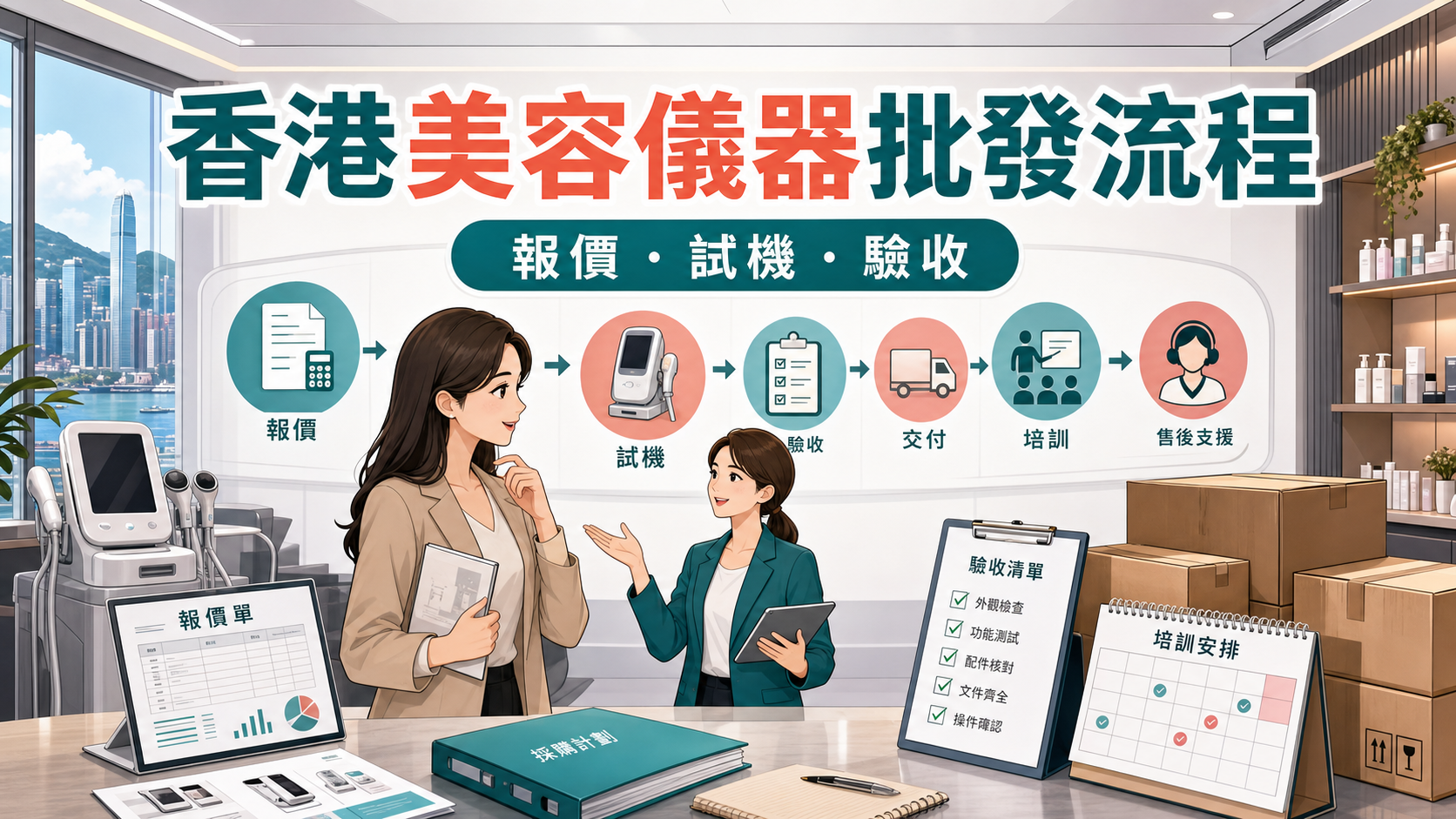
Step one: clarify the salon's needs before purchasing
Before asking suppliers for a quotation, a salon should first answer the following questions:
| Question | Why it matters |
|---|---|
| Is the salon positioned around entry-level care, anti-ageing, body management or light medical aesthetics? | Determines the equipment tier, the treatment spend per customer and the training requirements |
| How many treatment rooms are there? | Affects equipment size, room turnover and utilisation rate |
| How experienced are the therapists? | Determines whether high-energy or more complex equipment is suitable |
| What price point will customers accept? | Affects the payback model and package design |
| Are the related recovery products and consumables already in place? | Affects how complete the treatment is and how satisfied customers are |
If the salon has only just opened, the first batch of equipment should focus on items with high utilisation, straightforward training and the ability to support day-to-day facial revenue. Only where there is already a stable high-end clientele does it become more appropriate to introduce HIFU, MMFU, RF microneedling, laser or other high-ticket equipment.
Step two: distinguish between supplier types
Common beauty equipment supply roles in the Hong Kong market include agents, distributors, wholesalers, manufacturer representatives and online sellers. Any of them can be worked with, but the buyer needs to know what they are actually buying.
| Supplier type | Advantages | Risks |
|---|---|---|
| Local agent | Easier to arrange machine trials, training and after-sales support | Whether genuine manufacturer authorisation exists needs to be verified |
| Distributor | Stronger local stock, consumables and delivery capability | May not have direct command of the manufacturer's technology |
| Wholesaler | Equipment, skincare products and consumables can be sourced in one go | Service commitments must be written out item by item |
| Manufacturer representative | More direct technical support and parts updates | Brand choice may be narrower |
| Online seller | Fast price comparison, wide range of models | Local warranty and liability are the least clear |
For core equipment that is expensive or costly when out of service, a salon should not place an order on the strength of a web page alone. At the very least, the Hong Kong company, address, authorisation documents, repair arrangements and training content should be checked.
Step three: what to check before requesting a quotation from a supplier
Before a formal quotation, it is recommended to first ask the supplier for the following information:
- Company name, Hong Kong address, contact telephone number and business particulars.
- Whether they act as agent, distributor or wholesaler, and what the scope of authorisation is.
- Brand, model, place of origin and manufacturer details.
- Whether a machine trial or on-site demonstration can be arranged.
- Whether there is an operating manual, cleaning and maintenance guidance and contraindication notes.
- Whether training, retraining and after-sales repair are provided.
- How consumables, handpieces, probes, filters and parts are resupplied.
If the equipment may be medical device in nature, you can go on to ask whether there is MDACS, HKMD, LRP, or local importer or distributor information. MDACS is currently a voluntary listing system and should not be written up as statutory approval of efficacy, but it can still serve as an important checking tool.
Step four: which items should the quotation include?
A beauty equipment quotation should not list only a single "main unit price". A more complete quotation should include:
| Quotation item | What should be stated clearly |
|---|---|
| Main unit details | Brand, model, quantity, serial number or batch arrangement |
| Accessories | Handpieces, probes, filters, cabling, trolley, protective items |
| Consumables | First-batch consumable quantity, unit price, restocking price and lead time |
| Services | Installation, training, trial treatments, treatment design |
| Warranty | Warranty period, start date, what is covered and what is not |
| Repair | Response time, on-site visit arrangements, parts, replacement machine |
| Payment | Deposit, balance, instalments, financing and refund terms |
| Delivery | Delivery date, installation date, acceptance criteria |
The clearer the quotation, the fewer disputes there will be later. Wording such as "free warranty", "lifetime service" and "manufacturer support" in particular must be broken down into a specific scope, otherwise it is very hard to enforce.
Step five: check the documents before the machine trial, not just the demonstration result
The machine trial is the core of the procurement process, but the documents should be reviewed before it. Otherwise the demonstration day can easily turn into nothing more than a sales presentation.
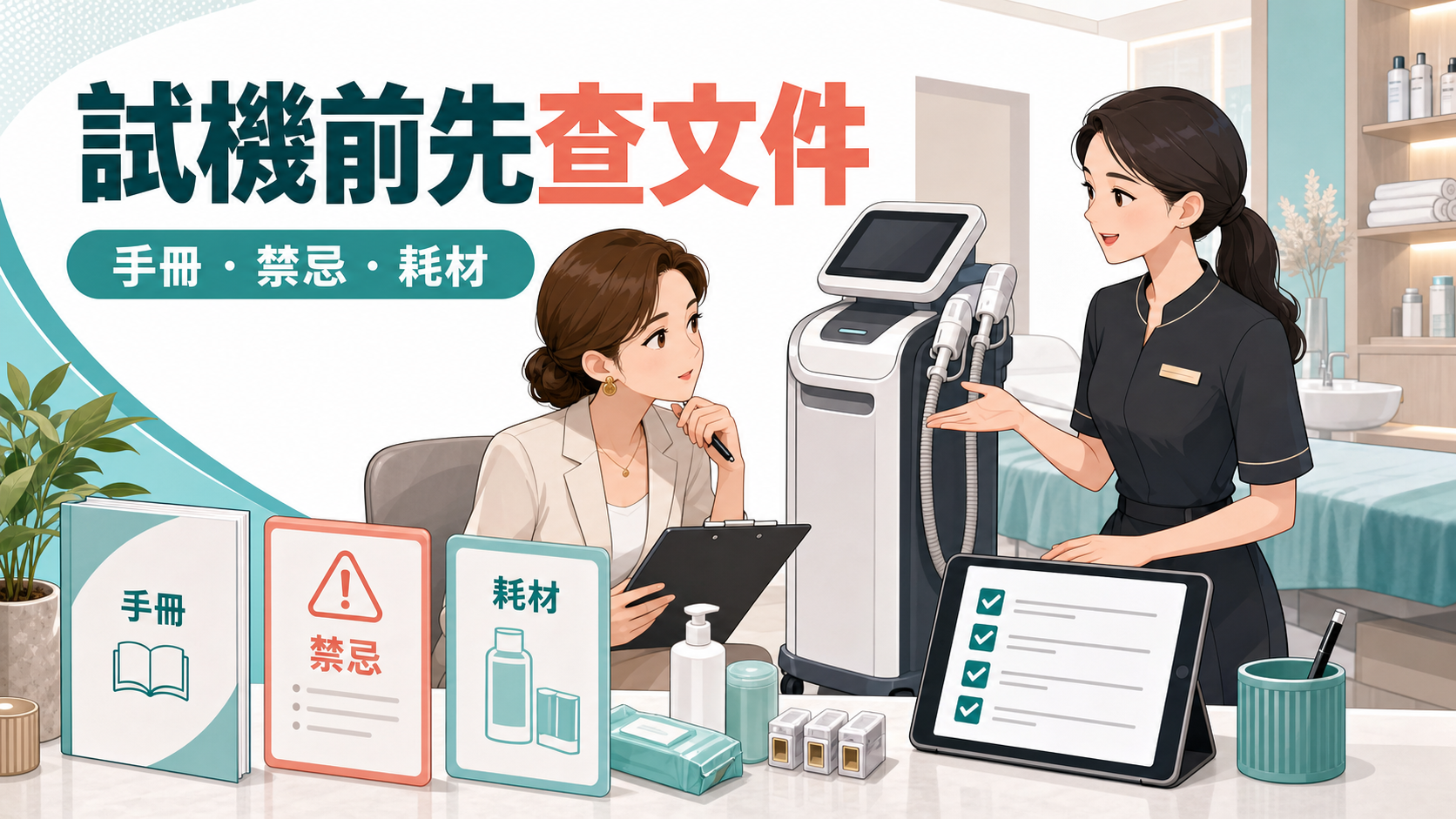
Before the trial, it is recommended to request:
- The operating manual or a simplified SOP.
- Contraindicated persons and unsuitable situations.
- Cleaning and disinfection procedures.
- An estimate of consumables used per treatment.
- Common mistakes and fault handling.
- Therapist training arrangements.
During the trial, observe whether the workflow suits the salon's actual conditions. For example, whether starting the equipment up is complicated, whether the handpiece is easy to operate, whether cleaning time will slow room turnover, whether consumables are easy to change, and whether the customer assessment form is adequate.
Step six: the contract must set out delivery, training and warranty clearly
B2B beauty equipment procurement should not rest on WhatsApp messages and verbal promises. A contract or quotation confirmation should set out at least the following:
| Clause | Recommended content |
|---|---|
| Delivery lead time | Specific dates, handling of delays, import or customs clearance responsibility |
| Installation | Who installs, what the salon needs to prepare, whether testing is included |
| Acceptance | Acceptance counts only once accessories are complete, functions have been tested, documents delivered and training finished |
| Training | Number of sessions, hours, participants, make-up training arrangements |
| Warranty | Start date, whether parts or labour are covered, exclusions |
| Repair | Response time, on-site visit arrangements, spare parts, replacement machine |
| Consumables | Price, lead time, shelf life, minimum order quantity |
| Marketing materials | Whether brand images and treatment names may be used |
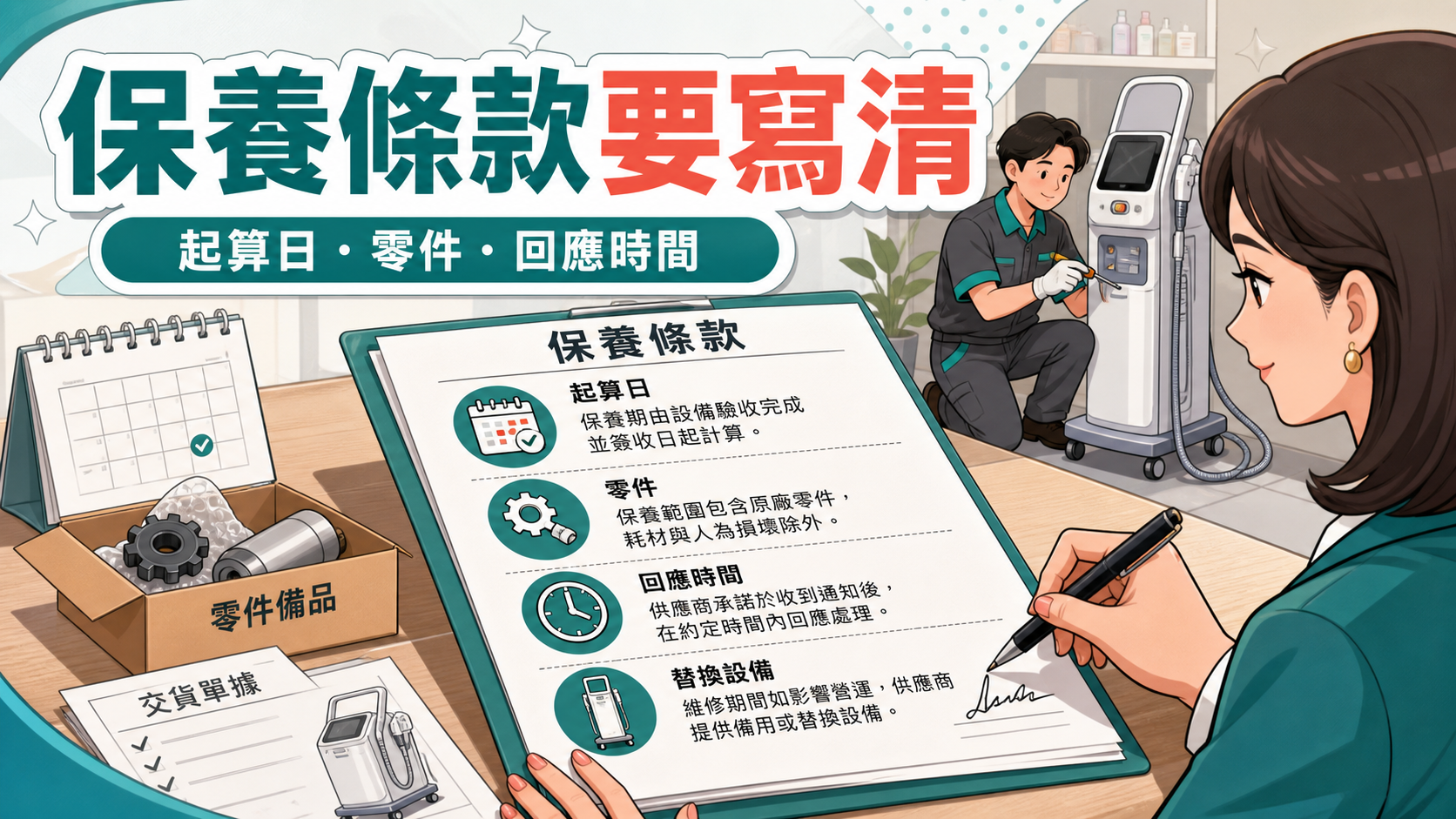
Pay particular attention to the warranty start date. Some suppliers count it from the invoice date, some from the delivery date, and some from the installation and acceptance date. For a salon, the most reasonable arrangement is usually to start counting once installation and acceptance are complete, because the salon cannot generate revenue before the equipment is formally in use.
Step seven: formal go-live only after delivery, installation and training
Equipment arriving at the salon does not mean procurement is complete. The following should be finished before formal go-live:
- Checking accessories and consumables.
- Installation and basic function testing.
- Operator training and sign-off.
- Confirmation of cleaning and maintenance procedures.
- Preparation of customer assessment and consent form templates.
- Design of treatment pricing, packages and aftercare.
- Compliance review of marketing materials.
If the supplier has only delivered the machine and has not completed training or acceptance, the salon should not rush to start selling the treatment. This applies all the more to high-energy, product infusion (導入), microneedling, RF or laser categories, where internal trial treatments and therapist familiarisation should be completed first.
Step eight: set up a tracking sheet once operations begin
After buying a machine, a salon should set up an internal tracking sheet, rather than going back to look up the information only when a fault occurs.
| What is tracked | Purpose of the record |
|---|---|
| Number of uses and shot count | Estimating consumable life and payback |
| Consumables stock | Avoiding selling packages with no consumables left to deliver them |
| Repairs and warranty | Retaining information for future claims and warranty |
| Customer feedback | Improving the treatment workflow and risk communication |
| Therapist list | Tracking who has been trained and who needs make-up training |
| Marketing material versions | Avoiding outdated or high-risk wording |
These records are not only for internal management; they also help with handling customer complaints, insurance, supplier warranty claims or subsequent upgrade purchases.
The regulations and risky wording Hong Kong buyers most easily overlook
Beauty equipment procurement touches on several areas that are easily confused:
- MDACS is a voluntary listing system and should not be written up as "statutory approval of efficacy in Hong Kong".
- High-risk beauty procedures and operations involving injection or deep skin peeling need to be handled prudently in line with the relevant Department of Health information.
- B2B procurement differs from ordinary personal consumption; a salon should not assume that it will necessarily be able to rely on consumer complaint mechanisms later on.
- The Trade Descriptions Ordinance focuses on avoiding false or misleading descriptions and the omission of material information; salons should not accept vague promises as protection.
The safer procurement principle is to put every item that will affect delivery and later operations clearly in black and white.
Beauty equipment wholesale procurement timeline
| Timing | Procurement work |
|---|---|
| Week 1 | Confirm the salon's needs, budget and treatment direction |
| Week 2 | Draw up an initial supplier shortlist and request company, authorisation and model information |
| Week 3 | Collect quotations and request details of consumables, warranty, repair and training |
| Week 4 | Arrange a machine trial and observe the workflow and the therapists' reactions |
| Week 5 | Compare total cost, contract terms and the payback model |
| Week 6 | Place the order and arrange delivery, training and acceptance |
| After go-live | Set up tracking of consumables, repairs, usage records and customer feedback |
For imported equipment, unusually expensive machines or equipment that requires fit-out coordination, the timeline should be extended further, so that a supplier's inability to deliver is not discovered only as the opening date approaches.
Frequently asked questions
What should a Hong Kong beauty equipment wholesale quotation usually include?
At the very least it should include the main unit model, accessories, consumables, installation, training, warranty, repair, payment, delivery lead time and acceptance criteria. If there is only a main unit price, the information is not enough to support a B2B procurement decision.
Which documents should I ask the supplier for before a machine trial?
You can request the operating manual, cleaning and maintenance guidance, contraindication notes, consumables price list, repair terms and a training outline. If the equipment is medical device in nature, you can go on to ask for MDACS, LRP or related local responsibility information.
From which date should the warranty period start?
It is best set out clearly in the contract. The more reasonable approach for a salon is to start counting once installation and acceptance are complete and the therapists have finished the first round of training, rather than simply from the invoice date.
Is it enough for a supplier to write only "free warranty"?
No. It should state clearly whether labour, parts, on-site visits, calibration, handpieces, software updates and consumables are covered, and which situations are excluded. Otherwise disputes are very likely later.
Is buying beauty equipment online necessarily cheaper?
The headline price may be lower, but local machine trials, training, repair, consumables resupply and accountability may be weaker. For expensive core equipment, it is not recommended to decide on online price alone.
Conclusion: beauty equipment wholesale is a procurement process, not a quotation
A Hong Kong salon buying beauty equipment should work backwards from the operating model: which treatments the salon will sell, what price point customers will accept, whether the therapists can operate the machine, whether consumables can be resupplied, whether repairs can be kept up, and whether the marketing is safe. Only once these questions are clear does comparing machine prices become meaningful.
If you are planning to buy beauty equipment, compare agents or arrange a machine trial, you can first put together your budget, number of rooms, target treatments and clientele, then contact the Asia Pacific Beauty team for procurement advice.
References
- Medical Device Division, Department of Health, Hong Kong: Medical Device Administrative Control System
- Medical Device Division, Department of Health, Hong Kong: Frequently Asked Questions
- Department of Health, Hong Kong: Differentiating Medical Procedures from Beauty Services
- Hong Kong Customs and Excise Department: Trade Descriptions Ordinance
- Hong Kong Consumer Council: Complaints and Services
- Trade.gov: Hong Kong Distribution and Sales Channels