
Korean Beauty Equipment Wholesale and Agency Guide: Checking Authorisation, Consumables, Servicing and Local Support Point by Point
When a Hong Kong salon searches for "Korean beauty equipment wholesale" or "Korean beauty equipment agency", the intention behind it is usually not simply to buy a new machine, but to draw on the market heat around K-beauty in order to add treatment items that are easier to package, feel fresher and leave a stronger impression on clients. The problem is that Korean origin in itself does not mean the procurement risk has been dealt with. What really affects a salon's long-term operations is whether the source of supply is traceable, whether the agency status is clear, whether consumables are stable, whether servicing is available on the ground in Hong Kong, whether training is sufficient, and whether the promotional wording goes beyond the product's original intended use.
This guide is not about chasing the lowest quotation. It is intended to help Hong Kong salons, spas, medical aesthetic centres and beauty industry procurement staff use a checklist that can actually be verified when evaluating Korean beauty equipment supply proposals. Particularly where a device involves energy output, skin care, transdermal delivery (導入), lifting or other professional beauty procedures, documentation, training, after-sales support and compliance responsibilities should be clarified before purchase.
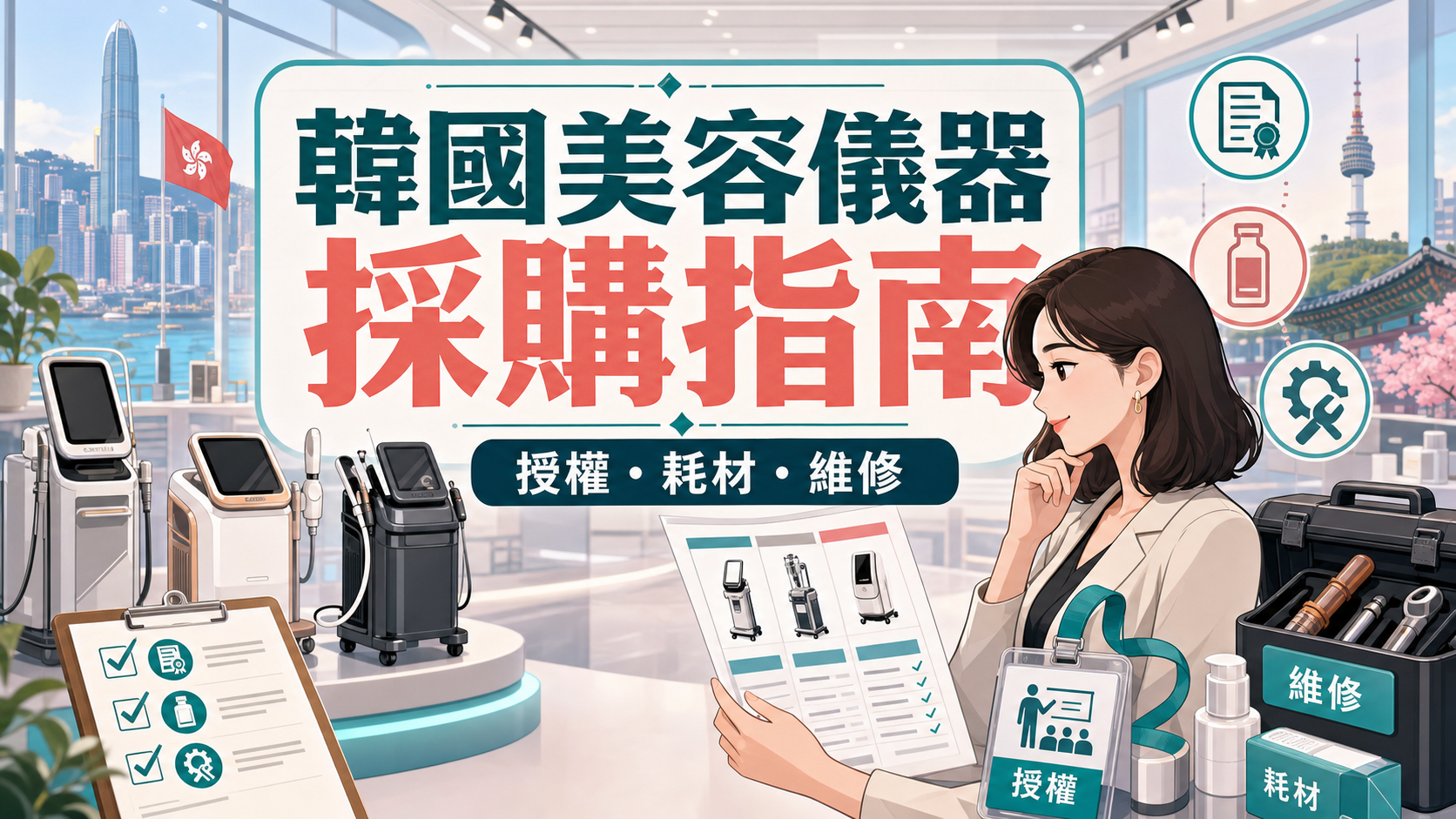
Why do Korean beauty devices have procurement appeal in Hong Kong?
The Korean beauty market has a strong brand image in skincare, cosmetics, derma cosmetics and beauty technology. For Hong Kong salons, Korean beauty devices usually have several attractions: a mature look and treatment packaging, an easy connection to the K-beauty story, fast product refresh cycles, active trade show and agency channels, and the fact that clients find them relatively easy to understand as "Korean-style care" or "Korean device treatments".
But this market halo also creates blind spots. Buyers can easily lump together terms such as "Korean original", "KFDA", "MFDS", "CE", "ISO" and "sole agent", and assume that a few certification marks on a page are enough. In reality, each category of document means something different: some concern quality management, some concern market access or technical documentation, and some are merely a supplier's marketing claim. What a salon needs to do is turn slogans into evidence that can be checked.
Distinguish three types of buyer intent before purchasing
Salon buyers searching for "Korean beauty equipment" can usually be divided into three types:
| Buyer intent | Common questions | What this article recommends |
|---|---|---|
| Wants to ride the popularity of Korean-style treatments | Which types of Korean machine are most popular? Are they easy to make social content with? | Look first at your clientele and treatment positioning; do not simply chase new buzzwords |
| Wants to compare prices and find wholesale | Which is cheaper: a local agent, direct overseas purchase or platform procurement? | Compare total cost, not just the price of the main unit |
| Wants to carry out due diligence | Is this a genuine agent? Are consumables, servicing and documentation reliable? | Work through authorisation, serial numbers, documentation and an after-sales checklist item by item |
For salons that genuinely have a budget and want to run a treatment over the long term, the third is the most important. Once the device has been bought, what affects payback is often not the machine price on day one, but whether consumables can be replenished reliably afterwards, whether servicing is available, whether therapists can operate it safely, and whether you can account for the source when a client asks.
Verify manufacturer authorisation: do not rely on the words "sole agent" alone
"Agent", "sole agent" and "official agent" are common terms in the beauty equipment market, but they should not remain verbal claims. A salon can ask the supplier directly for the following:
| Item to verify | Information to request | Why it matters |
|---|---|---|
| Manufacturer authorisation | Manufacturer's letter of authorisation, authorised territory, validity period | Confirms the supplier is entitled to sell, train and handle warranty work |
| Product model | Brand, model, serial number format, manufacturer's specification sheet | Avoids confusion with lookalike units or other models |
| Shipping documents | Invoice, packing list, shipment batch, serial number records | Establishes traceability of source and warranty |
| Hong Kong support | Hong Kong company, address, servicing contact and support personnel | Reduces the risk of having to pursue cross-border recourse after a fault |
| User documentation | Operating manual, contraindication notes, cleaning and maintenance guidance | Supports therapist training and the handling of client complaints |
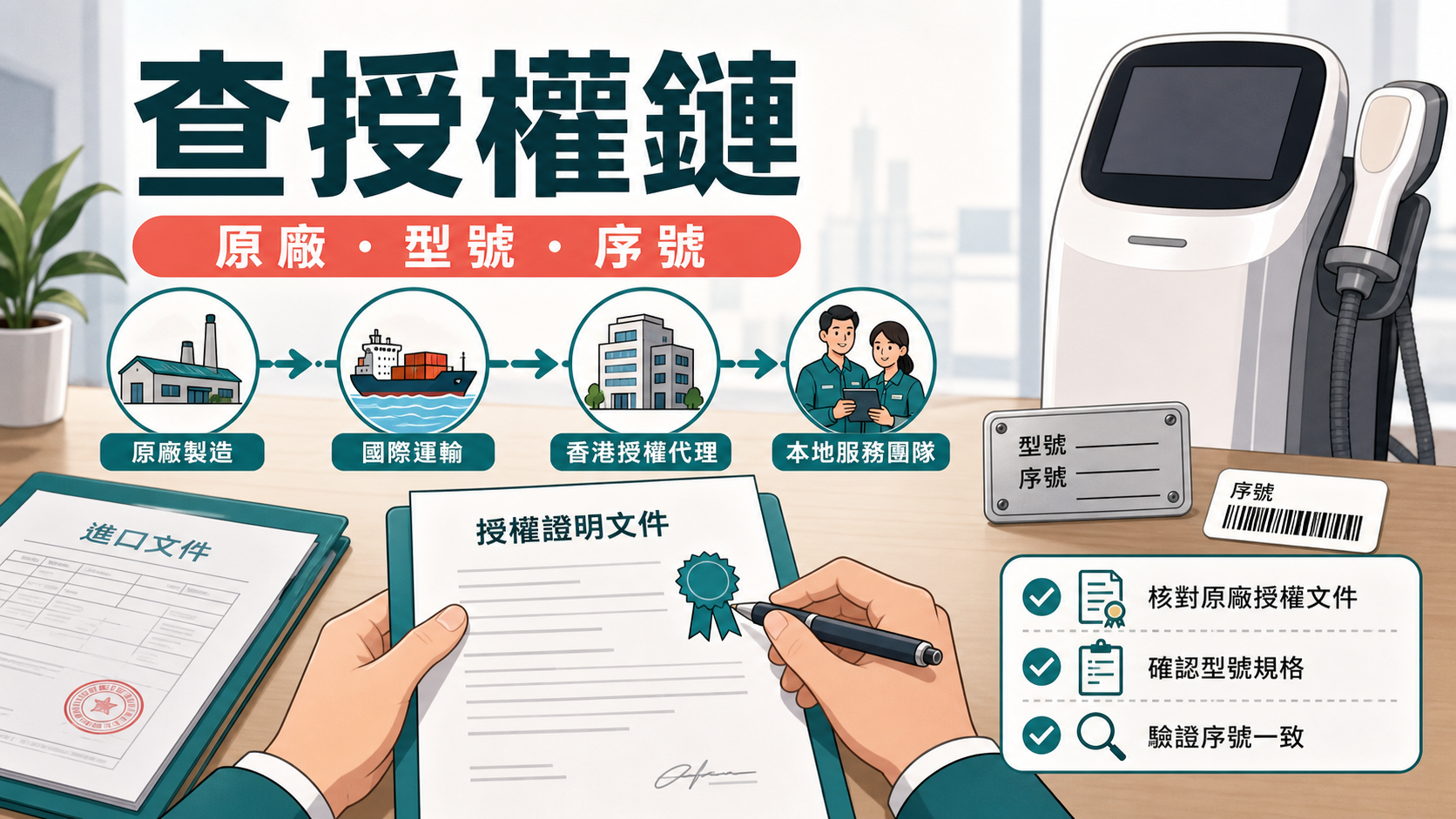
If the other party can only provide social media screenshots, promotional leaflets or vague certificates, and cannot clearly account for the manufacturer, model, serial number and authorisation chain, a salon should treat this as a risk signal. It does not mean that the supplier necessarily has a problem, but it does mean you do not yet have enough evidence to place it into a high-ticket treatment.
How should Korean documentation, CE and ISO be understood?
Korea's current medical device regulator is the MFDS. Some in the market still use the older name "KFDA", but what matters more at the procurement stage is asking for the actual documents: certificate number, corresponding model, issuing details, technical documentation, intended use and instructions for use. If a supplier claims to hold official Korean documentation, you should ask for document details that can be checked, rather than accepting the phrase "Korean certified" on its own.
In the same way, the CE marking and ISO 13485 cannot be reduced to "guaranteed to be effective". CE generally concerns a product's conformity with the applicable EU rules; ISO 13485 is a quality management system standard for medical devices; GMP, test reports and electrical safety standards are yet another set of concepts. These documents can increase confidence, but they are not a guarantee of efficacy, nor do they mean that medical uses may be promoted freely in Hong Kong.
A safer way to put it at the procurement stage is:
- These documents may serve as a reference for quality, compliance or supply chain management.
- The documents must correspond to the same brand, the same model and the same intended use.
- "Holding a certificate" should not be written up as "guaranteed results" or "efficacy officially confirmed".
- If the product is medical device in nature, it should be further checked against Hong Kong's MDACS and local responsibility arrangements.
How should Hong Kong's MDACS be brought into the procurement judgement?
The Medical Device Administrative Control System (MDACS) of the Medical Device Division of the Hong Kong Department of Health is a voluntary listing system. Whether a product is a medical device depends on the manufacturer's claims, the intended use and the design principle. When purchasing Korean beauty devices, a salon should not simply equate "not found on the list" with "definitely cannot be bought", but nor should it describe "being listed" as "statutory approval of efficacy".
A more practical approach is to treat MDACS as a risk-checking tool:
| Area to check | Questions to ask the supplier |
|---|---|
| Whether the device is listed | Is there HKMD information? Does the corresponding model match? |
| Local responsible person | Who is the LRP? Is there a Hong Kong contact and a documented procedure? |
| Importer or distributor | Can this be verified against a public list or documentation? |
| After-sales and recall | If the manufacturer issues a safety notice, who is responsible for notifying and handling it? |
| Advertising claims | Is the sales copy consistent with the product's intended use? |
If a supplier cannot explain the product's intended use, local responsibility in Hong Kong or the after-sales process, and only stresses that "Korean machines are very popular", then the salon needs to reassess whether it is appropriate to place that equipment into a formal treatment offering.
How do local agents, direct overseas purchase and platform procurement compare?
Korean beauty devices can be reached through local agents, overseas suppliers or online platforms. Each channel has its strengths and weaknesses, and the key is not to look at the quotation alone.
| Aspect compared | Local agent or distributor | Direct purchase from an overseas supplier | Online marketplace or platform |
|---|---|---|---|
| Verification of authorisation | Easier to check the Hong Kong company, authorisation, showroom and support point | You can ask the Korean side for documents directly, but local after-sales support must be arranged yourself | Hardest to verify brand authorisation and the authenticity of certificates |
| After-sales servicing | Where there is local engineering and spare parts, downtime risk is lower | May require shipping back overseas or waiting for cross-border support | Platform protection is not the same as local servicing |
| Price | Usually higher, but may include training, warranty and support | The main unit price may be lower, but there are more hidden costs | Lowest on the surface, but the highest risk on authenticity and after-sales support |
| Who it suits | Salons that want stable long-term operations | Buyers with procurement experience and cross-border after-sales capability | Preliminary price comparison or low-risk accessory purchases |
For high-value core equipment, it is not advisable to decide on the basis of platform badges or chat records alone. Platforms can be used for market reconnaissance, but before a formal purchase you should still come back to documentation, authorisation, serial numbers, warranty, training and consumable supply.
Consumables, probes and parts should be set out clearly before placing an order
Many Korean beauty devices have main unit quotations that look attractive, but it is the consumables that follow which are the real operating cost. Salons should clarify:
- Are the probes, cartridges, filters, handpieces or gels proprietary consumables?
- How many treatments or how many shots does each consumable support?
- Must original manufacturer consumables be used?
- How long does replenishment take? Is there stock in Hong Kong?
- If a consumable is discontinued, how will the supplier handle main units already sold?
- Are spare parts for repairs held in stock in Hong Kong?
If a supplier only provides the main unit price but is unwilling to provide consumable price lists, replenishment lead times or parts arrangements, it is very difficult for a salon to calculate a realistic payback period.
After-sales support must be on the ground: training, parts and servicing all need to be traceable
Whether a Korean beauty device is worth buying depends to a large extent on whether local after-sales support can be delivered on the ground. A salon can write the following into the quotation or a contract annex:
| After-sales item | What is recommended to be set out clearly |
|---|---|
| Training | Number of sessions, hours, who attends, whether refresher training is available |
| Warranty | Warranty period, start date, whether labour or parts are covered |
| Servicing | Response time, on-site arrangements, spare parts, whether a replacement unit is available |
| Consumables | Price, replenishment lead time, minimum order quantity, shelf life |
| Copy support | Whether usable promotional materials and reminders on prohibited wording are provided |
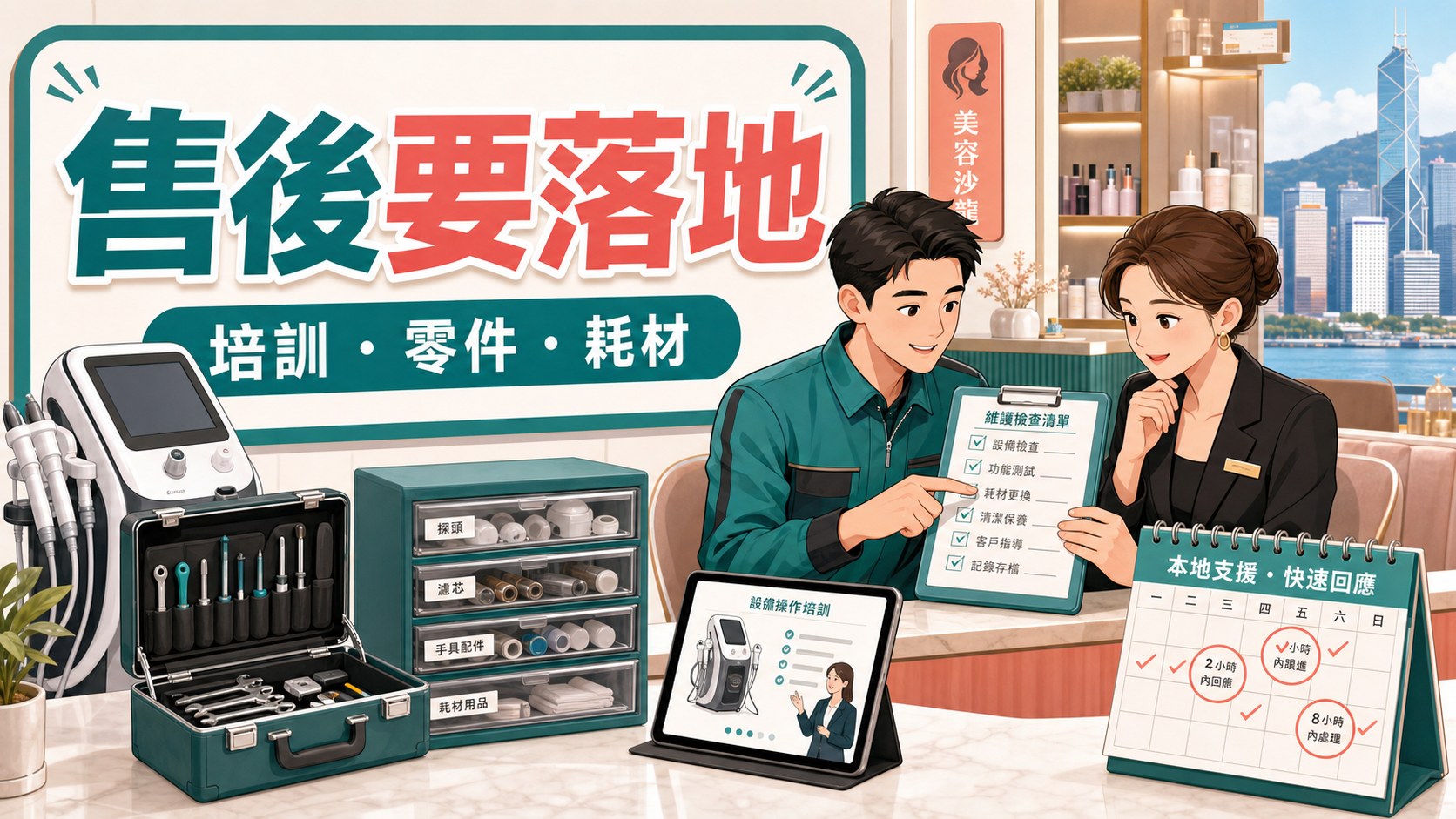
For a salon, "after-sales support is provided" is not a slogan but a question of who is responsible when something goes wrong, how quickly they respond, whether parts are available, and whether therapists will be supported with retraining. The earlier this information is set out clearly, the fewer disputes there will be later.
Promotional wording must follow the product's intended use
After bringing in a Korean device, salons often want to promote it on social platforms with eye-catching wording. But promotion should avoid writing up beauty care as medical treatment or guaranteeing results. The following wording calls for particular care:
- Guaranteed results
- Permanent lifting
- Zero risk
- Treats disease
- Completely free of side effects
- Officially guaranteed efficacy
- Suitable for everyone
A safer approach is to describe things in directions such as "skin condition management", "contour care", "soothing care", "treatment packages" and "improvement in appearance", and to note that results will vary with individual skin condition, lifestyle, treatment design and operating technique. If the promotional material provided by the supplier is itself excessively medicalised, the salon should not copy it directly.
Question checklist before purchasing Korean beauty equipment
| Question | What you actually need to confirm |
|---|---|
| Is it genuinely Korean original? | Whether the manufacturer, model, serial number and shipping documents match up |
| Is this a genuine agent? | Whether there is manufacturer authorisation, an authorised territory and a validity period |
| Is there local support? | Hong Kong address, servicing process, engineering or technical staffing arrangements |
| Is there any assurance on consumables? | Replenishment and pricing for probes, handpieces, filters, gels and the like |
| Is training provided? | SOPs, contraindication lists, operating records and refresher training |
| Is the promotion compliant? | Whether guaranteed results, disease treatment and excessive medicalisation are avoided |
Frequently asked questions
What is the difference between a Korean beauty equipment agency and Korean beauty equipment wholesale?
An agency usually emphasises brand authorisation, manufacturer support and after-sales responsibility; wholesale leans more towards supply, product range and price. A salon should not go by the label alone, but should verify the authorisation documents, source, warranty, training, consumables and servicing arrangements.
Is KFDA certification still the current term?
Korea's current official regulator is the MFDS. Some in the market still use the older name KFDA, but at the procurement stage you should ask for the actual certificate, model, number and intended use details, and then verify them through official or manufacturer channels.
If a Korean model cannot be found on the Hong Kong MDD list, does that definitely mean it cannot be bought?
Not necessarily. MDACS is currently a voluntary listing system, and whether a product is a medical device also depends on its intended use and the claims made. That said, when the information cannot be found it becomes all the more important to check the manufacturer's documentation, intended use, Hong Kong after-sales support and supplier responsibilities, rather than simply overlooking it.
Does a Verified Supplier badge on a platform amount to an authorised agent?
No, it does not. A platform badge is usually only a platform-level supplier verification or transaction protection; it does not represent brand authorisation, the authenticity of certificates, local after-sales support or compliance of the product's intended use. For high-value equipment you should still ask for manufacturer authorisation and Hong Kong support documentation.
Why do consumables and servicing matter more than the machine price?
Because in a salon's actual operations, every treatment may involve a probe, cartridge, gel, filter or maintenance cost. If consumables are hard to replenish, parts are out of stock or servicing is slow, then even a device bought cheaply may end up costing more in total because of downtime and client complaints.
Conclusion: buying Korean beauty equipment means buying long-term support, not just a machine
The market appeal of Korean beauty devices is real, but when purchasing, a salon needs to convert K-beauty heat into verifiable operational evidence. A supplier genuinely worth working with should be able to account clearly for manufacturer authorisation, the source of the model, shipping documents, consumable replenishment, local servicing, training arrangements and limits on promotional wording.
If you are comparing Korean beauty equipment wholesale, agency or local supply options, start by setting out your salon's positioning, target clientele, budget, therapist capability and the treatments you want to lead with, then contact the Asia Pacific Beauty team to arrange a device demonstration and procurement consultation.
References
- Medical Device Division, Department of Health, Hong Kong: Medical Device Administrative Control System
- Medical Device Division, Department of Health, Hong Kong: Frequently Asked Questions
- Korea MFDS: Medical Devices Approval Process
- Korea MFDS: Medical Device GMP Regulations
- Hong Kong Customs: Clearance documents for imported goods
- EMSD: Safety of household electrical products
- ISO: ISO 13485 medical devices quality management systems
- EU Your Europe: CE marking