
New Doublo 2.0 Salon Buying Guide: Technology, Treatment Design, Consumables, Certification and Payback
What attracts salons to New Doublo 2.0 is that the international product materials place microfocused ultrasound (MFU) and radiofrequency (RF) under the same platform concept. For a buyer, this may increase flexibility in treatment combinations, but it also increases the complexity of handpieces, consumables, training, documentation and servicing. The real question is not "how many functions are there", but what is actually delivered in Hong Kong, what each function may be used for, and whether it can be operated consistently in the salon.
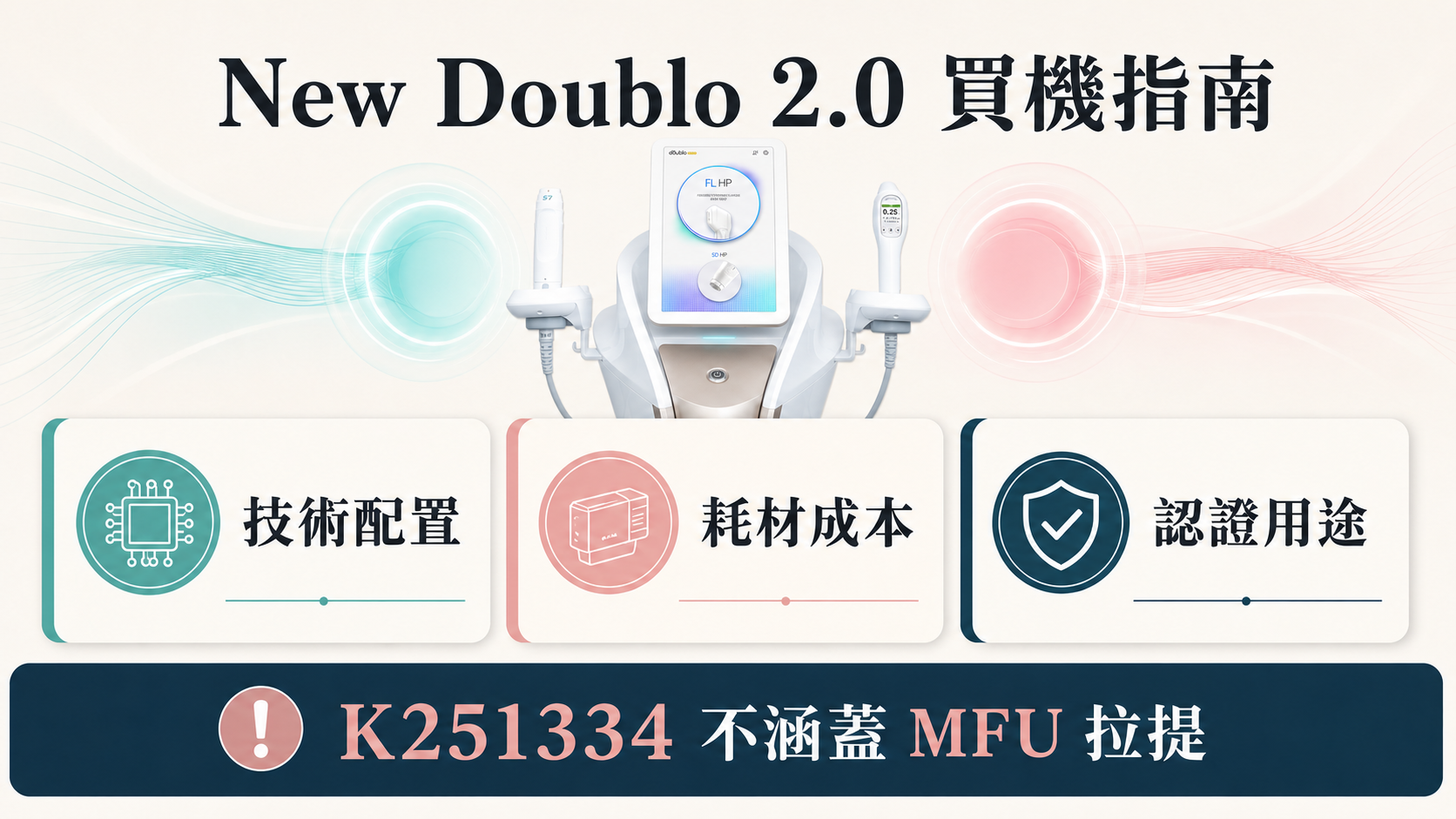
The conclusion first: the specifications and indications for use of New Doublo 2.0 may differ by country or market version; the US 510(k) K251334 covers designated RF microneedle/electrocoagulation and PS plasma handpiece uses, and does not list MFU lifting. Simplifying it into "FDA-cleared HIFU" is not accurate.
New Doublo 2.0 buying guide covering technology, documentation, consumables and payback
New Doublo 2.0 at a glance
Buyer's question | Prudent answer |
|---|---|
What is it? | A multi-handpiece platform under Hironic; international materials mention MFU and RF directions |
What configuration is available in Hong Kong? | Must be determined by the local quotation, packing list, IFU and device labelling |
How many cartridges are there? | Fixed figures found online should not be copied; the configuration currently sold must be verified item by item |
Is there clinical research? | There is one split-face study with 22 subjects, non-randomised fixed side allocation and short-term follow-up, which constitutes early evidence |
Is payback easy? | It depends on total investment, contribution margin per session, actual client volume, downtime and discounting; it cannot be judged from the machine price alone |
買家問題 | 審慎答案 |
|---|---|
What is it? | A multi-handpiece platform under Hironic; international materials mention MFU and RF directions |
What configuration is available in Hong Kong? | Must be determined by the local quotation, packing list, IFU and device labelling |
How many cartridges are there? | Fixed figures found online should not be copied; the configuration currently sold must be verified item by item |
Is there clinical research? | There is one split-face study with 22 subjects, non-randomised fixed side allocation and short-term follow-up, which constitutes early evidence |
Is payback easy? | It depends on total investment, contribution margin per session, actual client volume, downtime and discounting; it cannot be judged from the machine price alone |
For salons that already have a high-ticket treatment profile and can support multi-modality training and consumables management, a multifunction platform may be valuable. For a new salon with limited staff or unverified client volume, having too many functions may also turn into idle cost.
Brand, manufacturer, version and the configuration sold in Hong Kong
New Doublo 2.0 is launched by the Korean brand Hironic. The official international website can be used to understand the product concept at brand level, but the website also notes that specifications or indications for use may vary by country. When procuring, suppliers should be asked to write the following items into an annex to the quotation:
Legal manufacturer, full product name and model
Main unit, software version, serial number and place of manufacture
Name and code of every handpiece and cartridge
The manufacturer's intended use for each handpiece and the Hong Kong version of the IFU
Consumables that are single-use, reusable, or subject to a shot limit
Power supply, premises, cleaning, disinfection and storage requirements
Warranty period, service SLA, parts, and loan-unit arrangements
Training scope, assessment, refresher training for new staff, and incident escalation
If the quotation only says "full New Doublo 2.0 set" without an itemised list, gaps can easily arise later over the number of handpieces, cartridges, needle tips, software and warranty scope. You may first browse the New Doublo 2.0 product page, then request a documentation pack that corresponds item by item to the model currently sold.
What is the difference between MFU and RF?
MFU: the focused ultrasound direction
MFU uses a transducer to focus ultrasound energy at a designed focal zone; treatment planning involves the cartridge, depth, number of lines, energy, coverage and anatomy. It is not thread lifting, nor is it surgical suspension. The labelled depth cannot be read as the actual tissue position for every client, still less does it mean that deeper is better.
RF: the radiofrequency direction
RF uses electrical energy to create a thermal effect in tissue. If the configuration includes microneedle RF that penetrates the skin, it also involves needle-tip identity, sterile handling, infection control, penetration depth, earthing or return-path design, as well as requirements for who may operate it and on what premises. Non-invasive RF and microneedle RF also cannot be treated as the same treatment.
A combined platform does not mean all energies may be stacked at will
Even where the same main unit provides both MFU and RF, the IFU, applicable areas, contraindications, sequencing and training for each handpiece must still be checked separately. Just because the main unit allows a connection, one should not assume that all modes may be combined on the same day, in the same area, or on every client.
How should handpieces and cartridges be inspected on acceptance?
Do not use "someone online wrote that there are 20 cartridges" as a basis for procurement. Different markets, packages and updated versions may differ, and the configuration currently sold in Hong Kong should be listed item by item.
Field | To be completed for every handpiece |
|---|---|
Identity | Name, code, serial or batch number convention |
Use | Intended use and areas stated in the IFU |
Output | Energy form, modes, and where the adjustable range is documented |
Consumables | Cartridges, needle tips, tips, gel or other consumables |
Capacity | Shots, lines, number of uses, in-use period after opening, or expiry date |
Compatibility | Corresponding main unit and software version |
Handling | Cleaning, disinfection, sterility and disposal requirements |
Cost | Unit price, minimum order quantity, lead time, and substitution arrangements when out of stock |
On delivery, photograph and archive the main unit screen, device labelling, handpieces, consumable packaging, IFU and invoice. If consumables require software pairing, also test the remaining-quantity display, error prompts and lock-out rules.
How should official efficacy figures be interpreted?
Percentages are common in beauty equipment promotion, for example "how many times more lift" or "more effective". Before any figure is carried over into salon advertising, ask:
Compared with what: a single modality, the pre-treatment state, the other side of the face, or another machine?
Measuring what endpoint: device readings, physician scoring, subject satisfaction, or photographs?
Measured at what time: immediately, after several weeks, or after several months?
How many subjects, and was it randomised, blinded and appropriately controlled?
Are the model, handpiece, parameters and population used the same as the treatment in Hong Kong?
Who funded the study, and are the full data and adverse events publicly available?
If a figure such as "380%" has no clear denominator, endpoint and full study, it should not be written as "380% more effective". A more appropriate approach is to describe the study design and its limitations, rather than turning a single promotional figure into a guarantee.
What can the 22-subject split-face study show?
One published study used 22 subjects in a split-face comparison to assess facial outcomes with concurrent MFU and RF use. It provides an early human signal related to the product, but the following should be noted when interpreting it:
The sample was only 22 subjects
Allocation was not randomised, and the treated side was fixed
The follow-up period was relatively short
A split-face design can reduce inter-individual variation, but cannot represent all ages, skin tones and areas
A specific study protocol cannot be extrapolated directly to different handpieces, parameters or market versions
It may therefore be said that "a small, short-term study observed a signal of improvement", but it should not be said that it is "clinically proven to work for everyone", that "results are permanent", or that it "can replace surgery". Systematic reviews of HIFU/MFU also show that studies in this category have device and methodological heterogeneity.
What does K251334 actually cover?
K251334 is the US 510(k) summary for New Doublo 2.0. The document concerns the cleared uses of designated RM/RM(B) RF microneedle-electrocoagulation and PS plasma handpieces. There are three key points:
510(k) clearance does not uniformly "approve" every function of the whole platform.
Different handpieces on the same main unit may have different uses, classifications and evidence.
When verifying certification, match the K-number, applicant, full device name, model, handpiece and indications item by item. Displaying only an FDA logo, a registration number or a one-page screenshot is not sufficient to support a specific efficacy claim.
Treatment design should begin with assessment and records
New Doublo 2.0 is not a fixed "how many shots" menu. A safe and repeatable process includes at least:
1. Pre-treatment assessment
Record health status, medications, skin problems, previous energy-based treatments, surgery, fillers, threads, implants, tendency to scarring, and expectations. If there is an unexplained lump, neurological symptoms, infection, a wound or other red flags, appropriate medical assessment should be obtained first.
2. Selecting the handpiece and area
Select MFU, non-invasive RF, microneedle RF or another delivered handpiece according to the actual IFU and qualified judgement. The anatomy, depth, contact and sterility requirements of different areas are not interchangeable.
3. Settings and stopping criteria
Parameters are defined by the original manufacturer's training and the product labelling, and are adjusted according to skin condition and response on the day. The salon should keep records of the handpiece, cartridge/tip batch number, settings, number of shots, areas treated, operator and immediate response.
4. Follow-up and photographs
Photograph with consistent lighting, angle, distance and expression, obtain consent for use of the material, and arrange follow-up at an appropriate time. When promoting before-and-after images, do not select only the best cases or omit the time interval and other concurrent treatments.
Risks, contraindications and warning signs for seeking help
MFU may be accompanied by a sensation of heat, tingling, tenderness, redness, swelling or temporary changes in sensation; more serious tissue, burn or nerve-related problems are not necessarily the case, but must still be built into training and incident handling. RF risks vary by handpiece; a microneedle configuration additionally involves considerations such as bleeding, infection, pigment change, crusting or scarring.
There is no single universal contraindication list across handpieces. Pregnancy, electronic or metal implants, coagulation problems, medications, active infection, wounds, recent procedures and other health conditions should be checked against each IFU. If, after treatment, there is worsening pain, blistering, a suspected burn, persistent numbness, facial weakness, infection, visual or other unexpected symptoms, self-care should stop and help should be sought through the appropriate channels as soon as possible.
New Doublo 2.0 price and cost per session
Searching online for "New Doublo 2.0 price" usually surfaces only the main-unit quotation, but the total investment includes at least:
Cost category | Possible items |
|---|---|
Initial investment | Main unit, handpieces, trolley, freight, installation and the first batch of consumables |
MFU consumables | Cartridges, shots, expiry and inventory |
RF consumables | Where applicable: needle tips, tips, sterile supplies and disposal |
Labour | Consultation, operation, cleaning, photography, follow-up and training |
Premises | Room, electricity, infection control and storage |
After-sales | Warranty, calibration, parts, software and out-of-warranty repairs |
Commercial costs | Payment fees, discounts, advertising, commission, financing and insurance |
Risk buffer | Low season, stock-outs, no-shows and revenue lost to downtime |
The basic formula is:
Contribution margin per session = treatment price − consumables per session − operating labour − variable costs such as payment/promotion
Rough number of sessions to payback = total equipment investment ÷ contribution margin per session
If the contribution margin per session is zero or negative, it cannot be solved by increasing the number of treatments. Equipment depreciation, rent, administration, tax and downtime also need to be reviewed separately.
Conservative, base and optimistic payback scenarios
What follows is not a revenue forecast, but a stress test before buying:
Scenario | Client volume assumption | Pricing assumption | Cost assumption | Purpose |
|---|---|---|---|---|
Conservative | Count only verified client sources, and allow for no-shows and the low season | Factor in common discounts | Consumables at the higher price, with a downtime buffer added | Test whether cash flow can withstand it |
Base | Use the actual monthly average client volume of existing comparable treatments | Use the real average transaction price | Use the official price list and normal labour | Serve as the main budget |
Optimistic | Raise it only where there is evidence of a waiting list, pre-sales or branch referrals | Do not exceed sustainable pricing | Still retain servicing and promotion costs | Look at the capacity ceiling, not as a commitment |
Update monthly with actual transaction prices, client volume, consumables and downtime days, rather than multiplying the price list by a fully booked room. For details, see the beauty equipment payback guide.
Servicing, calibration and downtime terms
After-sales support for a multi-handpiece platform must be clarified component by component:
Which faults can be handled in Hong Kong, and the engineer's response and on-site attendance times
The respective warranty periods for the main unit, MFU handpiece, RF handpiece and consumables
How energy output, contact or safety functions are checked, and how often
Whether software updates will affect handpieces or older cartridges
Regular stock levels of parts and consumables, lead times when out of stock, and substitution arrangements
Whether there is a loan unit, extended warranty or other service terms for prolonged downtime
Who receives, records, investigates and reports incidents
Verbal undertakings should be written into the quotation or service agreement. The procurement process can also be checked against the Hong Kong beauty equipment wholesale procurement guide.
Comparing with VZET or other HIFU machines
When comparing New Doublo 2.0 with VZET, first set aside the brand differences around multifunctionality and score them on the same sheet:
Full model, IFU and local documentation
The energies and handpieces the salon genuinely needs
Product-specific evidence, rather than the whole HIFU category
Cartridge/tip cost per session and supply
Training, assessment and refresher training for new staff
Treatment time, room turnover and client base
Service SLA, parts, calibration and downtime risk
Total investment and payback under the conservative scenario
You may read VZET HIFU compared with New Doublo 2.0, then bring the documentation from both sides to a demonstration.
Frequently asked questions
Is New Doublo 2.0 HIFU or RF?
The official international materials describe the platform as having MFU- and RF-related functions, but which handpieces and uses are actually delivered in Hong Kong must be determined by the configuration currently sold and the IFU.
Is New Doublo 2.0 FDA-cleared for lifting?
It should not be written that way. K251334 covers designated RF microneedle/electrocoagulation and PS plasma handpiece uses, and does not state MFU lifting.
How many cartridges does New Doublo 2.0 have?
There is no fixed answer that can safely be applied to all markets and packages. Ask the supplier to list every handpiece, cartridge, depth, capacity, unit price and compatible software.
Are official efficacy percentages reliable?
A figure can be a starting point for verification, not a guarantee. First look at the comparison baseline, endpoint, sample, methodology, follow-up period and the full study, and confirm that it matches the Hong Kong version.
How long does New Doublo 2.0 take to pay back?
It depends on total investment, actual transaction prices, consumables, labour, monthly client volume and downtime. Start by calculating the rough number of sessions to payback using conservative client volume; a fixed number of months or a level of revenue should not be promised.
Is multifunction necessarily better than a single HIFU device?
No. Multifunctionality only brings value where the salon genuinely uses each handpiece, can complete the training and can maintain the consumables supply; otherwise it merely adds cost and process.
Request the configuration currently sold in Hong Kong
If your salon is evaluating New Doublo 2.0, you may contact the Asia Pacific Beauty team to request or verify the configuration currently sold in Hong Kong, the full certification, the use of each handpiece, cartridge/tip pricing, training content and service SLA. Submitting your client base, existing treatments, budget and premises before a demonstration makes it easier to reach an operationally sound decision than simply asking for a main-unit price.
This article is provided only for beauty equipment procurement, interpretation of evidence and risk education. It is not medical, legal or financial advice, nor is it a guarantee of operating parameters or revenue. Actual uses, operator qualifications, contraindications and premises requirements are subject to the applicable Hong Kong requirements, the actual product labelling and qualified professional advice.