
PICO Laser Distributor and Wholesale Guide: Wavelengths, Clearances, Laser Safety and Service
When a salon or clinic searches for a PICO laser distributor, PICO wholesale pricing or picosecond machine costs, two numbers tend to dominate the conversation: how many picoseconds the pulse is, and how many wavelengths are offered. But "picosecond" describes an extremely short pulse duration and nothing more. Whether appropriate energy reaches the target safely still depends on wavelength, delivered fluence, spot size, beam profile, repetition rate, output stability, handpiece, cooling, the operator, and the product labelling.
The current product catalogue does not list a verifiable PICO model in stock, so this article is a neutral purchasing framework. It does not state that Asia Pacific Beauty distributes any picosecond brand named here, holds stock, or can supply any regulated indication. Before any purchase, verify independently against the specific model, the site and the qualifications of whoever will operate it.
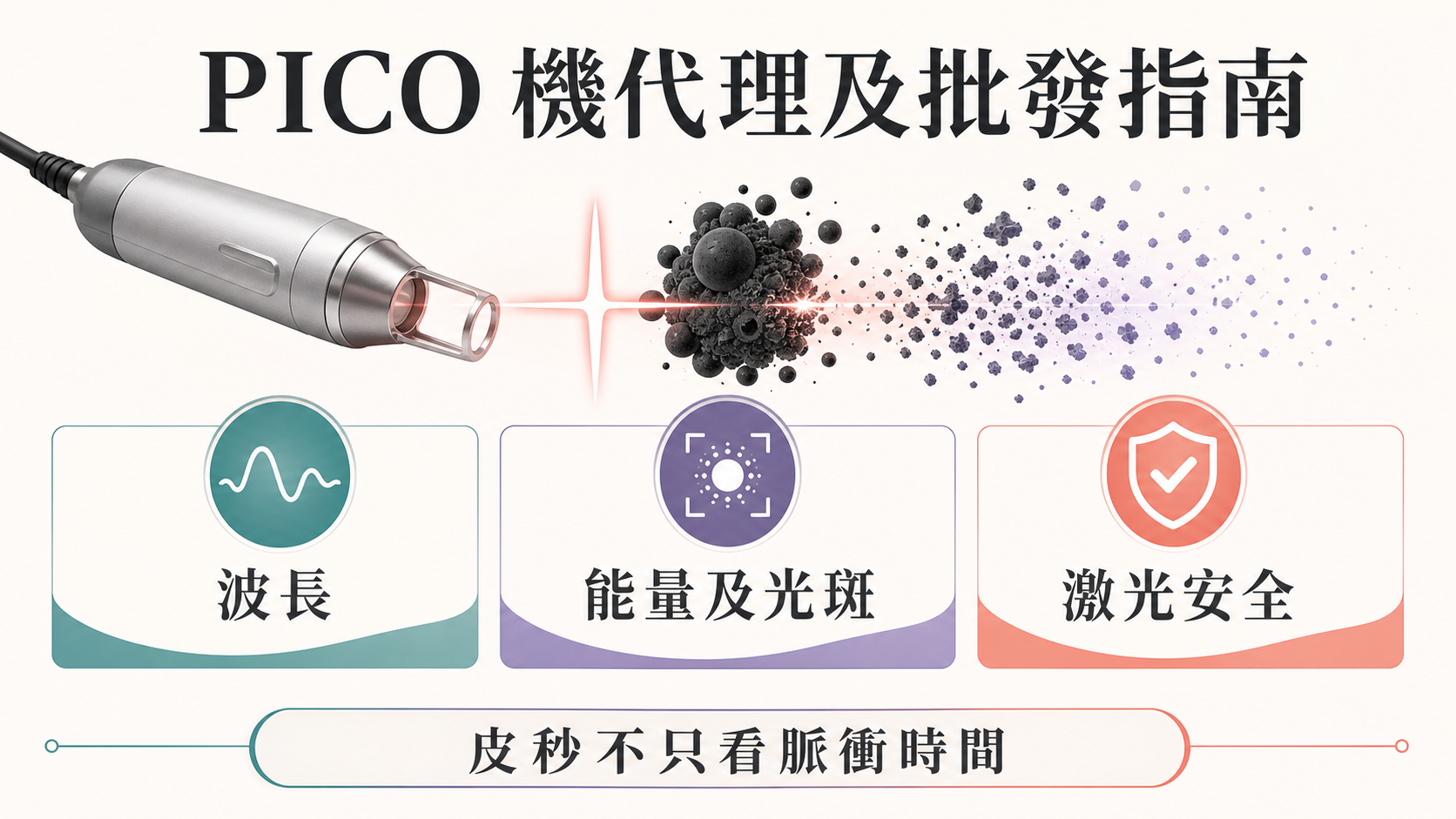
What is a PICO picosecond laser?
One picosecond is a trillionth of a second (10^-12 s). A picosecond laser delivers energy in very short pulses, which can produce photomechanical or photoacoustic effects on pigment particles. The marketing name says nothing about complete performance. Two devices both labelled "PICO" may use different light sources, pulse ranges, peak powers, spot sizes, energy stability and cleared indications.
A buyer should not treat "fewer picoseconds" as automatically meaning:
- The effect is stronger
- Fewer sessions will be needed
- Every pigment lesion or tattoo is suitable
- It is safer on darker skin
- It outperforms a nanosecond Q-switched laser
- Downtime, post-inflammatory hyperpigmentation or scarring risk is lower
A real comparison goes back to the complete model number, the instructions for use for each wavelength and handpiece, and measurable output and safety data.
How do 532, 755 and 1064nm compare?
Wavelength affects how light is absorbed and scattered in skin, but a treatment cannot be chosen on "shallow, medium, deep" alone. The following is a conceptual purchasing comparison, not an operating guide:
| Wavelength | General optical considerations | What the buyer must still verify |
|---|---|---|
| 532nm | Absorption by melanin and haemoglobin is generally higher and the action relatively superficial; epidermal pigment competition and skin-tone risk need particular assessment | Pigments and lesions listed in that model's IFU, skin-tone range, spot size, fluence and eyewear optical density |
| 755nm | Absorption and penetration sit between visible light and 1064nm; 755nm picosecond platforms differ considerably in design | Whether the wavelength is native, the handpiece, cleared indications and product-specific evidence |
| 1064nm | Lower epidermal melanin absorption and deeper penetration are often cited for darker targets, but burns and PIH remain possible | The actual indication, pulse, spot size, energy, skin-tone assessment and clinical endpoint |
A machine offering 532 and 1064nm does not therefore treat every colour, and one offering 755nm will not necessarily match another 755nm platform. Frequency-doubling, dye or other conversion handpieces may also change output, spot size and servicing needs. Any indication may only be described according to the specific model's IFU and local requirements.
Beyond picoseconds: six specifications that actually affect performance
1. Fluence
Fluence is energy per unit area, usually expressed in J/cm². A quotation should list the usable range and measurement tolerance for each wavelength, spot size and mode. Maximum console energy without a spot area cannot be compared meaningfully.
2. Spot size
Spot size affects coverage, energy density and how light propagates in tissue. Check whether the stated size is measured at the treatment end, whether energy adjusts automatically between spot sizes, and whether the edge is uniform.
3. Beam profile
A uniform beam helps reduce localised hot spots. The supplier should explain beam shape, calibration method and the acceptance criteria for drift over time — not simply show one idealised beam diagram.
4. Repetition rate
A higher repetition rate can speed up treatment, but it also affects heat accumulation, handpiece control and room throughput. Rate cannot be compared in isolation from single-pulse energy, spot size and protocol.
5. Pulse duration and modes
Ask for the genuinely usable pulse range at each wavelength, rather than the single lowest picosecond figure used in console marketing. Where fractional optics, a focus lens array or other specialised handpieces exist, list their specifications, indications and consumables separately.
6. Output stability
During a demonstration, look at stability across repeated shots, warm-up requirements, error reporting and calibration records. A device with an attractive peak figure but significant output drift makes repeatable treatment difficult.
Tattoos and benign pigment: how far does the evidence go?
Systematic reviews of picosecond lasers cover tattoos, benign pigmented lesions, scarring and rejuvenation, and show evidence of improvement for some indications. The same reviews note substantial variation in devices, wavelengths, parameters, outcome measures and study quality. "The picosecond category has research behind it" therefore does not mean every PICO machine is supported for the same use.
Tattoo colour, ink composition, depth, density, layering, location, skin tone, scarring and previous treatment all affect results. US FDA consumer information also notes that tattoo removal usually requires multiple sessions, that some colours are harder to treat, and that complete removal may not be possible. A salon should not advertise single-session clearance, all colours treated, or no marks left.
When a supplier cites a study, check it line by line against:
- The complete model and wavelength used
- Handpiece, spot size and pulse mode
- Participant skin tones, targets and exclusion criteria
- Number of sessions, intervals and follow-up period
- Objective scoring, blinding, photographic standards and adverse events
- Funding, author conflicts of interest and loss to follow-up
Melasma is not something a laser simply cures
Melasma is a complex, chronic and relapse-prone pigmentary condition influenced by sun exposure, hormones, inflammation, skin tone and other factors. Meta-analysis of picosecond lasers shows improvement signals in some studies, but results are inconsistent, and post-inflammatory hyperpigmentation, rebound and recurrence all remain considerations.
A PICO platform should therefore never be packaged as a permanent cure for melasma. More appropriate client education includes:
- Having the diagnosis and triggers confirmed by a suitable professional first.
- Placing sun protection and long-term pigment management at the centre.
- Explaining that a laser may only be one part of an overall plan.
- Setting expectations of multiple staged sessions with ongoing maintenance.
- Reviewing early if pigment darkens, tone becomes uneven, or burns or other abnormalities appear.
Pigment removal is a high-volume search term, but advertising must avoid guarantees, permanence, zero rebound pigmentation, and claims of suitability for every skin tone. The salon treatment marketing compliance guide sets out how to write this more accurately.
Acne scarring and rejuvenation depend on handpiece and protocol
Some picosecond research explores fractional optics, focus lens arrays or other approaches for acne scarring, texture and rejuvenation. Those results relate to a specific handpiece, energy distribution, study protocol and participant group. They cannot be added to a treatment menu simply because the console carries a "PICO" badge.
Before purchase, ask whether that specialised handpiece is included in the quotation, whether it has consumables, how it is cleaned, which documentation covers it, and what product-specific research exists. Where an intended use in Hong Kong involves medical judgement or a regulated procedure, confirm the appropriate operating model and personnel qualifications first.
PIH risk in Asian and darker skin tones
Darker skin carries more epidermal melanin, so energy selection and epidermal protection require greater caution. PIH risk does not disappear because a pulse is picosecond. Wavelength, fluence, spot size, overlap, recent sun exposure, existing inflammation, medication, skin tone and aftercare can all affect the response.
Supplier training should cover the limits of Fitzpatrick assessment, recent sun exposure, when test patches are appropriate, unintended endpoints, photographic follow-up and escalation routes. "Designed for Asian skin" is not a substitute for product labelling and evidence.
What do 510(k), CE, ISO 13485 and IEC actually mean?
| Document or marking | What it generally shows | What it does not mean |
|---|---|---|
| US 510(k) | A named applicant and device obtained substantial equivalence clearance for the stated indications | Not FDA approval of every console function, and it cannot be applied to a similar-looking model |
| CE marking | The product completed a conformity procedure under the applicable EU framework; check the regulation, device identity and certificate scope | Not an EU endorsement of any particular cosmetic outcome |
| ISO 13485 | A medical device quality management system for the organisation, within the certificate scope | Not proof that a given machine is effective, safe or permitted for all uses |
| IEC 60601-1 / -2-22 testing | A testing framework for basic safety and particular requirements for medical electrical and laser equipment | Not a standalone market authorisation or evidence of clinical outcome |
The PICOHI clearance K201773 illustrates the correct way to check: read the complete device name, applicant, model, wavelengths, handpieces and indications line by line, rather than letting one brand borrow another's K-number.
Document acceptance should also confirm:
- That the certificate holder matches the manufacturing chain
- That the model, revision and accessories cover the quoted equipment
- The issuing or certifying body, certificate number, validity and scope
- That the tested sample is the same hardware and software revision
- That Chinese and English labelling, IFU and serial numbers are traceable
- Hong Kong's Medical Device Administrative Control System and any other applicable requirements
Class 4 lasers: site safety is more than a pair of goggles
Many high-energy picosecond platforms are classified as Class 4 lasers. If the model under consideration is Class 4, the direct beam, specular reflections and in some cases diffuse reflections can present hazards to eyes or skin, along with a fire risk. The Hong Kong Electrical and Mechanical Services Department's laser product safety guidance emphasises classification, risk control, signage, training and personal protection.
A site assessment should cover at least:
- A designated controlled laser area and a responsible person
- Entrance warning signage and warning lights interlocked with operation
- Access control, interlocks or risk-assessed equivalent controls
- Key switch, emergency stop and protection against unauthorised use
- Removing or covering unnecessary reflective surfaces
- Beam termination, handpiece storage and standby procedures
- Fire-resistant materials, suitable extinguishing equipment and emergency drills
- Room, equipment and eyewear checks before every session
- Training, authorisation, incident and maintenance records
Safety features should be tested physically at acceptance, not merely ticked on a quotation.
Eyewear must match wavelength and optical density
"Two pairs of laser glasses included" is not a specification. Eyewear should clearly state the protected wavelength bands and optical density, chosen against maximum achievable output, pulse characteristics, exposure scenarios and the relevant standards. Protection needed for 532, 755 and 1064nm is not necessarily the same, and any aiming beam or additional wavelength must be included.
At acceptance, verify:
- Lens markings, manufacturer and conformity information
- That the protected bands fully cover every output
- That the optical density has been confirmed by a competent risk assessment
- Styles for the operator, the client and anyone else in the room
- That lenses are free of scratches, cracks, discolouration or cleaning damage
- How eyewear is stored, inspected, replaced and recorded
Eyewear is the last line of defence. It does not replace engineering controls, access control and correct operation.
Laser plume, debris and infection control
Some laser procedures may generate smoke, aerosols, odour or tissue and pigment debris. Actual risk depends on the indication and technique. Where plume is present, an occupational safety risk assessment should consider local exhaust near the source, suitable filter media, personal protection, equipment cleaning and filter replacement — rather than relying on general air conditioning or a mask.
Where a handpiece contacts skin, manufacturer-approved cleaning, disinfection, barrier and cross-infection procedures are also required. Contamination of filters, windows, lenses and consumables can affect both safety and output.
PICO demonstration and acceptance testing
Before the demonstration
Submit the intended indications, client skin tones, site, power supply, existing personnel qualifications and budget first. Ask the supplier for the complete IFU, certificates, specification sheet, risk classification, training outline and service terms, then decide whether to proceed to a demonstration.
During the demonstration
Do not use yourself or staff as unassessed demonstration subjects. A qualified person should test console start-up, key, emergency stop, interlocks, warning lights, handpiece recognition, cooling, error reporting and setting permissions according to the specified procedure. Output verification requires suitable instruments and methods, not judgement by sound or scorch marks on paper.
At handover
Record serial numbers, software revision, every handpiece, lenses and windows, eyewear, footswitch, keys, consumables, IFU, training records, test reports and the warranty start date. Capture baseline measurements of actual output, spot size, shot-to-shot stability and safety functions, so later servicing has something to compare against.
After-sales: ask about sources, modules, calibration and downtime
| After-sales question | The written answer you need |
|---|---|
| Light source / module | How expected life is measured, what triggers replacement, cost and lead time |
| Handpiece | Whether drops, window contamination, fibre or lens damage are covered |
| Calibration | Who performs it, by what method, how often, and the acceptable tolerance |
| Engineers | Whether they are based in Hong Kong, response and attendance times, qualifications and parts authority |
| Software | Updates, accounts, passwords, remote access and data security |
| Downtime | Loan units, warranty extension, appointment cancellation and consumable arrangements |
| Training | Initial course, assessment, retraining for new staff and safety refreshers |
The lowest console price can carry the highest total cost of ownership once expensive modules, long lead times or an inability to measure output locally are included. The beauty equipment supplier evaluation framework can be used to score suppliers against each other.
A PICO specification request list you can use directly
| Category | What to request |
|---|---|
| Identity | Manufacturer, complete model, serial number convention, country of production, software revision |
| Optics | Per wavelength: pulse duration, spot size, fluence, frequency, beam profile, stability |
| Handpiece | Native or converted wavelength, fractional optics, consumables, cleaning and compatibility |
| Indications | IFU, cleared indications, contraindications and market documentation for each wavelength and handpiece |
| Safety | Laser class, key switch, interlock, emergency stop, warning lights, beam termination |
| Eyewear | Protection range per wavelength, optical density, standards, quantity and replacement policy |
| Documentation | Market certificates, test reports, ISO 13485, IEC 60601-1 / -2-22 where applicable |
| Site | Power, heat dissipation, space, extraction, fire safety, access control and signage |
| Operations | Consumables, servicing, calibration, engineers, parts, software and downtime support |
| Commercial | Complete package price, financing, shipping, installation, training and out-of-warranty costs |
Frequently Asked Questions
Is a PICO machine better the lower its picosecond figure?
No. Picosecond duration is one pulse specification among several, and must be compared alongside wavelength, fluence, spot size, beam profile, stability, indication documentation and product-specific evidence.
Which is best, 532, 755 or 1064nm?
There is no single best wavelength. Different targets, skin tones and model designs require different assessment, and what each wavelength may be used for is determined only by the actual IFU and local requirements.
Can a picosecond laser clear a tattoo in one session?
That should not be promised. Tattoos usually require multiple sessions, colours and inks respond differently, complete removal may not be possible, and pigment change, scarring or other risks exist.
Can PICO permanently cure melasma?
No such guarantee can be made. Melasma recurs readily, a laser is usually only part of overall management, and PIH or rebound risk remains.
Does a 510(k) mean FDA approved?
For general devices, 510(k) is a clearance pathway and should not be written as FDA approval. It covers only the applicant, device and indications stated in the document, and cannot be transferred to another model.
What should a PICO machine price include?
Beyond the console: handpieces, optical accessories, eyewear, extraction, room modification, installation, training, calibration, light source or module replacement, servicing, financing and a downtime buffer.
Can any Hong Kong salon operate a Class 4 PICO laser?
That cannot be answered generically from the word "salon". It depends on the intended indications, device classification, site, personnel qualifications, whether medical judgement is involved and other applicable requirements. Obtain suitable regulatory and professional advice before purchase.
Submit your requirements for a neutral assessment
If you are comparing PICO machines, you can submit your intended indications, client skin tones, site, budget, personnel qualifications and existing documentation through the contact page to ask about model compliance and after-sales assessment. This enquiry does not indicate that any particular PICO brand is in stock, under distribution agreement, or necessarily suitable for your site. Quotation and demonstration should follow only after the actual available model, documentation, training and after-sales support have been verified.
You may also want to review the laser range and the triple-wavelength versus single-wavelength laser comparison to understand the purchasing logic behind other laser platforms.
*This article is general education on equipment purchasing, laser safety and evidence. It is not medical, legal or operating advice, and it does not constitute a distribution or supply statement for any brand. Actual indications, operator qualifications, site controls and contraindications should follow applicable Hong Kong requirements, the specific product labelling, a formal risk assessment and qualified professional advice.*