
PlaSon Plasma Beauty Device: A Complete Guide | PlasmaPoration, SonoPoration, Suitable Skin Conditions and a Salon Procurement Checklist
PlaSon frequently appears in the beauty market as a "plasma infusion" or "BB skin conduction device (BB肌傳導儀)", but the name alone is not enough to answer whether it suits a particular salon. Buyers first need to know the full model number, the intended use of the two handpieces, which products can be used with it, how it is cleaned, and whether published research actually addresses PlaSon itself or only the two technology categories of cold atmospheric plasma and ultrasound.
Public records allow the product identity of the PlaSon SLM-9600 and SeoulinMedicare to be verified, while market materials list PlasmaPoration and SonoPoration as the two main concepts. However, no sufficiently high-quality, independent clinical trial taking the SLM-9600 as its subject has so far been found that would substantiate all of the acne, infusion, firming or skin-rejuvenation claims made in the market. Understanding where this evidence boundary lies is the starting point for assessing whether PlaSon is useful.
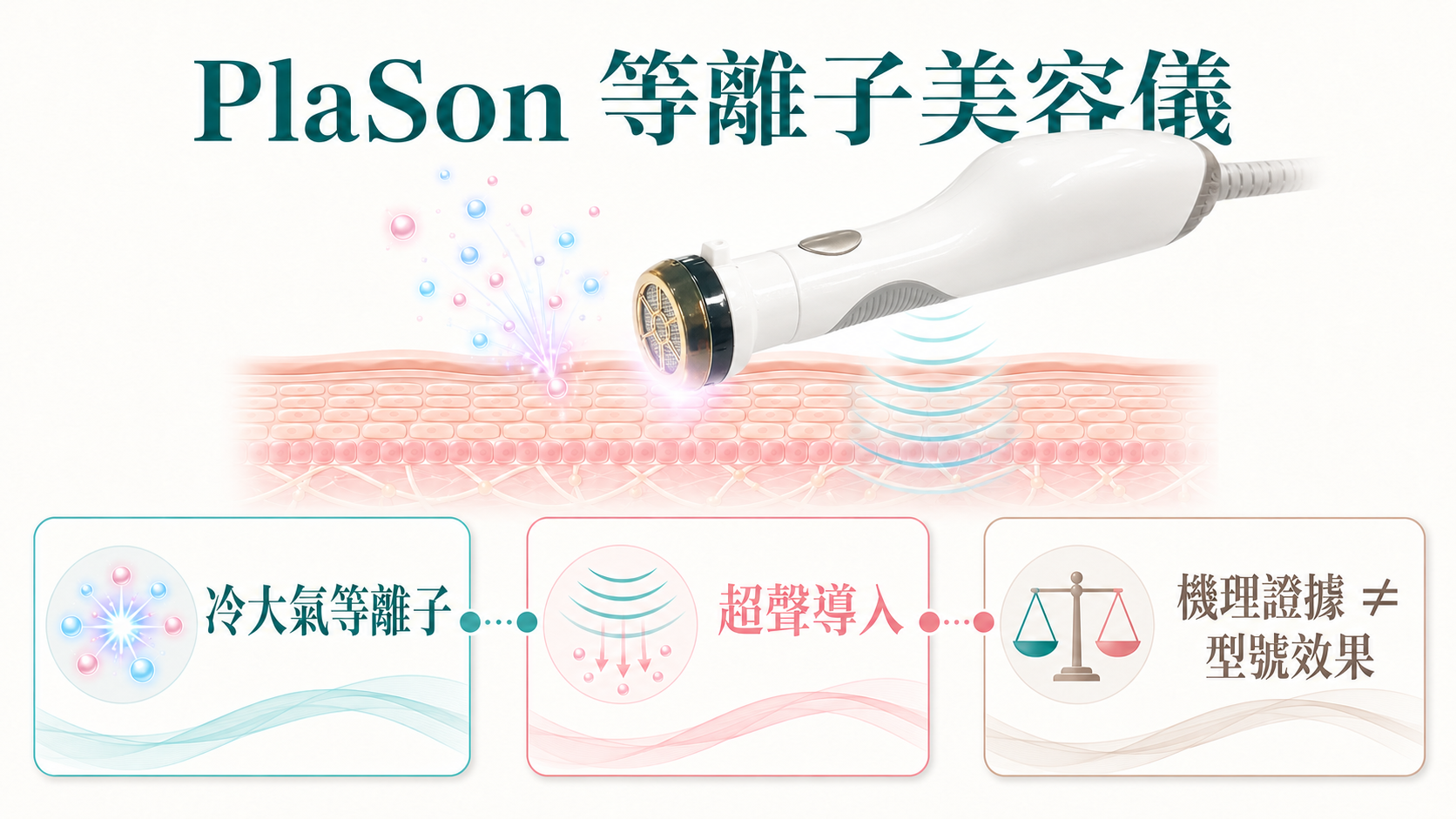
PlaSon plasma beauty device guide, explaining PlasmaPoration, SonoPoration, evidence tiers and the salon procurement checklist
PlaSon in 30 seconds
PlaSon is not PRP, which involves drawing and injecting blood, and the word "plasma" alone should not lead anyone to treat it as a plasma pen that creates scabbing on the skin.
Public product information describes it as a beauty device combining PlasmaPoration and SonoPoration, and the two functions may be used separately or together depending on the protocol.
Both cold atmospheric plasma and ultrasound infusion have general mechanism research behind them, but general research into a technology does not amount to model-specific proof of efficacy for PlaSon.
Whether it suits a particular client, which handpiece to use, and the formulation, energy and timing must be decided according to the latest IFU for the version currently sold in Hong Kong, together with training and professional assessment.
Salons should not rewrite "FDA registered" as "FDA approved", and should not promise a bactericidal rate, permanent results, or that any serum can reach the dermis directly.
What is PlaSon? Confirm the model and product identity first
The US AccessGUDID database holds device records for SeoulinMedicare, PlaSon and the SLM-9600. These can be used to verify the brand, model and identification data, but they do not mean the US FDA has endorsed every cosmetic effect.
The BuyKorea product page lists PlasmaPoration and SonoPoration as PlaSon's two core functions and states that the two can be operated independently or together. The page also carries a number of cosmetic-effect descriptions; these help in understanding how the manufacturer positions the product, but they cannot replace independent clinical research.
When purchasing, the supplier should be asked to use the same full model number on the quotation, the machine label, the IFU, training certificates and marketing documents. If the paperwork only says "PlaSon", "Korean plasma machine" or "plasma facial", it is difficult to judge whether the certificates, studies and consumables in hand really apply.
How should the principle behind PlasmaPoration be understood?
Cold atmospheric plasma is not a synonym for high-temperature ablation
Plasma is the state a gas takes on once it has been energised. Cold atmospheric plasma research discusses how charged particles, electric fields and reactive species interact with the skin surface. The relevant research indicates that it has the potential to temporarily alter the skin barrier and biological responses; results, however, are affected by gas, electrode, output, distance, time, environment and skin condition.
A review of transdermal delivery using cold atmospheric plasma notes that CAP can alter skin properties and increase the delivery of certain substances, while also stressing that clinical translation, safety and standardisation remain open research questions. The more accurate wording is therefore "the underlying mechanism may support transdermal delivery", rather than "delivers any nutrient into the cell in 30 seconds".
Mechanism research is not the same as PlaSon clinical results
The cold plasma literature may use different gases, waveforms, outputs and devices. Even where a study observes changes in barrier, bacterial or inflammatory markers in the laboratory or on another machine, that does not automatically prove the SLM-9600 will produce the same result with the same treatment time, the same serum or the same skin condition. Salon content should clearly label "category research on cold atmospheric plasma" and "PlaSon product information" separately, and not merge the two into a single proven efficacy claim.
How does SonoPoration affect infusion?
SonoPoration generally refers to the mechanical effects and cavitation-related phenomena produced by ultrasound energy, which temporarily change the delivery environment of tissue or of the skin barrier. Research on ultrasound transdermal delivery shows that the delivery of some substances can be increased; a review of sonoporation mechanisms also stresses that frequency, acoustic pressure, cavitation dose, contact time, molecular characteristics and tissue condition all affect the outcome.
This means that "there is ultrasound" is not enough to predict what depth a given serum will reach. The molecular weight of the formulation, the medium, skin integrity, handpiece output and the operating protocol all matter. Some sonoporation studies also use specific cavitation nuclei or microbubbles, which cannot be applied directly to ordinary cosmetic serums. Salons should only use products permitted by the manufacturer, with clear ingredients and compatibility.
What can reasonably be expected of PlaSon?
When assessing results, the question can be divided into three levels:
Concern | What existing information can say | Lines that should not be crossed |
|---|---|---|
Serum infusion | Both CAP and ultrasound have mechanism research on altering the delivery environment | No guarantee that any ingredient reaches the dermis or the cells directly, or of a fixed percentage increase |
Appearance of inflammatory acne | Other CAP devices have small human studies; the research field is still developing | Must not be rewritten to say that PlaSon can kill bacteria, cure acne or replace dermatological treatment |
Hydration, radiance and skin feel | Can serve as subjective and standardised imaging observation goals before and after treatment | Without independent PlaSon research, no specific magnitude or duration should be promised |
Pores, pigmentation, fine lines and firming | There are marketing claims along these lines in the market | Manufacturer claims should not be written up as established clinical effects |
Safety and comfort | Studies on other CAP devices have recorded transient warmth, erythema or discomfort | No guarantee of zero pain, zero redness, zero side effects or suitability for everyone |
Taking acne as an example, the relevant CAP clinical research is still progressing; trial registration does not mean positive results already exist, nor does it prove PlaSon is effective for all acne. Where the condition is severe, cystic, rapidly deteriorating, painful, suppurating or likely to scar, the client should first be referred to a qualified healthcare professional for assessment.
How do PlaSon, plasma pens, PRP and ultrasound infusion differ?
Market names are easily confused, and the safest approach is to compare actual operation and documentation rather than just the word "plasma".
Item | PlaSon-type plasma / ultrasound infusion | Plasma pen | PRP | Conventional ultrasound infusion |
|---|---|---|---|---|
Core concept | Cold plasma-related functions plus the ultrasound infusion concept | Usually forms epidermal hot spots through a localised thermal effect | Drawing, processing and injecting an autologous blood product | Ultrasound mechanical effect combined with a medium |
Does it break the skin | No absolute guarantee can be given apart from the specified device and its IFU | Common protocols produce scabbing or epidermal injury | Involves blood drawing and injection | Generally non-invasive, but judged by the device's intended use |
Main risks | Affected by output, distance, medium, skin and technique | Burns, pigment changes, scarring and infection, among others | Bleeding, infection and injection-related risks | Discomfort, local reactions and the risk of inappropriate parameters |
Qualifications and regulation | Verify against the exact model, intended use and Hong Kong requirements | Verify against the mode of operation and local requirements | Falls within the scope of medical procedures and requires the corresponding professional standing and infection control | Verify against the product's intended use, the IFU and operator requirements |
How evidence is written | Keep PlaSon model evidence separate from technology-category research | Cite only studies on the specified device and procedure | Cite only research on the corresponding indication and medical studies | Different frequencies and devices cannot be applied interchangeably |
What should a general treatment workflow include?
This article does not provide energy, distance, dwell time or combination procedures, because such information must come from the latest IFU for the version currently sold in Hong Kong and from qualified training. A salon's basic workflow may include:
Updating records of health, medication, allergies, implanted devices, pregnancy or breastfeeding, recent cosmetic procedures and same-day skin condition.
Confirming the treatment goal and explaining which outcomes are reasonable cosmetic observations and which are not medical treatment.
Checking skin integrity and cleansing according to the guidance; do not proceed directly where there are wounds, infection, obvious inflammation or skin lesions that cannot be assessed.
Recording the machine, model, handpiece, specified products, operator and settings.
Selecting PlasmaPoration, SonoPoration or the sequence permitted by the manufacturer according to training; not every client has to use both functions.
Observing sensation and skin response, and stopping and assessing immediately if unexpected pain, intense heat or marked changes occur.
Providing written aftercare, warning signs and contact details, and recording results using consistent lighting and angles.
Who needs to be checked further or referred first?
Until the current PlaSon IFU has been obtained, the contraindication list from another plasma device should not be carried over. At a minimum, salons should obtain formal guidance from the supplier on pregnancy or breastfeeding, pacemakers and other implanted devices, metal implants, epilepsy, medication, active infection, open wounds, severe inflammation, recent energy-based treatments and formulation allergies.
Where a client has an undiagnosed skin lesion, a rapidly changing mole, persistent bleeding, severe or cystic acne, obvious infection or intense pain, or wishes to use a cosmetic treatment to address a disease, they should first be assessed by a qualified healthcare professional. If worsening pain, blistering, weeping, persistent swelling, a suspected burn, infection or neurological symptoms appear after treatment, self-care should also stop and help should be sought as soon as possible.
Procurement checklist before a salon brings in PlaSon
Area to verify | What must be obtained or clarified | Common risks |
|---|---|---|
Product identity | Manufacturer, full model number, serial number, machine label and UDI | Certificates that do not match the actual console version |
IFU and intended use | The intended use, parameters, formulations, contraindications and stopping criteria for each handpiece | Verbal accounts from the agent taking the place of formal instructions |
Market documentation | Certificate number, holder, model, accessories, intended use, validity period and market | Treating another country's records as Hong Kong approval |
FDA wording | Whether it is registration, listing, 510(k) clearance or approval | Using "FDA registered" to imply that efficacy has been endorsed |
Training | Skin-condition screening, test treatments, operation, adverse reactions, referral and record-keeping | Teaching only how to switch the machine on, plus sales scripts |
Hygiene and consumables | Handpieces, caps, contact surfaces, cleaning agents, reuse limits and replacement cycles | Inadequate cleaning or the use of incompatible products |
After-sales | Warranty, calibration, parts, repair turnaround times, loan units and software | Downtime affecting bookings and revenue |
Marketing evidence | Every percentage figure, antibacterial rate, before-and-after photograph and the full text of studies | Deleting the test conditions and then making absolute promises |
The US FDA states clearly that a company or device completing registration/listing does not mean the product has obtained FDA approval, clearance or authorisation, and that there is no such thing as a "registration certificate" issued by the FDA. Hong Kong's Medical Device Administrative Control System is a voluntary listing scheme. Salons should describe things according to the actual market and the original wording of the documents, and not substitute a vague "international certification" for proper verification.
Beyond the price of the machine, replacement caps, the specified medium, cleaning supplies, staff training time, routine maintenance and downtime risk should all be counted into the cost per treatment. The beauty equipment payback guide can be used to build conservative, baseline and optimistic scenarios, but a sale should not be closed on the basis of guaranteed results or revenue.
How can PlaSon marketing content be worded accurately?
The safer wording is "research indicates that cold atmospheric plasma has the potential to alter the skin barrier and biological responses, with the effect depending on the device and the parameters", and "the delivery effect of SonoPoration depends on frequency, intensity, formulation and skin condition".
Claims that should be deleted, or for which original evidence should be required, include:
FDA approved, FDA certified or "international medical grade"
99.9% bacterial kill, curing acne, eczema or rosacea
Absorption increased by 12,000%, reaching the deep skin in 30 seconds, or penetrating the cell wall
That any serum, drug or growth factor can be infused
Guaranteed collagen production, permanent tightening or results after a single session
Zero pain, zero risk, zero side effects, suitable for all skin tones
For more principles on local content review, see the salon treatment marketing compliance guide.
Frequently asked questions
Is PlaSon cold plasma or a plasma pen?
Public product information positions PlaSon as a beauty device with PlasmaPoration and SonoPoration functions, and it should not be equated directly with the plasma pens that commonly form epidermal hot spots or scabbing. The actual energy form and treatment endpoint must still be taken from the latest IFU for the SLM-9600.
Is PlaSon FDA approved?
AccessGUDID can be used to verify device identification data, but a listing or registration is not the same as FDA approval. Whenever a supplier uses FDA wording, they should provide the document number, full model number, intended use and the original text.
Is PlaSon effective for acne?
Other cold atmospheric plasma devices have preliminary acne research, but that cannot directly prove PlaSon can treat acne. Severe, cystic or painful acne, or acne likely to scar, should first receive a medical assessment.
Can serums reach the dermis or the cells directly?
Existing mechanism research supports the possibility that CAP or ultrasound may alter the delivery environment, but it does not support the claim that "any serum will certainly reach the dermis or the cells". The outcome depends on the device, parameters, formulation and skin condition.
Will the treatment hurt or cause redness?
Sensation varies with the individual, the area, the settings and the operator. Studies on other CAP devices have recorded transient warmth, redness or discomfort, and it cannot be promised that PlaSon will be entirely without sensation or free of downtime.
Can it be used during pregnancy, on sensitive skin, or with implanted devices?
Do not judge by a generic online list alone. Consult the latest contraindications for the version currently sold in Hong Kong, and where necessary check with a qualified healthcare professional first.
How many sessions are usually needed?
There is no fixed number of sessions that applies to everyone. Sessions should be arranged according to the assessed goal, the response each time, full recovery, the manufacturer's protocol and regular review, and package size should not take the place of a safety judgement.
What should a salon ask first when buying PlaSon?
Start by obtaining the full model number, the current IFU, the intended use of each handpiece, the original certification text, the training syllabus, consumable price lists, the cleaning SOP, warranty terms and repair turnaround times, and then arrange a trial of the machine.
Conclusion
What distinguishes PlaSon is that it places plasma-related functions and the ultrasound infusion concept on a single beauty platform. General research helps in understanding the possible principles behind PlasmaPoration and SonoPoration, but it cannot replace independent model-specific research on the SLM-9600. For a salon, the most practical basis for a decision is not an exaggerated absorption rate or an "FDA" badge, but a verifiable IFU, formulation compatibility, contraindications, training, hygiene procedures, consumables and after-sales support.
If you are currently evaluating PlaSon, start with the PlaSon product information and the beauty equipment product categories, then use the contact page to request documentation, a trial, training and after-sales details for the version currently sold in Hong Kong.
This article provides general information on beauty equipment, procurement and research only. It does not constitute a medical diagnosis, treatment advice, legal advice or a judgement of suitability for any individual. If you have questions about skin symptoms, disease, medication or contraindications, please consult a qualified healthcare professional.