
Hong Kong RF Device Distributor Guide | RF Microneedling, Gold Microneedling and Salon Payback Considerations
When a Hong Kong salon searches for an "RF device distributor", an "RF microneedling distributor" or a "gold microneedling distributor", the question that actually needs answering is usually not "is there a market for this treatment", but rather: which category of RF equipment suits my type of premises? Is the supplier reliable? How do I cost the handpieces and consumables? Will my therapists be able to operate it safely? Will after-sales repairs affect my income? And can this machine work alongside HIFU, skin-tightening and medical skincare items to become a sustainably sellable, high-value treatment.
This article is written from the perspective of salon owners, spa managers, aesthetic clinic operators and professional procurement buyers, setting out the key points to clarify before bringing in an RF device. It touches on RF microneedling, gold microneedling, conventional RF, HIFU/MMFU and post-treatment recovery pairings, but the aim is not to write a consumer-facing treatment price article; it is to help you judge whether to buy, which category to buy, who to buy from, and how to recover your investment.
Why do Hong Kong salons consider bringing in an RF device?
RF-type equipment plays several common roles on a salon treatment menu: improving skin refinement, supporting collagen management, adding a device-led feel to facial or body treatments, and offering an upgrade option to clients already on basic skincare programmes. Compared with manual care alone, RF equipment is usually easier to package as an advanced treatment; compared with large high-energy lifting items, some RF services are also easier to schedule in terms of treatment pacing and aftercare.
But not every salon is suited to buying the highest-tier device from the outset. You should first work out what type of business you run:
- Newly opened salons: need items that are easy to train for, with a clear treatment workflow and high client comprehension.
- Salons with an established facial client base: may consider using RF or RF microneedling to raise the average spend per client.
- Premises positioned as aesthetic or light-medical aesthetic: need to pay greater attention to operator qualifications, infection control, pre-treatment assessment and compliant promotion.
- Multi-service clubs or spas: can design RF alongside HIFU, skin tightening, post-treatment recovery or body management into a programme.
If your clients are mainly concerned with pores, rough skin texture, fine lines, a sense of contour laxity or treatment upgrades, RF-type equipment is worth discussing; if your premises mainly offer purely relaxing care or low-ticket quick services, you should first work out carefully whether the training and consumables are worth it.
What is the difference between RF microneedling, gold microneedling and conventional RF?
In the market, "RF device" is a very broad category. When purchasing, do not simply take a supplier's word that "this one is radiofrequency" — ask clearly which category of technology it belongs to.
| Category | Common market descriptions | What to watch for when purchasing |
|---|---|---|
| Conventional epidermal or contact RF | RF skin tightening, RF facial care | Energy stability, comfort, handpiece design, treatment time |
| RF microneedling | RF microneedling, radiofrequency microneedling | Needle depth, single-use consumables, infection control, operator training |
| Gold microneedling | Gold microneedling, gold RF microneedling | Mostly a market communication name; you still need to come back to the actual technology and consumable specifications |
| Fractional RF | Fractional RF | Energy distribution, suitable treatment areas, explanation of the recovery period |
| Combination platforms | RF combined with other energies or modes | Whether it genuinely reduces overlapping equipment in the treatment room, or is merely a stack of features |
"Gold microneedling" should not be understood as a single standard. Different brands, needle designs, depth adjustments, RF output and operating workflows all affect how the treatment is positioned. Before a salon buys a machine, it should unpack the "name" back into "actual specifications": whether depth can be adjusted, whether the needles are single-use, whether the consumable supply is stable, whether complete training is provided, and whether there are clear contraindication statements.
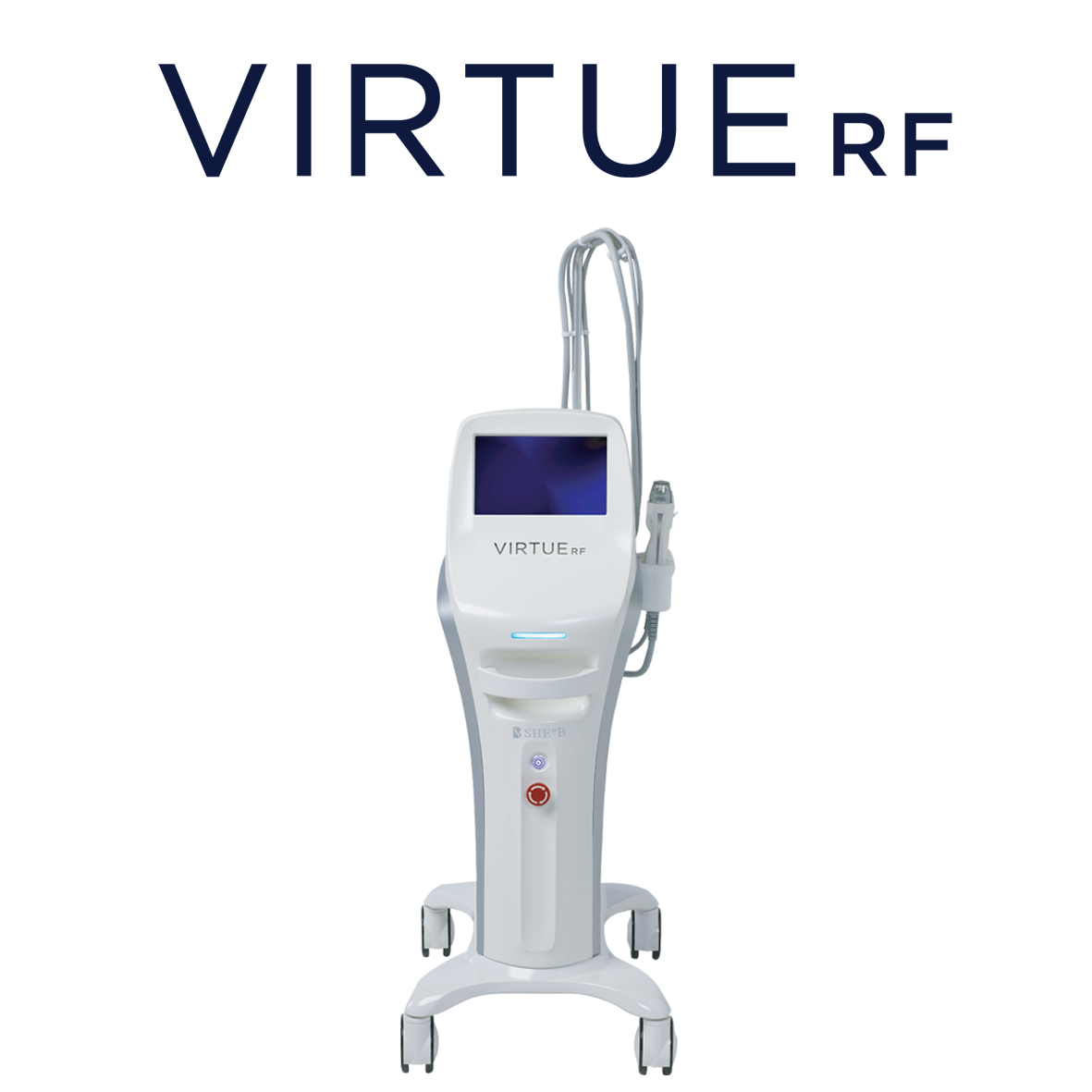
Taking an RF microneedling direction such as the Virtue RF gold collagen printer as an example, a salon should assess device stability, operating workflow, post-treatment recovery pairings and therapist training at the same time, rather than looking only at the market buzz around "gold microneedling".
How should RF and HIFU/MMFU divide the work?
Many salons compare RF, HIFU, MMFU, skin tightening and muscle-layer support items at the same time. These devices do not necessarily replace one another; more often they serve different roles.
RF or RF microneedling is usually better placed in the direction of skin quality management, refinement, collagen management and advanced facial care. HIFU/MMFU is more commonly used for contour, lifting and firming management at different depths. If the premises already has a lifting client base, RF can be used as part of skin quality improvement and treatment combinations; if the premises is only just starting to upgrade its equipment, it should first decide whether it wants to focus on skin quality, contour, or high-value anti-ageing programmes.
Put simply:
- If you want to do contour lifting: you may compare HIFU/MMFU directions such as New Doublo 2.0.
- If you want to do skin tightening and a sense of support: you may compare different tightening devices such as the Titan skin-tightening solution.
- If you want to do skin refinement, pores and collagen management: you may put RF microneedling and post-treatment recovery on the procurement list.
- If you want a complete anti-ageing menu: do not look at a single machine alone; you should design treatment tiers, pricing and aftercare at the same time.
If you are still comparing the investment priority of HIFU against RF, you may first refer to this site's HIFU equipment distribution and wholesale guide, then place both categories of equipment into the same payback model for comparison.
How should you verify a distributor before buying an RF device?
When searching for "RF microneedling wholesale" or "RF microneedling distributor", prices may vary widely. What really needs asking is: does this supplier have a stable source of supply, clear authorisation, local Hong Kong support, training capability and an after-sales repair process.
It is recommended that you ask an RF device distributor for the following information:
- Source of the device: whether they can provide manufacturer documentation, proof of distributorship or verifiable supply chain documents.
- Consumable arrangements: whether needles, handpieces or other consumables are supplied consistently, and whether there is a minimum order quantity.
- Operator training: whether it covers hygiene procedures, parameter settings, contraindicated individuals, post-treatment handling and refresher training.
- Repairs and maintenance: whether faults are handled by a local team, or the unit must be sent back overseas.
- Trial arrangements: whether the person in charge and the therapists can experience the operating workflow first-hand.
- Marketing support: whether they provide compliant, verifiable treatment introduction materials that are not excessively medicalised.
- Payment terms: whether one-off payment, instalments, machine rental or other cooperation arrangements are available.
The Hong Kong Department of Health publishes information relating to "distinguishing medical procedures from beauty services", and the Medical Device Division also operates the Medical Device Administrative Control System. When a salon purchases equipment involving energy output, skin penetration or higher risk, it should require the supplier to explain clearly the product's intended use, operating requirements and local support, rather than answering only with "overseas certification" or "lots of shops have bought it".
What determines payback for a salon?
The total investment in an RF device is not just the price of the machine. Where RF microneedling is involved, consumables and hygiene procedures matter especially, because single-use needles, post-treatment recovery, operating time and therapist training all affect the actual gross margin.
You can use the following formulas for a preliminary estimate:
| Item | Calculation |
|---|---|
| Consumable cost per session | Needle or handpiece cost + infusion/sterilisation/recovery materials |
| Gross profit per session | Fee per treatment session − consumable cost per session − labour and other variable costs |
| Monthly gross profit | Gross profit per session × sessions completed per month |
| Months to payback | Total device investment ÷ monthly gross profit |
Suppose a salon already has an established facial client base; the RF item can then serve as an upgrade to existing care. For such premises the key to payback is "conversion rate" and "package renewal". Conversely, a newly opened shop without a stable client source may not necessarily achieve quick payback even if it buys a popular device, because it still has to invest in education, trial treatments, promotion and the time therapists need to become proficient.
So when asking for a price, do not only ask "how much is the machine", but also:
- How much consumable is used per treatment?
- Must the consumables be bought from the same supplier?
- What is the recommended treatment time?
- How many sessions can a therapist handle in a day?
- Do post-treatment recovery products need to be paired with it?
- If the device is out of service for a week, does the supplier have a back-up arrangement?
These questions come closer to real payback than the machine price does.
Questions you must ask during a device trial
A device trial is not only about how the treatment feels; more importantly it is about whether this equipment can fit into your day-to-day operations. It is recommended that the person in charge and the therapists take part together, assessing it from the sales, operating and after-sales angles.
| Angle | What to ask during the trial |
|---|---|
| Operation | How long do therapists need to train? Are parameters easy to record? Is there a standard workflow? |
| Safety | Is there a contraindication list? Are there infection control and single-use consumable guidelines? |
| Comfort | How are client sensation, recovery period, post-treatment redness and aftercare arrangements explained? |
| Commercial | Time per session, viable pricing range, package design and how the payback estimate is done? |
| After-sales | Who follows up on maintenance, repairs, consumable restocking and marketing materials? |
If a supplier only demonstrates on-the-spot results but cannot answer questions on consumables, repairs, training, contraindications and compliant promotion, the salon should hold off on a decision. You may also refer to this site's 2026 Hong Kong Beauty Expo procurement guide and turn the trial questions into an internal procurement checklist.
Common misconceptions: do not be carried away by buzzwords alone
Misconception one: assuming all gold microneedling is the same
"Gold microneedling" is an easily understood market name, but different devices differ in needle design, depth, energy output, consumable quality and training requirements. When purchasing, you should come back to the actual technical documentation and the trial process.
Misconception two: looking only at influencer buzz or trial pricing
Buzz in the consumer market does not equate to a salon's ability to recover its investment. What a buyer has to calculate is whether the client base is willing to upgrade, whether therapists can operate the device consistently, whether consumables are controllable, and whether after-sales support is reliable.
Misconception three: overlooking aftercare and recovery pairings
RF, RF microneedling and other energy-based treatments usually require clear post-treatment care education. Salons may consider pairing them with medical skincare and recovery products, but when promoting them they should avoid describing topical products as medical treatment, guaranteed repair, or for injection use.
Misconception four: promoting with excessively medicalised wording
Do not promote beauty equipment as "guaranteed treatment", "permanent rejuvenation", "completely risk-free" or "suitable for everyone". A safer way to put it is: it may serve as one option for improving appearance and managing skin quality, and actual results and recovery will vary with individual skin condition, operating technique and treatment design.
Key points on compliance and risk communication
RF microneedling involves needles and energy output, and so requires stricter training and hygiene procedures than ordinary surface care. On 15 October 2025 the US FDA issued a safety communication on RF microneedling, noting that serious complications have been reported in certain use situations, including burns, scarring, fat loss, disfigurement and nerve damage, and stating that RF microneedling is a medical procedure that should not be used at home.
This does not mean that salons definitely cannot purchase such equipment; it means that when purchasing it is all the more necessary to ask clearly:
- Who operates it? Do they have sufficient training and experience?
- How are unsuitable individuals assessed?
- Are single-use needles changed for every client?
- How is the device cleaned and disinfected?
- Is there a referral or follow-up process if a client shows an abnormal reaction?
- Does the promotion avoid unverified or excessively medicalised claims?
The Hong Kong Department of Health also publishes information on distinguishing beauty services from medical procedures. If a salon offers services involving skin penetration, injection, medical procedures or high-risk services, it should handle these in accordance with local regulatory requirements and professional advice. If you are unsure whether a particular service is suitable for a salon to offer, you should first consult a qualified professional rather than rely on a supplier's sales claims alone.
Which RF device strategy suits your premises better?
If your premises is still building its client base, it is recommended that you first choose a solution that is easy to understand, easy to train for, transparent in consumables and stable in after-sales support, then upgrade the treatments step by step. Do not put all your funds from the outset into a high-specification device that is difficult to sell.
If your premises already has a high-end facial client base, you may consider designing RF microneedling as a combined item covering skin quality management, pore refinement, collagen management and post-treatment recovery. For such premises, the focus is not on one-off low-priced trial treatments, but on building client education, treatment records and a renewal mechanism.
If your premises also runs HIFU/MMFU, skin tightening or medical skincare, you can place the RF device within a complete anti-ageing treatment programme so that the different devices have clear roles: lifting for lifting, skin quality for skin quality, recovery for recovery. This is easier to explain to clients than cramming every result into one machine, and is also more favourable for long-term sales.
Quick pre-purchase checklist
| Checklist item | Confirm before moving to the next step |
|---|---|
| Business positioning | I know clearly which type of client this RF device is meant to serve |
| Technology category | I know whether it is conventional RF, RF microneedling, fractional RF or a combination platform |
| Consumable cost | I know the cost of needles, handpieces and recovery materials per treatment |
| Training arrangements | Therapists have a standard workflow, a contraindication list and refresher training arrangements |
| After-sales repairs | I know who repairs it, how long it takes and where the parts come from |
| Promotional compliance | The copy does not use wording such as guaranteed, permanent, zero risk or treating disease |
| Payback model | I have estimated using monthly gross profit, not just looked at the machine price |
Frequently asked questions
Is gold microneedling the same as RF microneedling?
Not necessarily. "Gold microneedling" is mostly a commonly used market name, usually related to RF microneedling or fractional RF, but different devices can vary considerably in design, depth, energy, consumables and operating workflow. When purchasing, a salon should look at the technical documentation and the device trial, not just the name.
What is the difference between an RF device distributor and an ordinary beauty equipment supplier?
A genuinely valuable distributor usually does more than supply goods; they should also be able to provide manufacturer or verifiable sourcing, operator training, consumable resupply, local repairs, treatment design and marketing support. An ordinary supplier that only offers low-priced equipment without after-sales support carries higher risk in the long run.
How should RF microneedling and HIFU/MMFU divide the work?
RF microneedling is more commonly placed in the direction of skin refinement, pores, fine lines and collagen management; HIFU/MMFU is more commonly placed in the direction of contour lifting and firming management at different depths. A salon should divide the roles according to what its client base needs, rather than handing every anti-ageing need to the same machine.
How should the cost of handpieces, needles and post-treatment recovery be calculated?
It is recommended to calculate on a "consumable cost per session" basis, including single-use needles or handpieces, sterilisation materials, and infusion or recovery products, plus an allocation for labour and repairs. This reflects the actual gross margin better than looking at the machine price alone.
Can RF microneedling be promoted as having zero downtime or being completely risk-free?
Not recommended. RF microneedling involves skin penetration and energy output, and should be arranged according to professional assessment, hygiene procedures and suitable candidates. Promotion should avoid absolute wording such as "zero risk", "completely free of side effects" or "guaranteed results".
Conclusion: an RF device distributor should help you solve operational problems
A reliable RF device distributor should not simply sell you equipment; they should help you think through the technology, training, consumables, after-sales support, treatment packaging and compliant promotion together. For a salon, what is genuinely worth investing in is not a popular name, but a treatment system that can be implemented consistently, is easy for therapists to operate, is easy for clients to understand, has controllable costs and can generate enquiries over the long term.
If you are comparing RF microneedling, HIFU/MMFU, skin tightening or other professional beauty equipment, you may first browse the Asia Pacific Beauty equipment range, or contact the Hong Kong team for RF device comparison advice and to arrange a device trial.
References
- Hong Kong Department of Health: Differentiating Medical Procedures from Beauty Services
- Medical Device Division, Hong Kong Department of Health: Medical Device Administrative Control System
- Medical Device Division, Hong Kong Department of Health: MDACS Guidance Notes
- FDA: Potential Risks with Certain Uses of Radiofrequency (RF) Microneedling
- FDA: Microneedling Devices
- Hong Kong Drug Office: Information on the Undesirable Medical Advertisements Ordinance