
How to Choose a Scalp Hair Growth Treatment? Comparing the Evidence for Microneedling, Exosomes and Low-Level Light Therapy
When hair becomes finer, the hairline recedes or the parting widens, the first question many people ask is: "Between low-level light therapy, scalp microneedling and exosomes, which one grows the most hair?" The genuinely sound answer is not to choose a treatment first, but to determine the type of hair loss first. Androgenetic alopecia, alopecia areata, telogen effluvium, traction alopecia, scalp infection and scarring alopecia differ in cause and management; using the same set of beauty treatments for every form of hair loss may waste money and may also delay proper diagnosis and care.
Comparing only the three currently popular directions, low-level light therapy (LLLT / photobiomodulation) has a relatively mature research base in male and female pattern hair loss; the better evidence for microneedling comes mainly from combining it with existing treatments such as minoxidil rather than from using it alone; and exosomes for hair loss remain at an early research stage, with wide variation in product source, preparation, dosage and method of application. The comparison below follows the order of "diagnose first, then look at the evidence, and assess risk and cost last".
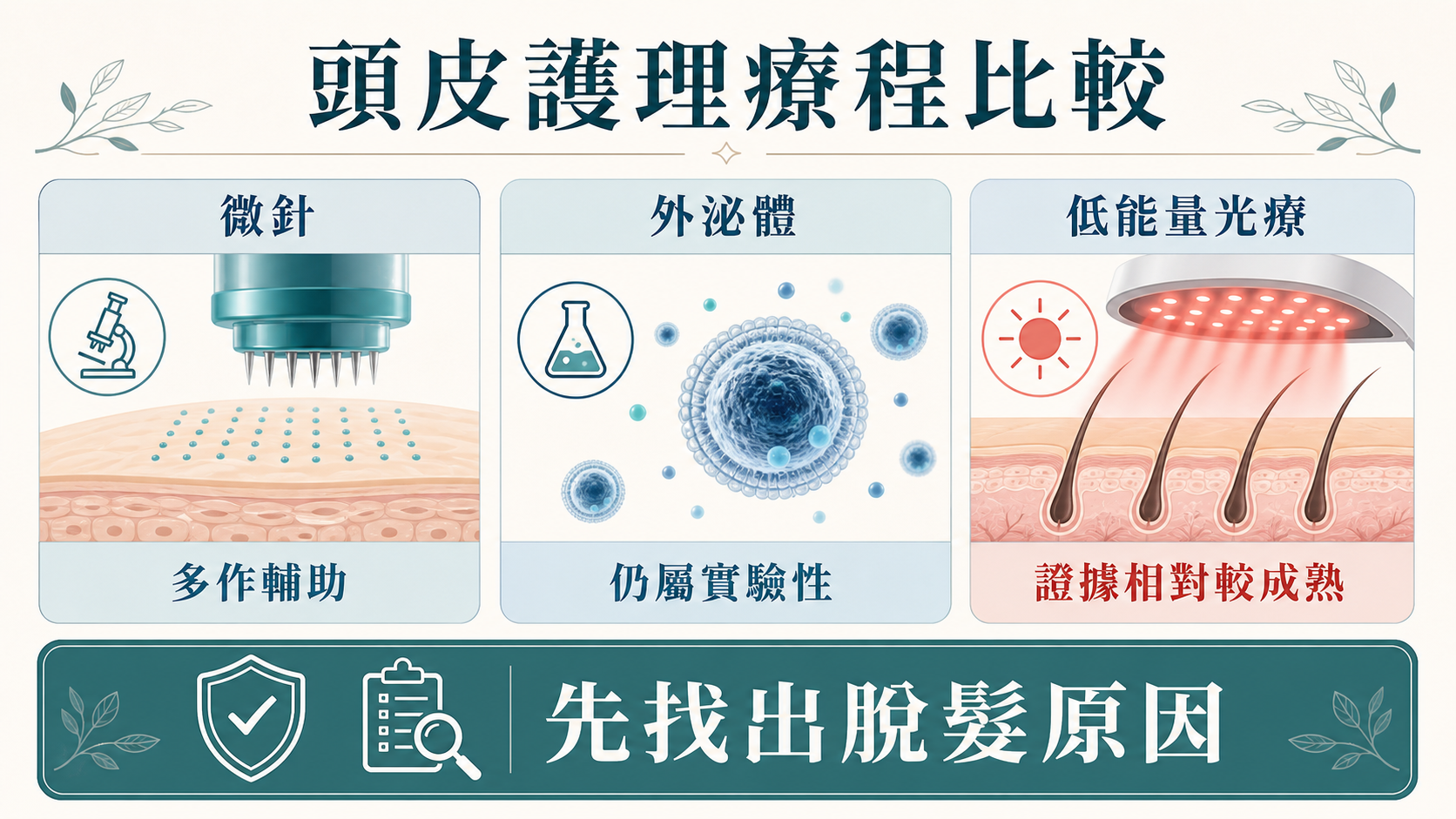
The conclusion first: the three scalp treatments are not on the same level of evidence
| Comparison item | Low-level light therapy (LLLT) | Scalp microneedling | Exosome treatment |
|---|---|---|---|
| Main research population | Mainly androgenetic / pattern hair loss | Most studies are adjunct protocols combined with minoxidil | Small studies, case series and a small number of controlled studies |
| More reasonable current positioning | A non-invasive adjunct option | An adjunct procedure assessed by a suitable professional | An experimental direction, not to be treated as a standard therapy |
| Relative strength of evidence | Relatively the more mature of the three, but study heterogeneity remains high | Combination treatment shows positive signals; the standalone effect is harder to judge | Early, small samples, wide product variation |
| Main limitations | Requires continued use; device parameters and adherence affect results | Invasive, involves infection and bleeding risk; procedures vary widely | Insufficient data on quality, purity, source, dosage and long-term safety |
| Promises that should not be made | Guaranteed hair growth, suitable for all hair loss | Results after a single session, self-administered needling of the scalp at home | Follicle regeneration, permanent hair growth, zero risk |
This is not a direct ranking of superiority among the three. At present there are not enough high-quality head-to-head studies to prove that any one of them necessarily outperforms the other two. The table above compares research maturity and reasonable positioning; it is not a treatment recommendation for any individual.
The first step is not to buy a treatment, but to identify the cause of the hair loss
The American Academy of Dermatology's material on diagnosing hair loss notes that dermatologists determine the cause based on the distribution of hair loss, medical history, scalp condition, the hair pull test and, where needed, blood or scalp examinations. Salons or scalp centres can record changes in the scalp and hair volume, but should not let device scanning replace medical diagnosis.
In the following situations it is advisable to seek a doctor's assessment first, rather than buying a treatment package outright:
- Sudden heavy shedding over a short period, or round, patchy areas of hair loss.
- Marked redness, pain, itching, discharge, thick crusting or severe flaking of the scalp.
- The scalp becomes smooth, with suspected loss of follicular openings or the appearance of scarring.
- Hair loss accompanied by loss of eyebrows, eyelashes or other body hair.
- Suspected links to a new medication, the postpartum period, acute illness, rapid weight loss, thyroid or nutritional problems.
- Hair loss in children, or persistently worsening hair loss with no similar family history.
Pattern hair loss usually develops gradually, but "appearing common" does not mean it can be self-diagnosed. The earlier reversible factors, inflammation or scarring problems are distinguished, the better the chance of not missing the window for treatment.
Low-level light therapy (LLLT): relatively the more mature evidence of the three
Low-level light therapy is also known as red light / near-infrared photobiomodulation. It uses non-thermally damaging light energy, and the research hypothesis is that it influences follicular activity through cellular photoreceptors and signalling pathways, although the full mechanism has still not been completely established. It differs from the high-energy lasers used for hair removal, cutting or tissue coagulation, and its effect should not be inferred from the word "laser" alone.
A 2024 systematic review and meta-analysis included 38 studies with a total of 3,098 participants, and the results showed a signal of increased hair density for LLLT relative to placebo devices; however, most of the studies concentrated on androgenetic alopecia, and devices, wavelengths, energy, frequency, treatment duration and outcome measures were highly inconsistent. The study authors also noted that data on other types of hair loss remain insufficient.
How is LLLT better understood?
- It may be regarded as a non-invasive adjunct option following a correct diagnosis, not a universal answer for all hair loss.
- Studies are usually measured in months, rather than judging success or failure after a single session; regular use and the way the device provides coverage will affect results.
- "Red light caps", "laser helmets" and in-clinic light therapy machines are not inherently equivalent. Wavelength, output, number of light sources, treatment area, dose and the device's intended use all need to be verified item by item.
- When wording such as "FDA cleared" is seen, it is necessary to check which specific model was cleared, for which population and for what intended use; the regulatory status of one model cannot be extended to an entire product category.
LLLT is generally regarded as relatively low risk, but it still needs to be used in accordance with the device instructions. Eye protection, a history of photosensitivity, medications currently being taken, scalp lesions and discomfort from overheating should all be assessed before treatment. Any persistent redness and swelling, burning sensation or discomfort should not be endured.
Scalp microneedling: what is better supported is "adjunct treatment", not going it alone
Microneedling creates controlled micro-channels in the skin using fine needles. In hair loss research, common hypotheses include micro-injury signalling and increased contact with topical medication, but the actual effect is influenced by needle length, the instrument, frequency, operating pressure, degree of bleeding, disinfection and the products used at the same time.
A 2025 meta-analysis included 12 randomised controlled trials with 631 participants with androgenetic alopecia, and found that "microneedling plus minoxidil" improved hair counts relative to minoxidil alone; however, heterogeneity between the studies was high and the procedures were inconsistent. This result is better able to support microneedling as an adjunct to existing treatment, and cannot prove that microneedling alone is necessarily effective.
Why is it not advisable to follow online tutorials and roll needles on yourself?
The scalp is covered by hair, which makes it harder to clean thoroughly, to see inflamed areas clearly and to control the depth of each pass. Reused or improperly disinfected needles can increase the risk of infection; incorrect technique may also cause bleeding, persistent inflammation, pigment changes or scarring. If serums, medications or "growth factors" that are not labelled for use on broken skin are introduced into the micro-channels at the same time, the risk becomes even harder to predict.
The U.S. FDA's material on microneedling devices clearly notes that the FDA has not authorised microneedling devices for hair loss, nor has it authorised such devices to deliver cosmetics, topical medications, vitamins or other products into the skin. This is United States regulatory material and does not amount to a determination under Hong Kong law, but it is enough to show that "having a microneedling machine" does not mean that every scalp application and combination has been validated.
Exosomes for hair growth: the research is early, and a technology story must not be treated as a clinical conclusion
Exosomes are one category of extracellular vesicles released by cells, and can carry protein, lipid and nucleic acid messages. Research has indeed explored their relationship with hair follicle cell signalling, but "exosome products" on the market may come from different cell sources, culture and purification methods, and the actual content, purity, activity, sterility and storage conditions may also differ.
A 2025 systematic review found only 11 human hair loss studies, of which just two were randomised controlled trials; overall sample sizes were small, follow-up periods were short, and products and methods of application were also highly inconsistent. The authors considered the preliminary results worth researching, but that standardised products and larger, long-term controlled trials are still required.
In addition, the U.S. FDA's consumer alert on regenerative medicine states that there are no FDA-approved exosome products in that market. This is the regulatory background of the United States market and cannot directly substitute for Hong Kong's product classification, but consumers and buyers alike should keep "under research" separate from "an approved treatment".
Topical exosome skincare is not the same as an exosome medical procedure
The topical scalp serums sold in salons are not the same thing as the extracellular vesicle preparations, injections or broken-skin applications used in research. Topical products may be positioned according to their labelling for scalp hydration, daily care or the appearance of fuller hair; they should not be claimed to regenerate hair follicles or treat hair loss simply because the name contains "exosome". When sourcing topical products, you may also refer to the exosome skincare wholesale and compliance support guide.
How to choose according to the situation, rather than according to advertising hype?
| Situation | A more reasonable next step | What should not be assumed outright |
|---|---|---|
| The hairline or parting thins year by year; pattern hair loss suspected | Have a doctor confirm the type first, then discuss evidence-based standard treatments and adjunct options such as LLLT | That a scalp scan alone can already give a diagnosis |
| Already using minoxidil as prescribed, but wanting to add a procedure | Ask the doctor whether microneedling is suitable, who should perform it and how to avoid contraindications | That the same needle length and frequency seen online suits everyone |
| Sudden, patchy, or accompanied by scalp inflammation | Medical assessment takes priority | That a stimulating treatment should be done first to "wake up the follicles" |
| Interested in exosomes | Request full product information, study design, method of application and an explanation of the risks | That all exosome preparations are the same, or that a high price equals effectiveness |
| Simply a dry scalp, or wanting to improve the appearance of the hair | Choose clearly labelled daily scalp care and keep observing | That topical maintenance is equivalent to treating hair loss |
Every plan should have a measurable observation period. Baseline photographs can be taken under the same lighting, angle, hairstyle and wet or dry condition, recording the hair loss timeline, the medications being used and any adverse reactions; do not magnify and compare by eye every day, and do not start several new treatments at the same time, otherwise it becomes very hard to know which one is working or causing a problem.
Treatment and procurement review checklist for salons or scalp centres
If a business wishes to introduce LLLT, microneedling or exosome-related services, procurement responsibility cannot stop at "there is a certificate" and "there are before-and-after photos". The following information should be verified before placing an order and before writing any advertising.
| Review item | To confirm with the supplier or the internal team |
|---|---|
| Intended use | Whether the uses stated on the model label, the instructions for use and the regulatory documents genuinely include the scalp or hair loss |
| Eligible operators | Whether it involves puncturing, medication, injection or other procedures that should be handled by a qualified professional |
| Technical parameters | The wavelength, output, treatment area and dose for LLLT; the needle instruments, depth control and single-use requirements for microneedling |
| Product identity | The source, composition, batch, storage, expiry date, quality and route of application of the exosome product |
| Hygiene procedures | How parts that contact the scalp are cleaned; how broken-skin procedures are handled aseptically and how sharps are disposed of |
| Contraindications and referral | How inflammation, infection, bleeding risk, pregnancy, medication and other unsuitable situations are screened |
| Adverse events | Who is responsible for recording, following up and referring when redness and swelling, infection, burns or worsening hair loss occur |
| Evidence for promotion | Whether before-and-after photos use the same lighting; whether the research corresponds to the same model, the same product and the same method of use |
Social media copy should also avoid absolute statements such as "guaranteed hair growth", "reactivates dormant follicles", "reverse hair loss in one course" and "zero side effects". Teams can use the salon treatment promotion compliance guide to establish a copy review process that separates verifiable product information from imagined efficacy.
Frequently asked questions
Between LLLT, microneedling and exosomes, which has the best evidence?
If the question is limited to pattern hair loss, LLLT has the relatively more mature research base of the three; what is better supported for microneedling is adjunct use alongside minoxidil; exosomes remain an early and highly inconsistent research direction. That said, there is not enough direct head-to-head evidence among the three, and none of them can replace identifying the cause of the hair loss first.
Will one session of low-level light therapy show new hair?
That expectation should not be held. The relevant studies generally assess hair density on the basis of regular use sustained over several months, and results are affected by the type of hair loss, device parameters and adherence. The immediate impression of "fullness" after one light session cannot be taken as evidence of new hair growth.
Can scalp microneedling replace minoxidil?
The better existing studies mainly compare microneedling plus minoxidil with minoxidil alone, and it cannot be inferred from this that microneedling can replace medication. Whether to use minoxidil, microneedling or another treatment should be judged by a doctor based on the individual diagnosis, medical history and risks.
Can any exosome or hair growth serum be applied immediately after microneedling?
This should not be done on your own initiative. Once micro-channels have formed in the skin, the safety conditions for a product differ from ordinary topical use on intact skin. The device and product labelling, sterility requirements, route of application and professional guidance need to be checked, rather than treating an ordinary cosmetic as a product that can be delivered into the skin.
Have exosomes been proven to regenerate hair follicles?
There is not enough evidence to support such a definitive statement. Human studies are still few, products and procedures are inconsistent, and data on long-term safety and effect are insufficient. Topical skincare based on the exosome concept is also not the same as the exosome clinical therapy under research.
Can a scalp care centre diagnose my hair loss?
Scalp imaging and hair volume records can assist with observation, but cannot replace a doctor's diagnosis. This applies all the more to sudden, patchy, painful, inflamed, crusted or suspected scarring hair loss, where medical attention should be sought as soon as possible.
How can you judge whether before-and-after photos are credible?
Check whether the date, lighting, angle, distance, way the hair is combed and the wet or dry state of the hair are consistent, and also ask whether any medication or other treatment was used during the same period. A single success story cannot replace a controlled study, nor can it guarantee that you will get the same result.
Conclusion: diagnose first, then choose an option with corresponding evidence
The most important choice in scalp hair growth treatment is not microneedling, exosomes or LLLT, but "what is the cause of your hair loss". Once pattern hair loss is confirmed, LLLT can serve as a non-invasive adjunct direction with a relatively better research base; microneedling should be placed within a framework of professional assessment and existing treatment; and exosomes require their experimental nature and product uncertainty to be clearly stated.
Salons or scalp centres wishing to build a scalp care product range, equipment line-up or compliant promotion process can first browse the medical skincare product category and the beauty equipment supplier evaluation framework, then contact the Asia Pacific Beauty team to learn about product information, training and procurement support. Any question involving hair loss diagnosis, medication, puncturing or injection should be handled by a qualified healthcare professional in Hong Kong.
This article is intended only as general health education and as a reference for salon procurement and market communication, and does not constitute medical diagnosis, treatment advice or legal advice. The causes of hair loss, contraindications and suitable options differ from person to person, and enquiries should be directed to a Hong Kong registered doctor or other relevant qualified professional; research results also cannot guarantee an individual outcome.
References
- American Academy of Dermatology: Hair loss diagnosis and treatment
- Low-level light therapy for alopecia: 2024 systematic review and meta-analysis
- Microneedling combined with minoxidil for androgenetic alopecia: 2025 meta-analysis
- U.S. FDA: Microneedling Devices
- Exosome treatment for hair loss: 2025 systematic review
- U.S. FDA: Consumer alert on regenerative medicine products including exosomes