
How to Verify a Genuine BLUECORE Trinity Liftoning Device
A genuine-device check is not completed by seeing a logo, black-and-gold housing or a familiar product photograph. Buyers should establish a traceable chain from the legal manufacturer to the quoted model, supplied applicators, serial number, regulatory documents, warranty and authorized service route.
For Trinity, the official manufacturer information and the United States FDA K241951 record provide strong starting points. They still need to be matched to the actual unit and destination market.
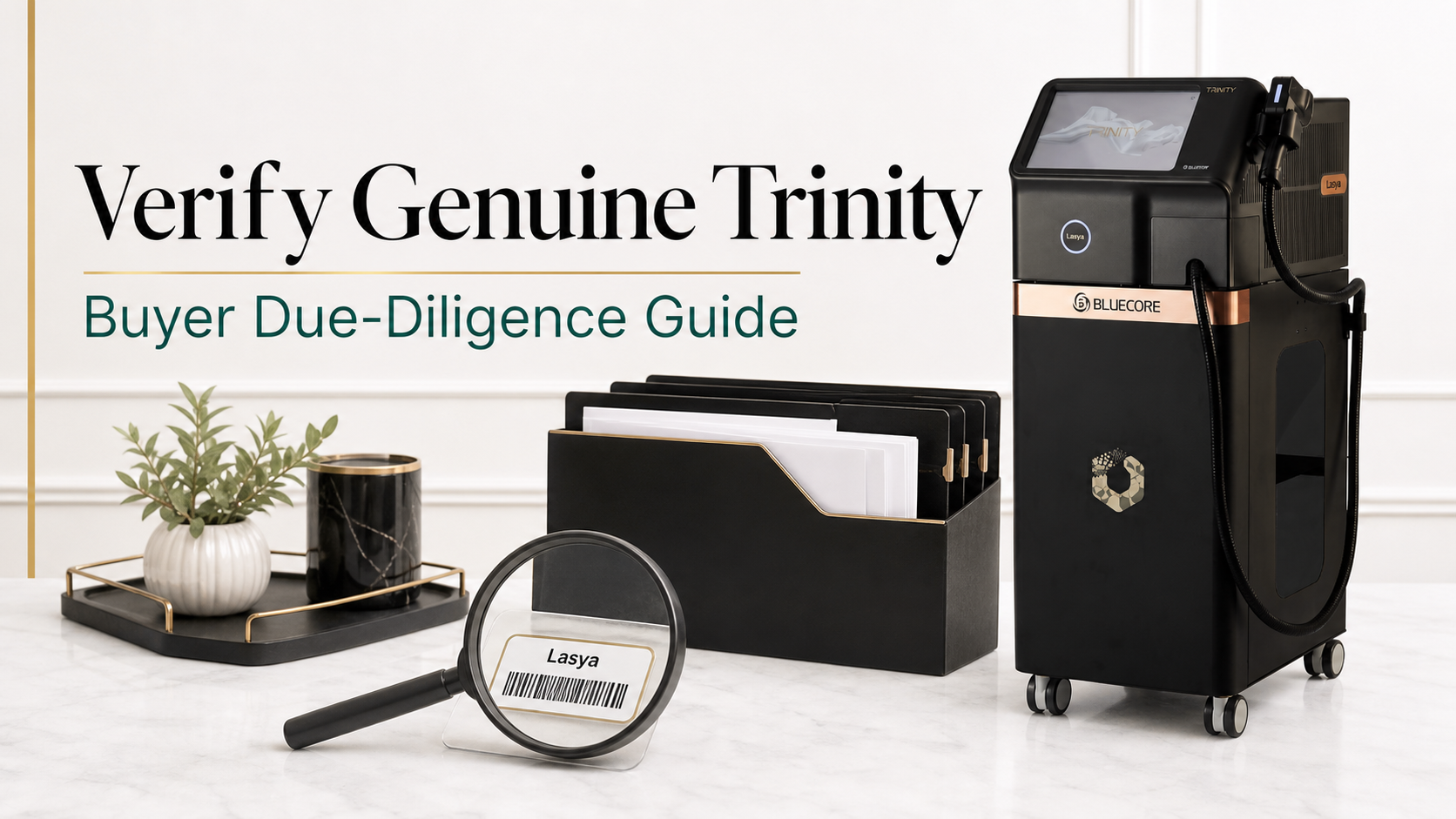
Start with the Legal Manufacturer
BLUECORE COMPANY Co., Ltd. identifies itself on its official global website as a Korean medical-laser manufacturer. Its current site lists corporate locations, a business registration number and the Trinity Liftoning product page.
The FDA K241951 database entry names BLUECORE COMPANY Co., Ltd. as applicant and identifies the device as Lasya-Trinity. The summary describes a diode-laser system with a triple 755/808/1064 nm applicator and a separate 808 nm applicator.
Ask the seller to explain in writing how the commercial name "Trinity Liftoning," the device label and "Lasya-Trinity" regulatory record relate to the exact unit being offered. Similar branding is not enough.
Check the Evidence, Not the Badge
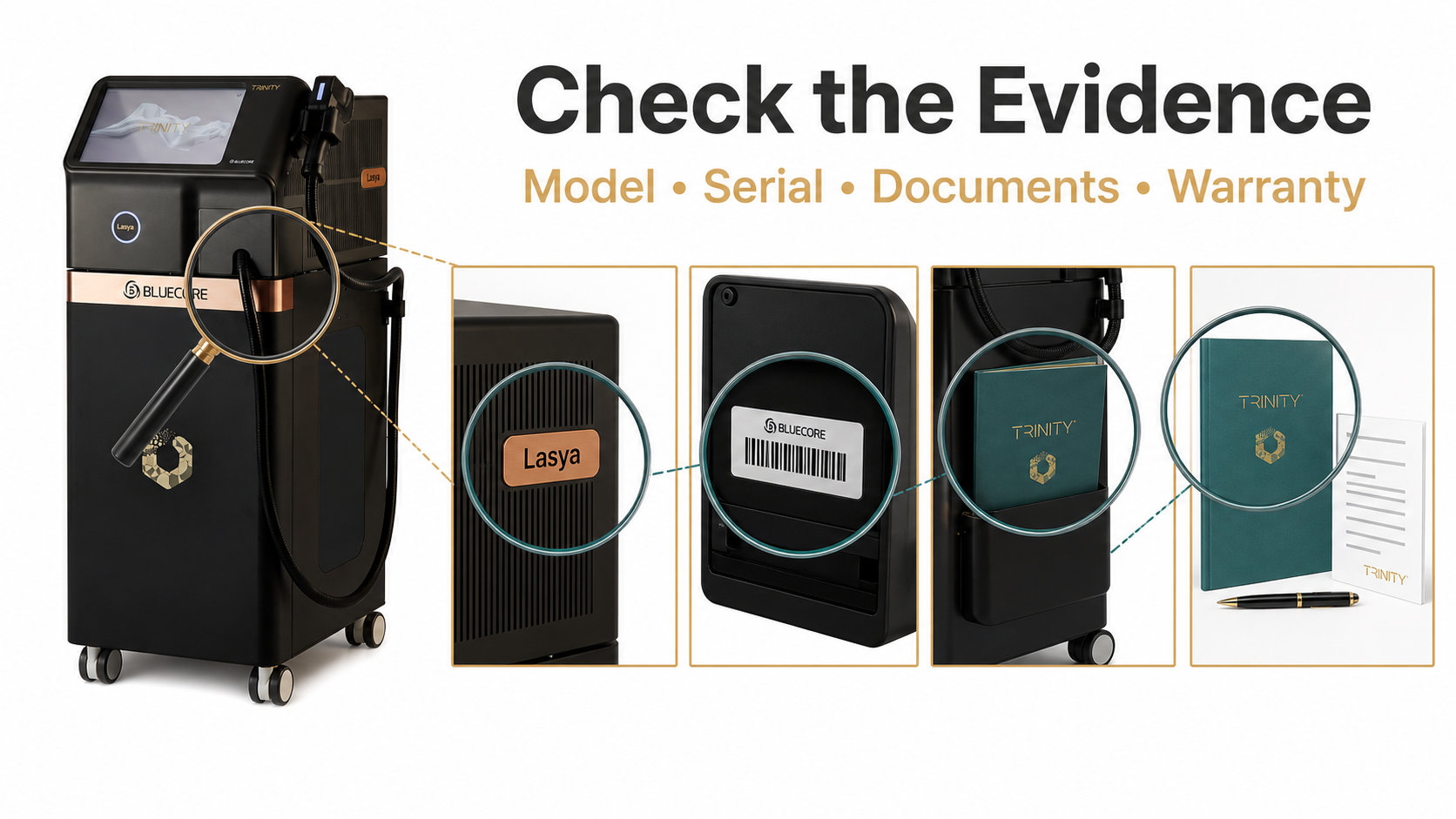
1. Model identity
Request photographs of the device label and product packaging. Match manufacturer, model, electrical rating, laser information, country of origin and any UDI or regulatory identifier.
2. Serial number
Obtain the serial number before final payment where possible. It should match the device, invoice, packing list, warranty and installation record. Ask the authorized supplier or manufacturer to confirm the serial and production status in writing.
3. Applicators
List each included applicator by name, wavelength and serial or part number. The public FDA record distinguishes the triple-wavelength applicator from the 808 nm applicator; a quotation should do the same.
4. User manual
The manual should match the model and supplied configuration. Check the document number, revision, language, indications, warnings, cleaning and maintenance.
5. Regulatory record
Search the issuing authority's database directly. For the US record, compare K241951, Lasya-Trinity, BLUECORE, product code GEX, decision date and indications. Do not accept a screenshot without a searchable source.
6. Certificate scope
Check the legal entity, manufacturing site, standard, certificate number, issuing body, scope, dates and current status. ISO explains that it develops standards but does not itself certify companies. An ISO 13485 certificate concerns a quality-management system; it is not the same as product authorization.
7. Commercial chain
Ask who purchased the device from whom and who is authorized to sell, train, install, update and repair it in your territory. The invoice seller, warranty provider and service provider should be clearly identified.
Understand Common Document Terms
| Term | What It Can Show | What It Does Not Automatically Show |
|---|---|---|
| FDA 510(k) clearance | The named device was found substantially equivalent for stated indications | Approval of every claim, every market or another model |
| FDA establishment registration / listing | A firm or device is registered or listed in the database | FDA approval; the database itself warns against that interpretation |
| CE marking | Conformity under applicable EU rules when valid and correctly applied | Automatic authorization outside the EU or proof of every brochure claim |
| ISO 13485 certificate | A certified quality-management system within the stated scope | Product performance, local registration or distributor authorization |
| Korean manufacturer licence or product record | Relevant Korean regulatory status when matched and current | Import authorization in the buyer's country |
| Distributor authorization letter | A commercial relationship within its stated territory and dates | Product registration or technical competence unless separately shown |
Verify the Supply Chain
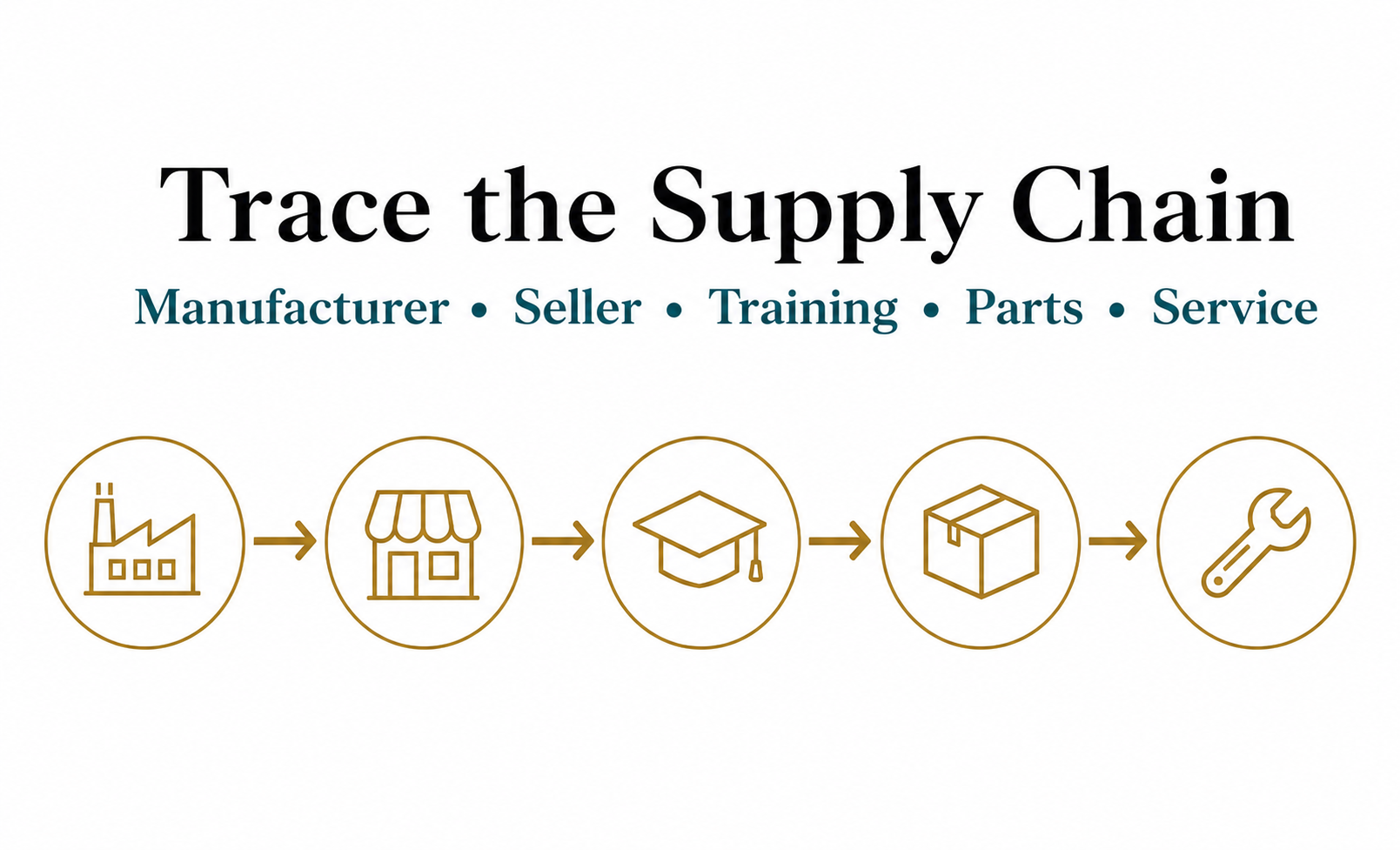
Request a written chain that answers:
- Who is the legal manufacturer?
- Who exports the unit?
- Who invoices the buyer?
- Who provides the destination importer or representative role?
- Who performs installation and training?
- Who can access diagnostics and software updates?
- Who holds spare parts and replacement applicators?
- Who decides warranty claims?
- Where is the unit repaired?
A genuine unit sold outside an authorized support route can still create serious commercial problems. Authenticity and service eligibility are separate checks.
Inspect Before Shipment or Acceptance
Use a live video inspection, independent inspection or in-person demonstration. Record:
- full exterior and label
- serial number and seals
- console startup and software identification
- included applicators and connectors
- cooling status and fault display
- footswitch and accessories
- eyewear labels
- manuals and packing list
- visible damage or modification
Do not ask an unqualified person to open the console. Internal inspection can create laser, electrical and warranty risks.
Red Flags
- Seller refuses to provide the legal manufacturer or exact model.
- One certificate is used to cover several unrelated devices.
- Serial number is missing, altered or does not match documents.
- FDA "approval" is claimed without a 510(k), De Novo or PMA record matching the device.
- The seller points only to establishment registration.
- Warranty provider and technical-service route are unknown.
- Training is limited to a short unrecorded video call.
- The price excludes essential applicators or safety accessories without saying so.
- Software, labels or casing show unexplained changes.
- Payment is requested to an unrelated personal or company account.
One red flag does not always prove a counterfeit, but it does justify stopping payment until the discrepancy is resolved in writing.
Documents to Keep for Resale or Operation
- quotation and final invoice
- commercial invoice and packing list
- serial-number and acceptance record
- product specification and current manual
- verified regulatory evidence
- manufacturer or distributor authorization
- warranty and service terms
- installation and training records
- maintenance, repair and software-version history
- adverse-event and complaint records
How Asia Pacific Beauty Group Can Help
Asia Pacific Beauty Group was established in Hong Kong in 1998 and provides professional beauty-equipment agency, wholesale and consultancy services. Buyers can review the Trinity product page, prepare cross-border questions with the overseas buying guide, and request a product-specific quotation, demonstration, document checklist, training discussion and after-sales plan through the contact page.
For overseas orders, ask the team to identify the exact seller, exporter, warranty territory and service route in the written quotation. The destination buyer remains responsible for local import and use requirements.
Frequently Asked Questions
Can I verify Trinity from a photo?
Not fully. A photo can support model and label comparison, but serial confirmation, documents, seller authorization and service eligibility are also required.
Does K241951 use the name Trinity Liftoning?
The FDA database trade name is Lasya-Trinity. Ask the supplier to document how the offered commercial product and configuration correspond to that record.
Is an FDA registration number proof of approval?
No. FDA registration and listing do not, by themselves, denote approval. Verify the relevant premarket record and indications.
Does ISO 13485 prove the machine is genuine?
No. It can support verification of a manufacturer's quality system when the certificate is valid and in scope, but it does not authenticate a specific serial-numbered unit.
Is a grey-market genuine machine safe to buy?
It may be authentic yet lack authorized warranty, parts, software, training or local compliance. Verify both authenticity and support eligibility.
This guide provides procurement due diligence, not a final authentication service or legal and regulatory advice.