
VZET HIFU Complete Guide | Principles, Cartridge Depth, Treatment Design and Comparison with New Doublo 2.0
People searching for "VZET HIFU" or "VZET invisible thread lift" (無形埋線) usually want to know three things: how the device works, what the differences between the various cartridges are, and whether it suits a salon better than New Doublo 2.0. The most important answer is this: do not buy a machine on the strength of "HIFU", "invisible thread lift" or a brand nickname alone. You must match, item by item, the full model name on the quotation, the legal manufacturer, the market version actually being sold, the instructions for use (IFU), the cartridges and the after-sales arrangements.
Publicly available information can help you understand V-ZET's market positioning, but it is not enough to complete identity and certification verification for a particular unit in stock. In particular, VZET should not be promoted loosely as "FDA certified" or "KFDA certified" before model-specific documentation has been seen.
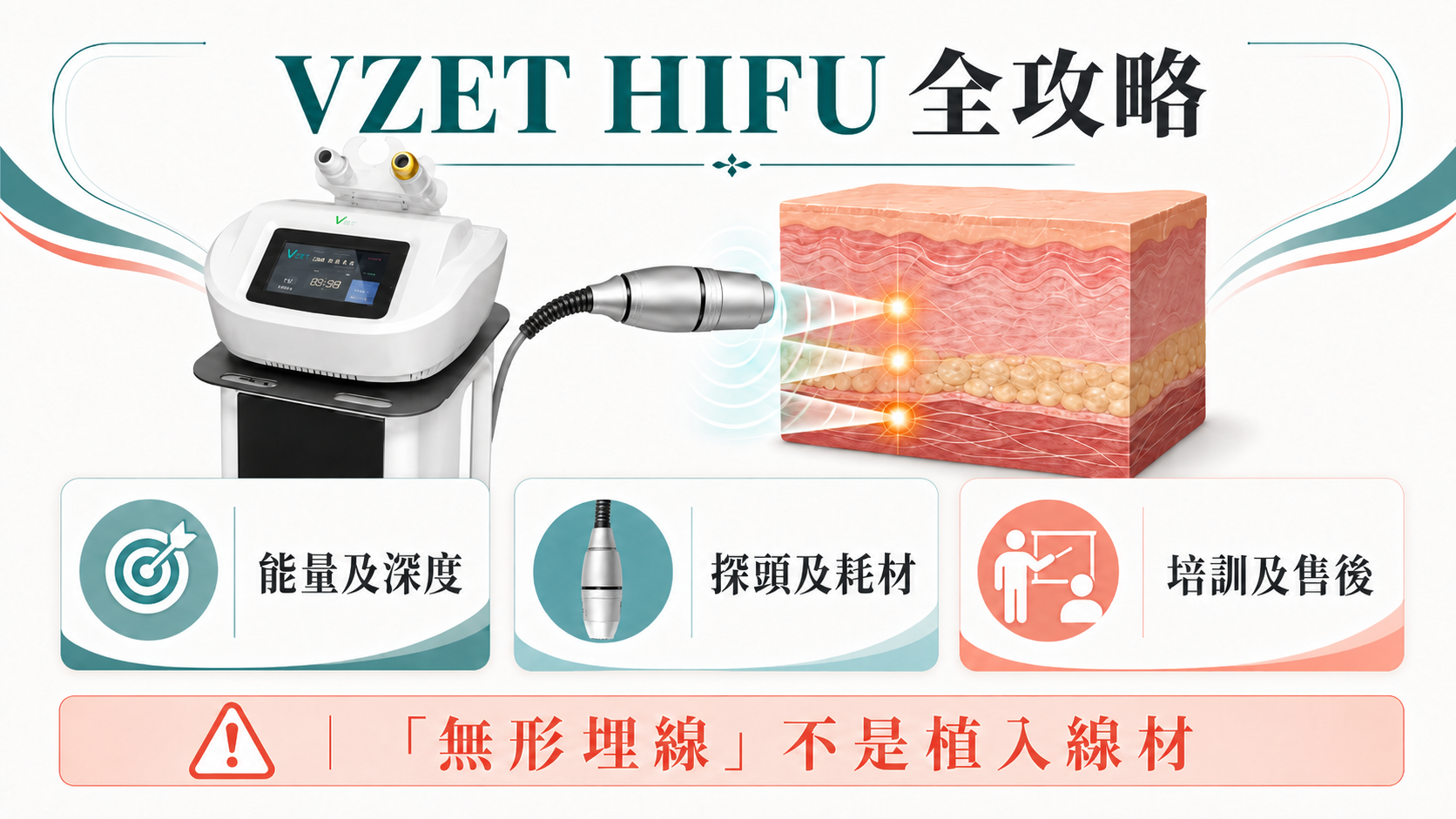
Comparison chart for salons buying VZET HIFU versus New Doublo 2.0
What is VZET? Start with the full model name
VZET is generally categorised by the market as focused ultrasound contouring and tightening equipment. Different spellings such as V-ZET and VZET can be found online, along with distributor product pages and overseas public documents, but a brand name is not the same as a complete product identity. When a salon requests a quotation, it should ask for the following information and check that it all agrees:
Identity item | What to verify |
|---|---|
Manufacturer | Legal company name, address and place of production |
Product | Full product name, model, main unit label and serial number format |
Market version | The software, handpiece and cartridge combination actually delivered in Hong Kong |
Intended use | Confirmed word for word from the manufacturer's IFU, not replaced by sales slogans |
Document chain | Whether the quotation, packing list, certificates, IFU and machine label all refer to the same model |
After-sales responsibility | Who provides training, maintenance, calibration, parts and incident escalation |
If the documents only say "HIFU machine" without a full model name, or the company on the certificate cannot be linked to the machine label, the procurement should be paused first. You may refer to the VZET product page to understand its market positioning, then ask the supplier for the original documents for the configuration currently being sold.
The basic principle of HIFU / MFU focused ultrasound
HIFU is short for high-intensity focused ultrasound; the aesthetic literature also often uses MFU, or microfocused ultrasound. The concept is to focus ultrasound energy at a designated focal point so that a localised thermal effect is produced at a selected tissue layer, thereby initiating a subsequent tissue response. It does not heat an entire section of skin evenly, nor does it place threads under the skin.
Treatment outcomes are not determined by the four letters "HIFU"; they are influenced by a number of variables together:
The exact model and transducer design
The depth marked on the cartridge and the effective focal zone
The energy and pulse pattern per line or per point
Whether linear or dot output is genuinely offered on that model
The number of treatment lines, shot count, spacing and area of coverage
Anatomical assessment, contact, coupling and the operator's technique
The client's age, subcutaneous fat, degree of laxity and individual response
Category-level HIFU research can therefore be used to explain the principles and common risks, but it cannot automatically prove the results of any particular VZET model.
How should you read cartridge depth, linear and dot output, and shot count?
Deeper is not better
The millimetre figure marked on a cartridge usually represents the design focal depth, not a guarantee of where the effect actually occurs on every client. The distribution of skin, fat and important structures differs across facial and body regions; nor should the same depth be applied wholesale to every location. Salons should require the original manufacturer's training to clearly define usable areas, areas to avoid, contact requirements and stopping criteria.
Linear and dot are output modes, not a guarantee of results
If the model currently sold in Hong Kong offers linear or dot modes, the purpose, compatible cartridges and limitations of each mode should be confirmed from the IFU. "Full coverage" or "more concentrated", as described by a salesperson, still has to be supported by measurable output, a correct protocol and product-specific documentation.
More shots does not mean better results
Shot or line count affects coverage, time, consumables and heat accumulation, but there is no single "optimal shot count" that suits every face shape. Selling on a large shot count alone may overlook anatomy, overlap, energy, comfort and risk. Procurement training should teach the assessment logic, not simply supply fixed sales packages.
"VZET invisible thread lift" does not involve implanted threads
"Invisible thread lift" or "hidden thread lift" (隱形埋線) is a marketing metaphor used to describe a non-surgical contour management direction. VZET HIFU itself does not implant absorbable threads into the skin, nor does it produce the mechanical suspension of thread-lift surgery.
More accurate client communication could be written as: "Focused ultrasound is used for non-invasive tightening and contour management; the actual sensation and results vary from person to person." It should not be written as "a genuine thread lift", "a replacement for surgery", "a permanent lift" or "surgical results in a single session". However appealing a name may be, it cannot change how the device actually works.
Does VZET work? How far can the evidence take you?
Systematic reviews and meta-analyses of focused ultrasound for facial aesthetics show overall that some subjects may see tightening or contour improvement, with common study findings mostly amounting to mild to moderate change. However, the devices, parameters, scoring, treatment sites and follow-up periods used in the studies vary considerably, and study quality is also inconsistent.
A reasonable reading in relation to VZET is:
Category-level research supports focused ultrasound as having researchable aesthetic applications, but it is not proof specific to the VZET model.
Manufacturer or agent photographs only have reference value when the photography, timing, lighting, expression and protocol are consistent.
An immediate visual change does not equal a long-term result, and a consistent follow-up assessment should be set.
No client should be promised the same magnitude of change, duration or number of sessions.
If a supplier claims a particular percentage, a fixed number of years of maintained effect, or specific study findings, ask for the full text of the study and check whether the model, cartridge, control, sample size and follow-up period in the study match exactly.
Sensation, short-term reactions and risks
During a focused ultrasound treatment there may be sensations of heat, prickling or aching; afterwards there may be temporary redness, swelling, tenderness or altered sensation. The degree and duration are affected by the model, the site, energy, technique and the individual's condition, and "no needles" cannot be taken to imply "zero risk".
Regulatory guidance and safety literature also raise concerns about more serious events such as burns, tissue damage and nerve-related symptoms. This does not mean every client will experience them; rather, it shows that proper screening, anatomy training, device output, contact and incident handling are indispensable. If worsening pain, blistering, obvious depressions, persistent numbness, facial weakness or visual symptoms occur, the treatment should be stopped and professional assessment sought as soon as possible through established channels.
Who should pause or be assessed first?
Contraindications must be governed by the IFU for the exact model and by qualified professional judgement. At consultation, at minimum the following should be actively declared:
Pregnancy, breastfeeding or significant health conditions
Infection, open wounds, severe inflammation or altered sensation at the treatment site
Implanted electronic or metal devices, as well as dental implants
Recent surgery, thread lifts, fillers, energy-based treatments or injections
Bleeding disorders, medication affecting coagulation, or a history of abnormal scarring
Neurological symptoms, facial weakness or undiagnosed lumps
This list is not permission to decide for yourself that a treatment "can be done". Any unclear case should be referred to an appropriate healthcare professional before treatment.
VZET vs New Doublo 2.0: compare against the same yardstick
The official international material for New Doublo 2.0 mentions MFU and RF-related functions, but it also notes that specifications and indications may vary by country. For VZET, the full model currently being sold must first be confirmed. The two should not be compared on brand name, machine size or "how many handpieces" alone.
Comparison item | VZET | New Doublo 2.0 |
|---|---|---|
Identity | Obtain the full model currently sold, the manufacturer and the IFU | Obtain the Hong Kong version, the handpiece list and the IFU |
Energy modes | Record only the linear, dot or other modes stated in the documents | International material mentions MFU + RF; the local combination must be confirmed separately |
Cartridge / handpiece | Verify depth, area, shot / line capacity and unit price | Verify the actual MFU, RF or other handpieces and consumables |
Evidence | Category-level research cannot substitute for model-specific evidence | A 22-subject short-term split-face study is only an early signal |
US documentation | FDA certification must not be claimed where no corresponding documentation has been seen | K251334 does not cover MFU lifting claims |
Operations | Compare consumables, time, training, repairs and downtime | Cost each handpiece and the after-sales responsibilities in the same way |
Note in particular that the US 510(k) K251334 concerns the designated RF microneedling / electrocoagulation and PS plasma handpiece uses of New Doublo 2.0, and cannot be extended into "FDA-certified HIFU lifting". The same main unit with different handpieces may have different regulatory uses.
For further comparison, you may read the New Doublo 2.0 salon buying guide and the HIFU device agency guide.
How do you calculate cartridge cost and payback?
When requesting a quotation, do not ask about the main unit price alone. First build a consumables table for each type of cartridge:
Data to ask for | Impact on operations |
|---|---|
Price per cartridge | Determines the direct consumable cost |
Total usable shots / lines | Used to estimate the cost per shot |
Opening, pairing or expiry rules | Affects stock wastage |
Typical usage range per area | Affects treatment time and pricing |
Counting and machine-lock rules | Affects management of remaining capacity |
Lead time when out of stock | Affects bookings and cash flow |
You can make a preliminary calculation as follows:
Cost per shot = cartridge price ÷ usable shot count stated in the documents
Contribution margin per session = treatment revenue − cartridge consumables − operator labour − variable costs such as payment and marketing
Rough number of sessions to payback = total equipment investment ÷ contribution margin per session
Total equipment investment should also include the first batch of consumables, training, shipping, maintenance, financing, insurance and a downtime buffer. You can use the beauty equipment payback guide to build conservative, base and optimistic scenarios.
Training, servicing and document acceptance checklist
Training
Training should cover ultrasound principles, anatomy and areas to avoid, client screening, coupling, contact, settings permissions, stopping criteria, record keeping, aftercare instructions and incident escalation. Ask clearly about refresher training for new staff, assessment and the language of training.
Servicing and output
Ask for the maintenance scope in writing, along with where engineers are based, parts lead times, software updates, cartridge recognition, output checking methods, fault response times and loan-machine arrangements. A "lifetime warranty" with no scope or time limit offers no practical protection to the business.
Regulatory documents
The FDA guidance on focused ultrasound aesthetic devices is a regulatory framework for a product category, not a certificate issued to every HIFU brand. Any FDA, Korean MFDS (still commonly called KFDA in the market), CE or other claim must be checked against the certificate holder, the full model, the intended use, the validity period and official databases; you cannot rely on a single image that cannot be traced.
Frequently asked questions
Does VZET HIFU involve a real thread lift?
No. The "invisible thread lift" spoken of in the market is a metaphor; focused ultrasound does not implant threads and is not the same as surgical thread lifting.
How often should VZET be done?
There is no universal interval. Scheduling should follow the IFU for the exact model, the area treated, the client's response, recovery and professional assessment, and a fixed frequency should not be pre-set for the sake of a package deal.
Is VZET FDA or KFDA certified?
Until official records matching the exact model sold in Hong Kong are obtained, this should not be claimed. Product-category guidance, manufacturer registration or documentation for another model do not amount to that particular VZET being approved for the same use.
Which is better, VZET or New Doublo 2.0?
There is no answer separate from context. You should compare the local version, IFU, functional gaps, client base, consumables, operating time, evidence, training, servicing and total cost of ownership. More functions does not necessarily make payback easier.
Is VZET suitable for all face shapes?
No. Suitability involves anatomy, fat thickness, laxity, health status and expectations; some cases require assessment by a qualified healthcare professional first.
Next steps in procurement
If your salon is comparing VZET, New Doublo 2.0 or other focused ultrasound equipment, it is recommended that you request all four items together — full model documentation, cartridge costs, training content and after-sales SLA — rather than screening first on the lowest machine price. You can contact the Asia Pacific Beauty team with your salon's client base, budget and existing treatments to ask about configurations, documentation and demo arrangements available for evaluation.
This article is for general beauty equipment procurement and risk education only. It is not medical advice, operating parameters or a guarantee of results. Actual intended use, operator qualifications, contraindications and premises requirements should be governed by the regulations applicable in Hong Kong, the exact product labelling and qualified professional advice.