
Beauty Device Evidence Files: Model, IFU, Training and Claims Review
A beauty device evidence file should connect the unit in the salon, the instructions staff follow, their training and the evidence behind each advertising statement. A folder of certificates alone may not establish these links. Assign an owner and make the records searchable and easy to update.
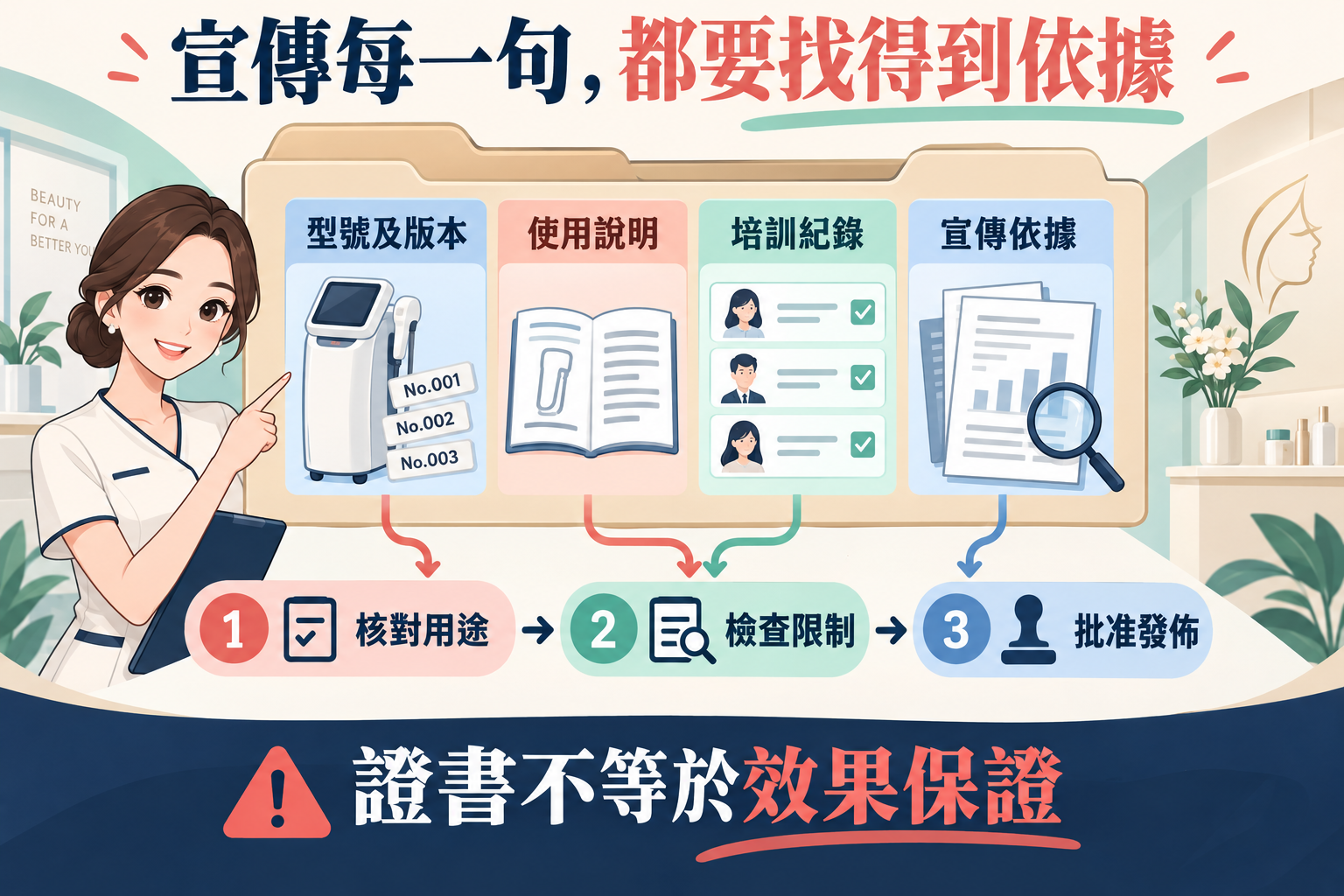
This AI-generated infographic illustrates document management. Its documents and numbers are not real certifications; the labels are in Traditional Chinese.
Start with the actual device identity
Record the manufacturer, model, serial number, location, handpieces, accessories, software, supplier and acquisition date. Keep the service name separate from the device name so records identify the configuration actually used.
Log software and accessory changes with dates and confirmation sources. Documents for another market or a similar model do not automatically apply. Sharing a brand does not establish identical uses, output, evidence or operating requirements.
Organise six groups of documents
| Group | Keep | Check |
|---|---|---|
| Identity and supply | Serial number, invoice, authorisation scope, contacts | Exact unit and relevant market |
| Instructions for use | Intended use, limitations, contraindications, maintenance | Version, language, accessories and source |
| Regulatory documents | Relevant documents and verification records | Issuer, scope, model and current status |
| Training and competence | Content, attendees, assessment, permitted tasks | Actual functions and version |
| Maintenance and safety | Faults, servicing, updates and notices | Open actions and restrictions |
| Claims and evidence | Copy, sources, limitations and approval | Evidence for each statement |
Hong Kong's MDACS is currently a voluntary listing and post-market monitoring system; check its actual scope. A listing, overseas document or quality certificate does not guarantee every beauty use or outcome. Official MDACS information
An IFU is different from a sales presentation
Instructions should support the relevant staff in understanding intended use, limitations, preparation, operation, cleaning, maintenance and safety. A brochure or video may help explain these, but should not replace confirmed manufacturer documentation.
If staff cannot understand important instructions, obtain suitable support. Label local translations and summaries with their source and version. Preserve warnings and identify missing information; the responsible person should decide any restrictions while documents are incomplete.
Maintain a version register
| Example code | Information | Action |
|---|---|---|
| IFU-01 | Document name, manufacturer version, date received | Identify the current version |
| TR-01 | Training content, date, configuration | Reassess training after changes |
| CL-01 | Copy, page, evidence, approver | Review before publication; retain revisions |
| SN-01 | Safety notice, affected units, action | Inform operators and track completion |
These are example internal codes. Retain historical documents with clear superseded labels. Give staff one designated current source rather than competing copies on phones, messages and printouts. Record who issued updates, who received them and when acknowledgement was completed.
Ask five questions about each claim
Which device, accessory and use does it describe? Is the source a study, manufacturer document or supplier explanation? Do its participants, settings, comparison and follow-up apply? What limitations or adverse reactions are missing? Does the final wording express more certainty than the source?
A finding in selected participants under defined conditions cannot become a promise for everyone after one session. Absorption, temperature and tissue mechanisms do not directly establish visible improvement. Avoid ranking devices as universally superior without relevant comparative evidence.
Record how claims are corrected
| Example wording | Problem | Action |
|---|---|---|
| Suitable for everyone; no risk | Omits assessment and limitations | Remove absolutes; explain assessment and risks |
| Certified, so every use is approved | Scope does not match the claim | State and verify the actual scope |
| Another model's study proves this unit's results | Model, accessory or use differs | Find applicable evidence or omit the claim |
| One case shows everyone's expected result | Selection and photography limitations | Describe the case and timing; retain originals |
| A mechanism proves long-term results | Mechanism and outcomes are different | Separate them and avoid unsupported inference |
Hong Kong's Undesirable Medical Advertisements Ordinance restricts certain advertisements for medicines, appliances or treatments. Applicability depends on the actual wording; do not apply rules for one product category to every beauty service. Department of Health information
Link training records to competence and scope
Record the attendee, trainer, date, configuration, instruction version, content, assessment and permitted tasks. Attendance alone does not show competence in every function. The responsible person should arrange appropriate reassessment or training after staff, configuration or significant process changes, or long periods without use.
Industry competency standards can help define roles, but a general qualification does not replace device-specific requirements. Hong Kong beauty industry standards
Review the file when something changes
New instructions, safety notices, software, accessories, service uses, advertising or staff should trigger a review. A salon can also set risk-based checks; do not describe an internal interval as a universal legal requirement.
Test one website paragraph: can staff find its source, the exact model and the relevant operator training? Mark gaps as unverified and arrange the necessary restrictions, information and approval rather than filling them with assumptions.
Frequently asked questions
Can a manufacturer poster serve as an IFU?
Not automatically. Obtain complete instructions matching the configuration.
Does certification justify a no-risk claim?
No. Certification scope and individual risks are different; explain limitations accurately.
Can evidence for one model apply to an entire series?
Not automatically. Check the model, accessories, use and study conditions.
What should training records include?
Include configuration, content, assessment and permitted tasks as well as attendance.
Should superseded documents all be deleted?
Historical versions may be retained under policy, but label them clearly and give operators current instructions.
Related reading
Connect the file to device handover, consultation and reassessment, and fair photography and consent. These links open the Traditional Chinese guides.