
Beauty Device Handover and Stop-Use Decisions: Checks and Restart Authority
Beauty equipment maintenance includes more than calling for repairs after a fault. Shift handover must explain whether the unit can be used, what remains unresolved and who may approve restart. A record reduces assumptions but does not replace instructions, qualified checks or client assessment.
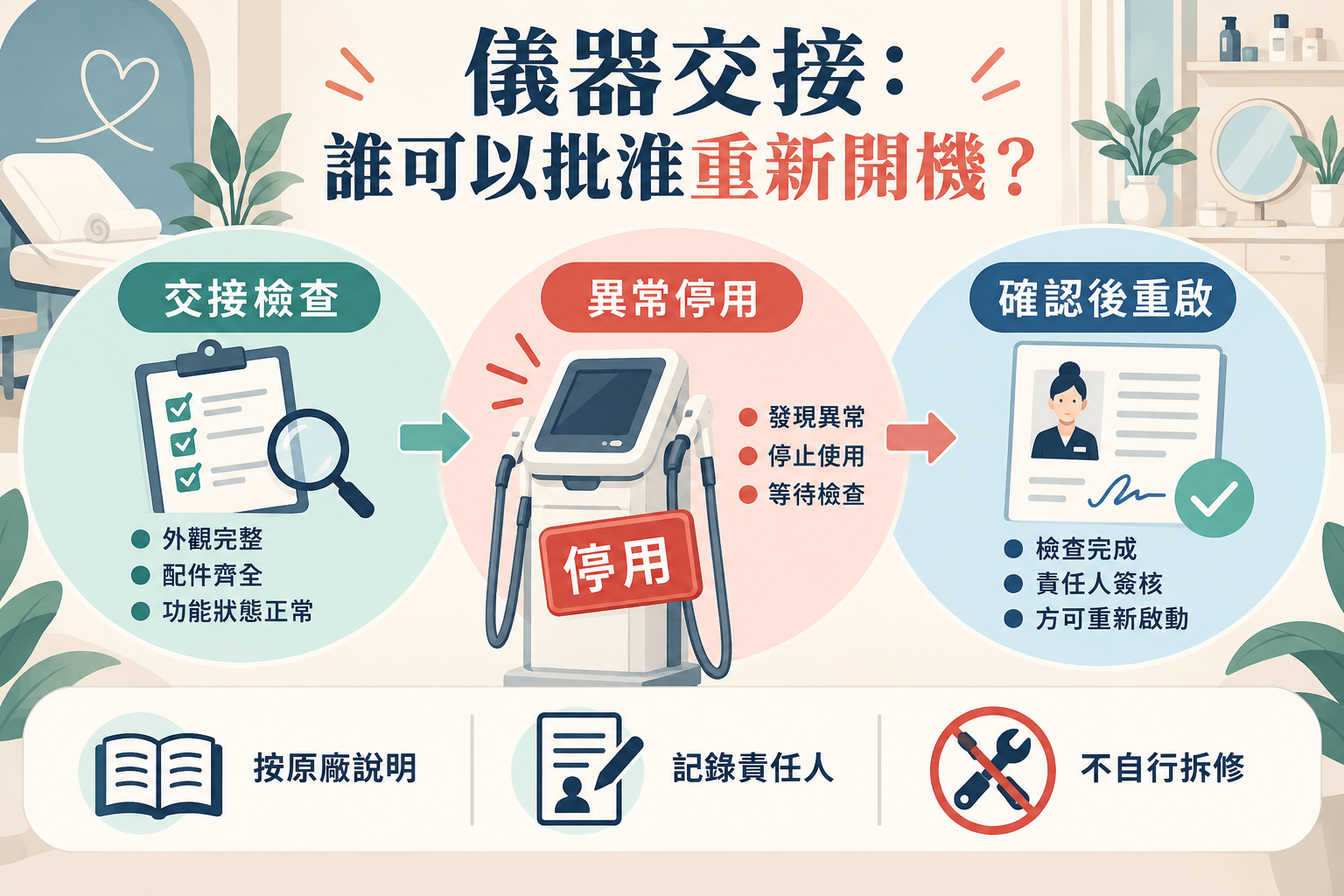
This AI-generated graphic uses Traditional Chinese labels. It illustrates management rather than a particular device's operation or repair.
Identify the unit and current documents
Matching models may have different serials, handpieces, software and servicing histories. Record the unit, configuration, instruction version and date. A generic “RF machine OK” entry cannot trace a specific accessory.
Hong Kong beauty competency standards address manufacturer-based procedures, checks and maintenance records. Begin with the actual manual and define staff tasks versus supplier tasks. Industry standards
What belongs in each shift handover?
| Field | Record | Avoid |
|---|---|---|
| Identity | Model, serial, location, handpiece | Only a service nickname |
| Exterior/connections | Manual-based casing, cable and connector checks | Unauthorised dismantling |
| Cleaning/supplies | Time, method version, replenishment | Unspecified cleaning chemicals |
| System | Self-check, prompts, error codes | Clearing errors without records |
| Open tasks | Repair reference, parts and appointments | Private-message-only history |
| Status | Available, pending verification, stopped and reason | “Probably fine” |
| Responsibility | Handover, acceptance, supervisor, approval | No decision owner |
Set checks and intervals from instructions, risk and operations rather than invent universal schedules. Tests requiring tools or qualifications belong with appropriate personnel.
Use clear status labels
Available means required checks are complete without unresolved restrictions. Pending verification means relevant functions remain out of service until uncertainty is resolved. Stopped identifies a stop-use issue or instruction. These are internal labels; substantive decisions follow instructions and responsible advice.
A dropped handpiece without a visible crack may still need checking. Record the event, restrict it and obtain advice. Do not assume another handpiece can be used without confirming the device's design and support instructions.
Handle unexpected faults safely
Unusual smell, leaks, damaged cables, heat, repeated errors or unexpected output warrant manual-based stopping and escalation. Do not repeatedly reboot, raise settings, bypass warnings or use clients to test whether the fault disappeared.
When safe, retain time, identity, function, error message, circumstances and actions. Label restrictions and block bookings or access. If someone is unwell, prioritise assessment and use the incident process.
Share necessary fault information rather than complete client records. Before following diagnostic instructions, confirm staff competence and safe conditions. Maintain restrictions when requirements remain unclear.
Who may approve restart?
The designated salon responsible person authorises release, with suitable written technical findings where servicing, output or safety functions are involved. Management approval does not replace technical judgment. A disappearing warning, a casual suggestion or an arriving client is insufficient.
Check the cause and correction, configuration changes, required tests, new instructions, training needs, approver and date. Specify unresolved restricted functions rather than summarise everything as repaired.
Define cleaning, maintenance and repair roles
Trained staff perform permitted cleaning and exterior checks. Calibration, internal parts, output tests and electrical work follow the relevant technical requirements. Staff should not dismantle units or mix parts to reduce downtime.
Each unit needs its own cleaning, fluid-path, filter, consumable and software requirements. Supplier response times, replacement units and downtime costs belong in the maintenance/SLA guide.
Test handover with a simulation
Use a fictional pending-verification situation without confusing it with a real device status. Ask incoming staff to identify the unit, restriction, contact and approval requirements. If they still need to find whoever remembers the event, improve the record.
Retain process versions and training. Managers can sample missing fields, repeated errors and approval records to identify ongoing weaknesses.
Frequently asked questions
Should staff dismantle the unit daily?
No. Perform permitted manual-based checks without unauthorised dismantling.
Can a reboot without errors release a stopped unit?
Not alone. Check the cause, required tests and approval.
Does a one-unit salon need handover records?
Yes. A simple record can still identify status, responsibility and open tasks.
Does cleaning establish safety?
No. Cleaning, functional checks, servicing and fault handling are separate.
What if technical advice is verbal?
Obtain a retained finding and permitted-use scope for responsible approval and handover.
Related reading
Connect installation checks and the evidence file to keep unit, staff and process records aligned.