
Facial EMS Pre- and Post-Treatment Care: Consent, Imaging and Records
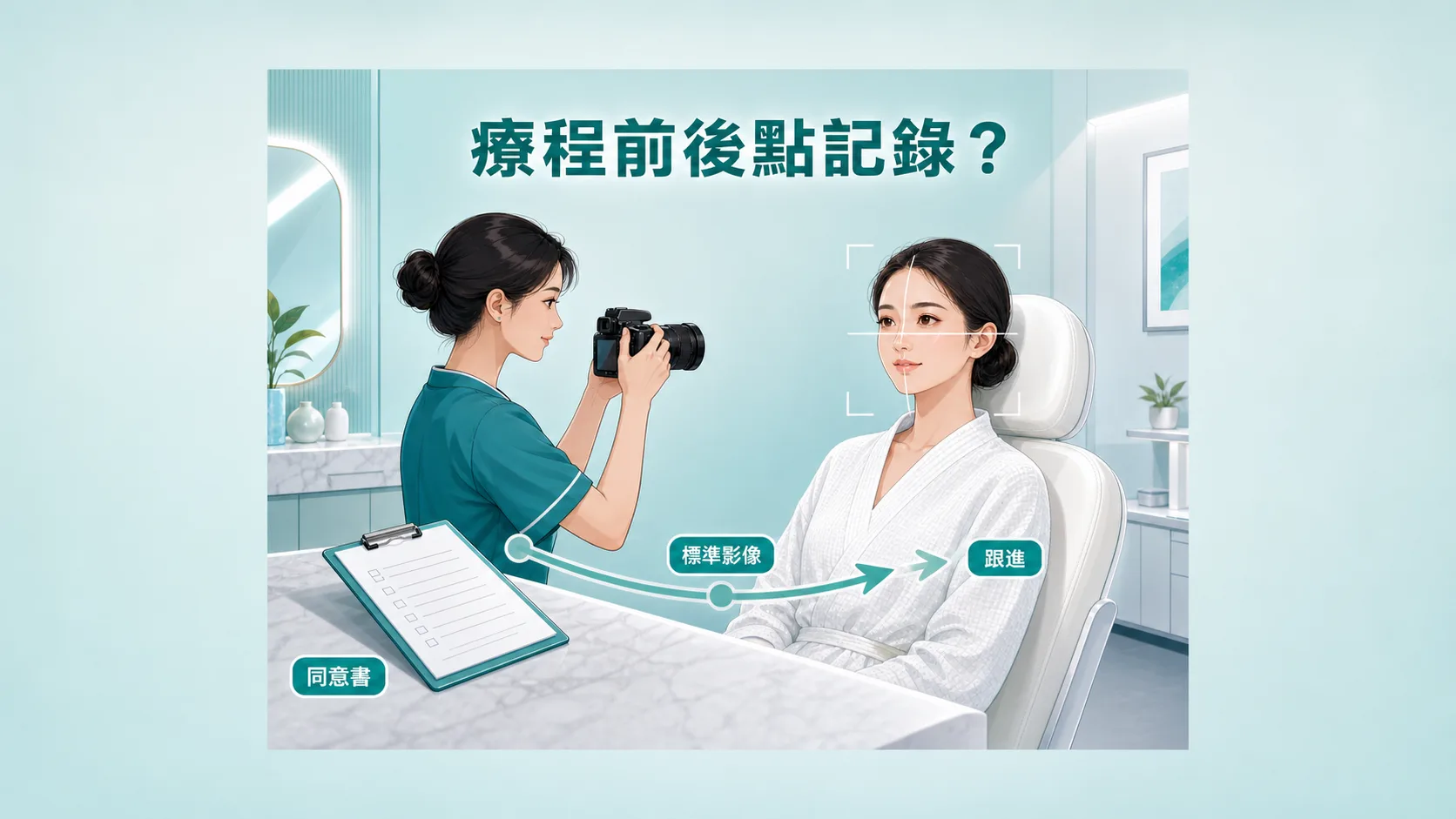
The part of the PRS Global Open facial EMS case series most worth borrowing is not the result. It is the method.
What allowed the study to survive peer review was three quite concrete things: fixed imaging conditions, session-by-session parameter records, and written informed consent. All three are within reach of any salon — and doing them improves not only treatment consistency but your ability to handle any future dispute.
1. Why copy the study's record-keeping
Start with the counter-example. The authors concede in their limitations that session-level stimulation outputs were not uniformly archived, leaving them unable to reliably reconstruct cohort-wide parameter ranges or means. They also acknowledge that although a standardised imaging system was used, no mandibular stabilisation was applied, so minor variations in chin position may have influenced the observations.
If a peer-reviewed study with a dedicated imaging system still left those two gaps, it is easy to imagine what happens in a salon relying on memory and casual snapshots.
The good news is that closing both gaps costs very little. It only requires fixing them into the process.
2. Before treatment: a six-step consultation
| Step | Content | Record that must exist |
|---|---|---|
| 1 | History taking: work through the contraindication list item by item | The client's written answers to each item, not one verbal question |
| 2 | Treatment area inspection: active infection, wounds, rash | Findings and date |
| 3 | Injection history: date and site of the most recent filler or botulinum toxin | Specific date and site |
| 4 | Expectation setting: this is appearance care, not a medical procedure; results vary | Confirmation that this was explained |
| 5 | Written consent: treatment, expected sensations, risks, image use | The client's signed consent form |
| 6 | Baseline imaging where applicable | Taken under the fixed conditions in section 3 |
The detailed contraindication list behind steps 1 to 3 is in facial EMS treatment protocol and contraindications.
What consent should cover: the nature and sequence of the treatment; expected sensations (transient muscle contraction and warmth); known general risks and contraindications; a statement that results vary between individuals; the scope of image capture and use — internal records, and separately whether the client agrees to marketing use, which should be a separate tick box; the retention period for personal data and how it can be accessed; and the client's right to withdraw consent at any time.
Note the last two. Hong Kong's Privacy Commissioner for Personal Data has issued specific guidance for the beauty industry on collecting and using client data. Client photographs are personal data, the purpose must be stated at collection, and marketing use requires separate, explicit consent — it cannot be bundled into general treatment consent.
3. Standardised imaging: conditions matter more than equipment
The study used the Janus Pro imaging analysis system, capturing frontal and left and right oblique views with a neutral expression and closed eyes, repeated before treatment and approximately one month after the 10th session under identical lighting and positioning conditions.
A salon does not need a professional imaging system, but it does need to fix the conditions:
| Condition | How to do it | Common mistake |
|---|---|---|
| Lighting | Fixed lamp position and colour temperature; exclude daylight from windows | Shooting at different times of day, so light differences read as results |
| Angle | Frontal plus left and right oblique, camera height fixed | Handheld shots at a different angle each time |
| Expression | Neutral, eyes closed; smiling shots form a separate set if needed | One neutral shot before, one smiling shot after |
| Head position | A fixed reference point such as a wall marker or chin position cue | The study's own gap — without mandibular stabilisation, posture affects perception |
| Distance | Fixed shooting distance and focal length | Zooming in and out freely |
| Timing | Before treatment, and at a fixed interval after completion | Re-shooting only on the day it looks best |
| Make-up | Always photograph after make-up removal | Bare face before, made-up after |
Head position deserves particular attention, because that is exactly what the authors flagged. A chin pushed slightly forward or drawn back changes the apparent midface and perioral relationship — that is posture, not result.
4. During treatment: what to record
Record at least six things per session: date and operator; treatment areas and sequence; the parameter settings actually used; session duration; the client's immediate response and any discomfort; and the intended adjustment for next time.
If the device supports parameter export, use the export rather than writing it out by hand. The problem with handwriting is not accuracy — it is that it usually does not get done.
This record serves three purposes: it lets the next session continue rather than start over; it prevents a break in service when the operator changes; and it gives you a session-by-session objective record if a client ever raises a question.
5. After treatment: client guidance and follow-up
The study records that the only common sensations were transient muscle contraction and warmth during treatment, resolving immediately afterwards, with no erythema, oedema or persistent pain, and no downtime or post-procedure intervention required. That said, with only 7 participants concentrated in the 24–39 age range, the sample cannot cover every situation.
Practical post-treatment guidance:
- Explain the sensations that may occur and that they are typically brief
- Advise the client to contact the salon, and seek medical attention if needed, should persistent redness, swelling, pain or any unusual sensation occur
- State the recommended interval before the next session (the study protocol used 1–2 weeks) and book it there and then
- Remind the client that immediate appearance can vary with their condition on the day, and to avoid judging from a single observation
That last point is the heart of expectation management. Saying "results take time and vary between individuals" before the treatment rather than after it is by far the easier path.
6. Compliance requirements for before-and-after photographs
| Requirement | In practice |
|---|---|
| Written consent | Marketing use requires separate, explicit consent, distinct from treatment consent |
| State individual variation | Mark every comparison set with a note that results vary between individuals |
| Consistent capture conditions | Lighting, angle, distance, expression and make-up must match; do not optimise only one image |
| No retouching | No filters, smoothing, liquify or any editing |
| No effect figures | The study made no objective measurement; any percentage or multiple is fabricated |
| No implied medical benefit | Do not use words such as treat, therapeutic effect or cure |
| Withdrawable | Stop using and remove the images once consent is withdrawn |
A specific caution: the PRS Global Open paper is published under a CC BY-NC-ND 4.0 licence, which prohibits modification and commercial use. The patient before-and-after photographs in that paper (Figures 1–3) may not be used in any marketing material. The full explanation is in our breakdown of the facial EMS clinical study; complete wording guidance is in our salon marketing compliance guide.
Frequently Asked Questions
Is there downtime after a facial EMS treatment?
In that study, none of the 7 participants experienced erythema, oedema or persistent pain, there was no downtime, and no post-procedure intervention was needed; the only common sensations were transient muscle contraction and warmth during treatment, resolving immediately afterwards. With only 7 participants concentrated in the 24–39 age range, however, the sample cannot cover every situation, and clients should still be told to contact the salon and seek medical attention if discomfort persists.
Do before-and-after photographs require written client consent?
Yes, and consent for marketing use should be separate from treatment consent. Client photographs are personal data, the purpose must be stated at collection, and marketing use requires separate, explicit consent that cannot be bundled into a general treatment consent form. The form should also state the retention period, how the client can access the data, and their right to withdraw consent at any time, after which the images must no longer be used and should be removed.
Can standardised photographs be taken without a professional imaging system?
Yes. What matters is fixing the conditions, not spending on equipment: fixed lamp position and colour temperature, fixed camera height and distance, frontal plus left and right oblique views, neutral expression with eyes closed, make-up always removed, and a head-position reference point such as a wall marker. The limitation the authors themselves flagged was the absence of mandibular stabilisation, which makes the head-position reference the single most worthwhile addition.
Do parameters have to be recorded every session?
Strongly recommended. The authors concede in their limitations that session-level stimulation outputs were not uniformly archived, which left them unable to reconstruct parameter ranges — a clear demonstration of the cost of not recording. At salon level there are three practical benefits: the next session continues rather than starts over, service does not break when the operator changes, and there is an objective record if a client raises a question. Where the device supports export, use it rather than transcribing by hand.
Conclusion: records are the cheapest professional investment
Salons looking to build a professional image usually think first of fit-out, equipment or certificates. In an actual client relationship, though, what builds trust most reliably is a session-by-session record — when a client asks what was done last time, which settings were used and how they reacted, you can answer.
That record needs no expensive system, only a process fixed in place: an intake form, a consent form, photographs under fixed conditions, and parameters logged each session. The same method carried a study through peer review. In a salon, the same method produces consistent service quality and a record that can be checked.
For Titan treatment record templates, a reference consent form format or training arrangements, contact us to request them.
This article is general operational reference for beauty salons and does not constitute medical or legal advice. Collection and use of personal data should follow the Personal Data (Privacy) Ordinance and related guidance in Hong Kong, and marketing content must comply with the Trade Descriptions Ordinance. Treatment sensations and appearance changes vary between individuals, and operating requirements should follow the official product documentation and supplier training.