
Facial EMS vs RF vs HIFU: What Each Energy Actually Reaches
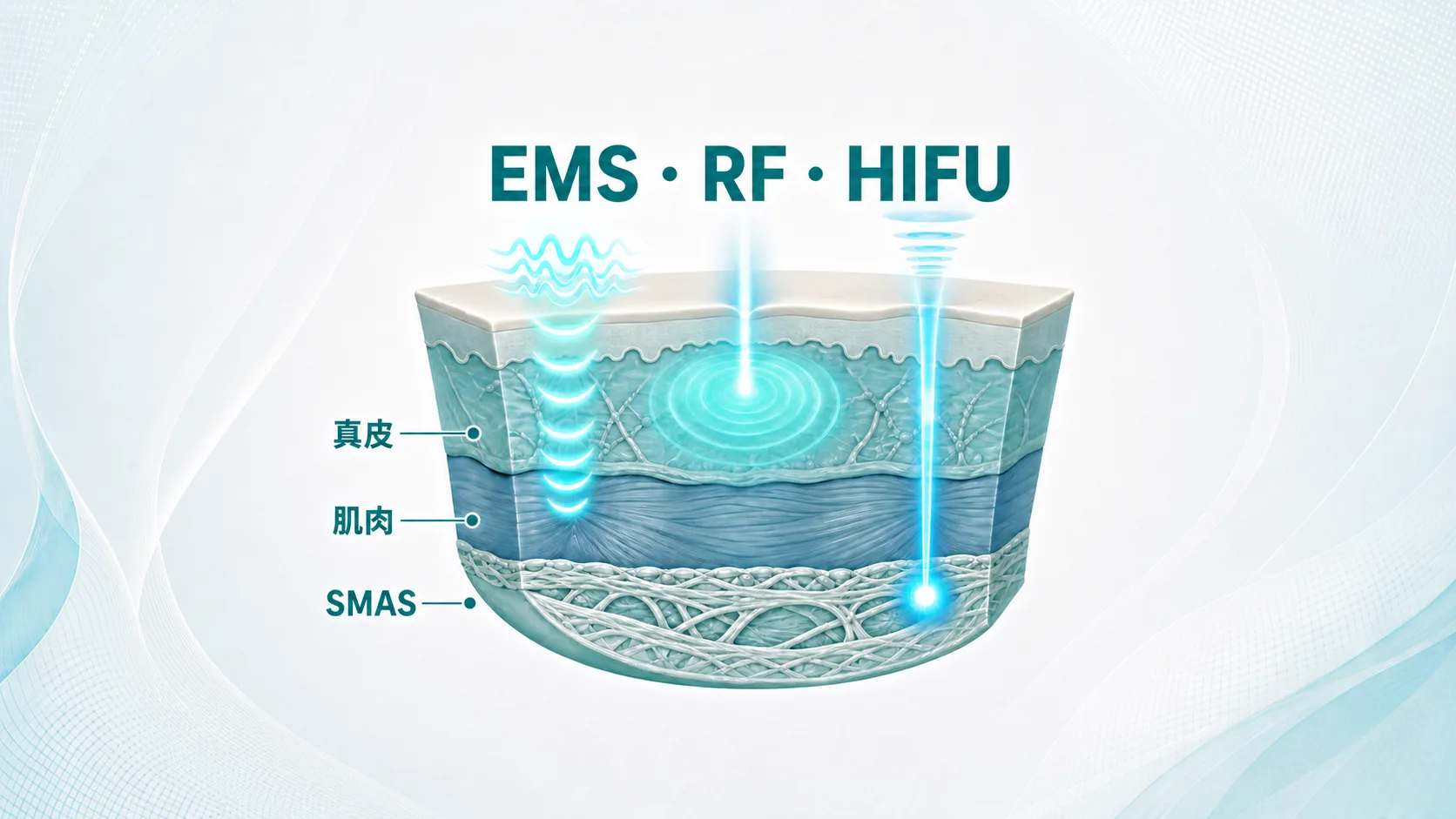
Beauty equipment brochures routinely list EMS, RF, HIFU and microcurrent on the same line, as though they were different intensities of the same thing. In reality they act on completely different tissue layers, and what each can and cannot do differs accordingly.
For a salon the value of understanding this is not academic. It comes down to three practical things: how you sequence treatments, how you explain them in consultation, and what you should be asking manufacturers at procurement.
1. First, what each of these four energies actually does
One sentence for each:
- EMS (neuromuscular electrical stimulation, NMES): uses electrical current to depolarise motor nerves and evoke muscle contraction. It addresses muscle recruitment and tone.
- Radiofrequency (RF): current meeting tissue impedance generates heat, warming the dermis and subcutaneous tissue. It addresses collagen and tissue firmness.
- HIFU (high-intensity focused ultrasound): focuses ultrasound at preset depths to create discrete thermal coagulation points, targeting mainly the SMAS layer.
- Microcurrent: microampere-level current, deliberately below the motor threshold, producing no visible muscle contraction — low-intensity stimulation at the cellular level.
Put differently, the first three correspond to three different depths — muscle, dermis, fascia — while the fourth is not even on the same intensity scale.
2. The four energies by tissue layer
| Energy type | Primary tissue layer | Physical mechanism | Typical sensation during treatment |
|---|---|---|---|
| EMS / NMES | Mimetic muscle (muscular layer) | Current depolarises motor nerves, evoking contraction | Visible rhythmic muscle contraction, mild warmth |
| Radiofrequency | Dermis and subcutaneous tissue | Resistive heating from tissue impedance | Sustained, gradually building warmth |
| HIFU | SMAS layer and deep dermis | Focused ultrasound forms coagulation points at set depths | Brief, pinpoint deep prickling or heat |
| Microcurrent | Cellular level (sub-sensory) | Microampere current, below motor threshold | Usually barely perceptible |
The most practically useful column here is the last one: what the client feels is itself a clue to the mechanism. If a treatment claims to "train the facial muscles" but produces no visible muscle contraction at all, then physically it is not doing what EMS does.
3. EMS and microcurrent: the pair most often confused
These two get grouped together because both involve electricity. The distinction is fundamental, and it comes down to current magnitude and whether the motor threshold is crossed.
| Aspect | EMS / NMES | Microcurrent |
|---|---|---|
| Current magnitude | Milliampere (mA) range | Microampere (µA) range, typically under 1 mA |
| Evokes muscle contraction | Yes, and it should be visible | No — deliberately kept below motor threshold |
| Primary target | Motor nerves and muscle recruitment | Low-intensity stimulation at cellular level |
| Client sensation | Distinct contraction | Barely perceptible |
For reference: in the EVE Titan facial EMS case series published in PRS Global Open, the single case with a complete parameter record used 3–200 Hz, 60–75 V and 120–150 mA. Note that those are milliampere-range figures, an entirely different scale from microcurrent. Our full reading of that study is in breaking down the facial EMS clinical study.
One caution: those figures come from a single case. They are not general parameters and should not be treated as a setting recommendation for any device.
4. The physiological rationale behind facial EMS
Facial ageing is not only a matter of skin and fat. Alongside bone resorption, fat redistribution and dermal thinning, the tone and coordination of the mimetic muscles also change with age. Reduced baseline muscle activity or altered recruitment patterns may contribute to drooping oral commissures and loss of periocular tone.
Facial EMS is aimed at that layer — using repeated stimulated contractions to improve motor-unit recruitment efficiency and coordination. The two muscle groups targeted in the EVE Titan study were selected on exactly this logic:
- The lip elevator complex (levator labii superioris, zygomaticus major and minor): responsible for upper-lip elevation and the smile arc
- Orbicularis oculi: responsible for eyelid closure, and providing dynamic support to the lower eyelid and midface
One distinction must stay explicit. The rehabilitation literature on NMES in facial palsy, Bell's palsy and post-stroke facial dysfunction consists of medical-use studies. That literature can support the biological plausibility of the mechanism, but it cannot be restated as evidence that a salon may address such conditions. Aesthetic use and medical use are separate things.
5. Why "which one is best" is the wrong question
Because they are not solving the same problem.
| Client's stated concern | Corresponding tissue layer | More relevant energy type |
|---|---|---|
| Skin texture, fine lines, firmness | Dermis | Radiofrequency |
| Contour descent, laxity | SMAS fascia | HIFU |
| Lack of expressive support, drooping commissures, tired look | Mimetic muscle | EMS |
| Routine maintenance, post-procedure soothing | Cellular level | Microcurrent |
This is also why many recent devices take a combination approach — Titan, for instance, integrates radiofrequency, EMS and microcurrent, the intent being to address more than one layer with one machine rather than forcing a single energy to answer every concern.
If your question is "which treatment should this particular client have" rather than "how do these technologies differ", that is treatment selection — see our Trinity vs HIFU vs RF treatment selection guide.
6. What to ask at procurement
Once the mechanism is clear, the procurement conversation can move on from "is this machine any good" to questions that can actually be verified:
- What is the actual output range of the EMS module? (frequency, voltage, current ceiling)
- Is there impedance feedback? Facial tissue impedance varies considerably; without feedback, stable output is unlikely.
- Can parameters be recorded or exported? This directly determines whether you can reproduce last session's settings.
- Which energy does each treatment head correspond to? Do not accept a vague "three-in-one" description.
- Does manufacturer training cover electrode placement? EMS outcomes depend heavily on anatomical placement; electrodes are not simply stuck on.
The full specification checklist is in 9 specification questions to ask before buying a facial EMS device; session counts and contraindications are in facial EMS treatment protocol and contraindications.
Frequently Asked Questions
Are facial EMS and microcurrent the same thing?
No. The difference lies in current magnitude and whether the motor threshold is crossed. EMS operates in the milliampere range and is designed to evoke visible muscle contraction; microcurrent operates in the microampere range and is deliberately kept below the motor threshold, so clients usually feel almost nothing. They act on different layers for different purposes and should not be conflated in marketing.
Is a machine with EMS, RF and microcurrent necessarily better than a single-function device?
Not necessarily. The value of a combination device is that it can address more than one tissue layer, but the actual specification of each module is what matters. At procurement, ask for the output range of each energy and the mapping of each treatment head to be listed separately, rather than accepting a blanket "three-in-one" description. Number of functions and real-world performance are not automatically related.
Can EMS replace HIFU or radiofrequency?
No, because they act on different tissue layers. EMS targets mimetic muscle, RF targets the dermis, and HIFU targets the SMAS layer. The relationship between them is division of labour, not substitution. Any claim that one energy type can replace all the others is inconsistent with its physical mechanism.
Is facial EMS supported by clinical research?
There is relevant research, but its level should be stated honestly. An exploratory case series using EVE Titan was published in PRS Global Open in 2026, documenting qualitative observations in 7 adults who completed 10 sessions, with no adverse events; the authors explicitly describe the findings as hypothesis-generating. There is also an earlier facial EMS randomised controlled trial (Kavanagh et al., 2012). Our detailed reading is in breaking down the facial EMS clinical study.
Conclusion: ask about the layer before you ask about the brand
Equipment comparisons so often turn into people talking past each other because the conversation jumps straight to brand and price, skipping the question of which tissue layer the machine actually reaches.
Sort out the layers first, and every subsequent judgement becomes easier: how to combine treatments, how to explain them in consultation, how to write marketing copy that does not overstate, and which specifications genuinely need verifying at procurement.
To review the actual module configuration and treatment-head mapping of Titan, or to arrange a demonstration, contact us directly.
This article is general operational and procurement reference for beauty salons and does not constitute medical diagnosis, treatment or health advice. The mechanisms described are technical explanations and do not represent any promise of results. Product functions, treatment areas, contraindications and operating requirements should follow the official product documentation, supplier training and the regulations applicable in your jurisdiction. Treatment sensations and appearance changes vary between individuals.