
Sensitive Skin: Product Trials, Medical Patch Tests and Facial Assessment
One drop without immediate stinging does not establish suitability for the entire face, repeated use or device-assisted infusion. A small-area product trial observes tolerance; medical patch testing investigates contact allergy. Begin with stable skin, introduce one product at a time and retain complete product and reaction information.
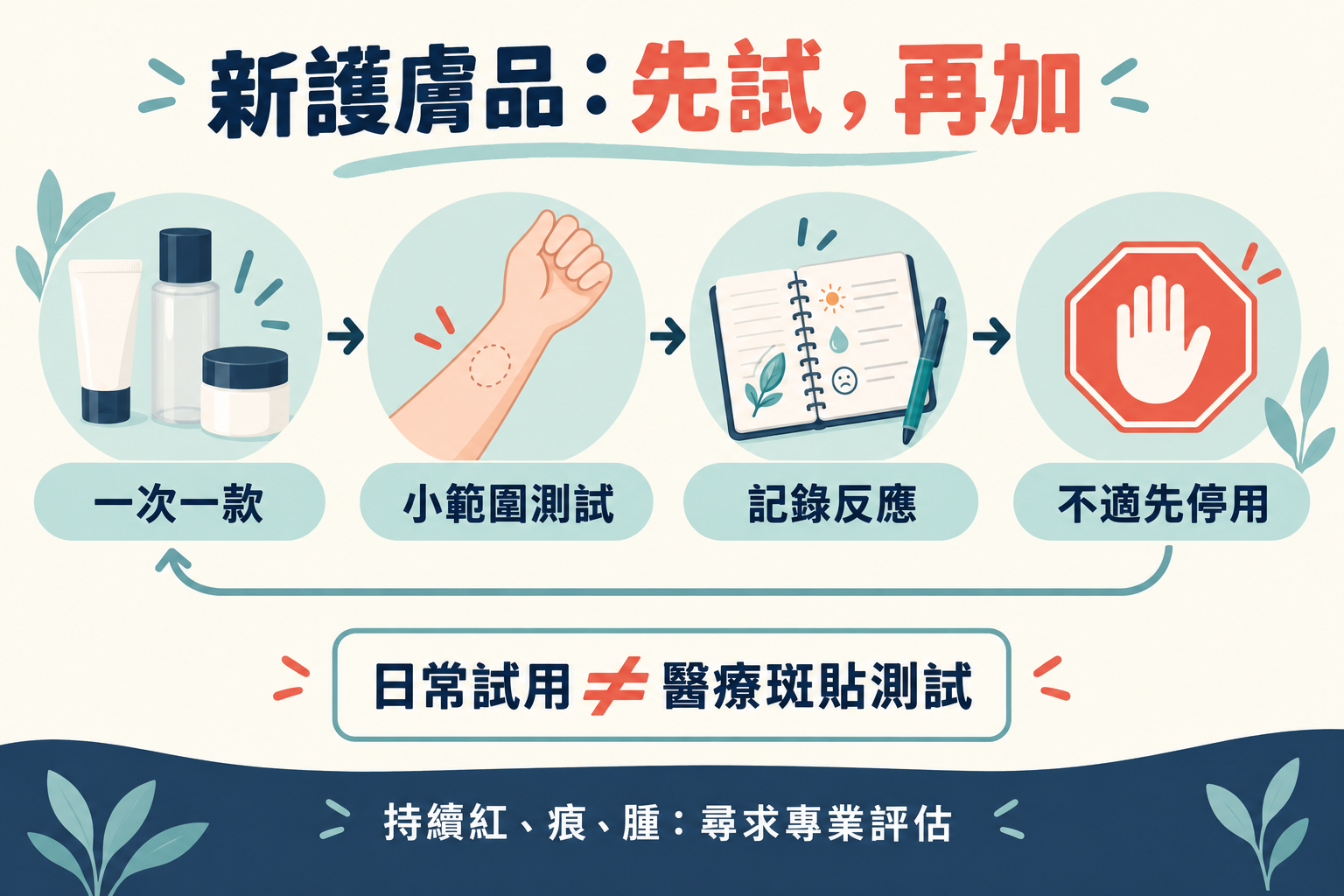
This AI-generated diagram uses Traditional Chinese labels and does not show a medical testing protocol.
Sensitivity does not always mean allergy
Dryness, redness, itching, pain or swelling may involve irritation, allergy or another skin problem. Timing alone does not identify the cause. Persistent, recurrent or severe reactions require appropriate medical assessment.
DermNet's contact dermatitis information explains differing causes and barrier-related irritation. Do not dismiss painful redness as detoxification or diagnose an allergen for a client without assessment.
Three different kinds of testing
| Situation | Purpose | Does not establish |
|---|---|---|
| Everyday small-area trial | Observe a product reaction | Safety on the face, injured skin or with infusion |
| Medical patch testing | Investigate contact allergy | Every irritation or skin diagnosis |
| Device-procedure test | Assess under particular instructions | Product-allergy diagnosis or complete suitability |
DermNet patch-test information distinguishes this from skin-prick testing. A salon trial is not diagnostic patch testing. Do not obtain allergens and imitate a medical occlusion test at home.
Prepare an everyday trial on stable skin
Read the label and confirm the intended use and application method. AAD describes observing a normal amount and normal leave-on or wash-off use on a small area over several days, rather than concluding after one application. AAD product-testing information
This approach does not automatically apply to strong peels, products needing dilution, prescriptions, injection products or broken skin. Known allergy, active disease or severe reactions warrant advice before re-exposure. A trial cannot guarantee no subsequent reaction.
Change one product at a time
Avoid replacing cleanser, acids, brightening serum, sunscreen and mask together. Keep tolerated basic care and add one item following its label and relevant advice, allowing observation before another change.
For example, a serum may seem tolerated before an exfoliating facial is added and stinging develops. That sequence alone does not prove serum allergy. A complete timeline helps assess combined irritation rather than reduce the history to “sensitive skin”.
Keep a useful reaction diary
| Field | Record |
|---|---|
| Product | Full name, ingredients, batch and expiry |
| Method | Site, amount, frequency, leave-on or wash-off |
| Timeline | First use, reaction onset, stopping and changes |
| Observations | Visible redness, swelling or peeling and original photos |
| Sensations | Itching, stinging and pain separately |
| Other changes | Products, medication, procedures, sun and lifestyle |
Avoid filters in photos and use consistent light and angles. Bring the actual product and label to assessment instead of relying on broad terms such as natural ingredients.
Stop and obtain help when needed
Stop a product causing a reaction and follow appropriate advice. Worsening redness, blisters, marked pain, discharge or eye involvement need medical assessment. Breathing difficulty, throat swelling or fainting needs urgent help; Hong Kong emergency services can be reached on 999.
Do not use strong acids to renew irritated skin, repeatedly re-test a suspected product or book equipment care as an immediate rescue. Medication decisions belong with the prescribing professional.
Prepare for a facial consultation
Bring recent procedures, products, known allergies and previous reactions. State whether skin is currently painful or inflamed. Ask about every solution, contact component and step. Everyday tolerance does not establish suitability when a procedure changes the barrier or delivery conditions.
Salons should record client statements, observations and the assessment decision with a postponement and referral route. An operational process is more meaningful than a sensitive-skin label.
Frequently asked questions
Are natural ingredients allergy-free?
No. Full formulation and individual history still matter.
Does no noticeable scent mean no fragrance ingredients?
Not necessarily. Read the label rather than judge by smell alone.
Does a successful trial permit use after a laser?
No. Skin condition and use context differ; follow the treating professional's advice.
Can medical patch testing be imitated at home?
No. Allergen choice, concentration, procedure and interpretation need medical arrangements.
Can a cleansing facial resume as soon as redness fades?
Confirm recovery and the cause first. No visible redness does not establish immediate suitability for added irritation.
Related reading
Read the water-facial comparison, post-treatment sunscreen guide and CEBELIA comparison. This is general education, not a personal diagnosis or prescription.