
Trinity Liftoning Combination Treatment Planning Guide
Combination treatment should not mean placing every available device into one appointment. A valid combination plan has a defined client concern, a reason for each component, a sequence, a recovery gate, separate contraindication checks and an outcome-review point.
For Trinity, product-specific guidance is essential. Evidence or expert timing for another laser, RF, ultrasound or injectable cannot be transferred automatically to the Trinity platform.

First Decide Whether a Combination Is Needed
Use a single Trinity pathway when one defined service can address the permitted concern and the client benefits from a simple recovery and review process.
Consider a staged combination only when:
- the client has more than one clearly assessed concern
- each component has a distinct, supportable role
- the exact devices and products are permitted for the intended use
- the operator or clinical lead is qualified for every component
- interactions, recovery and cumulative energy have been considered
- the client can follow aftercare and attend review
Adding steps to increase package value is not a clinical or safety rationale.
Sequence Matters
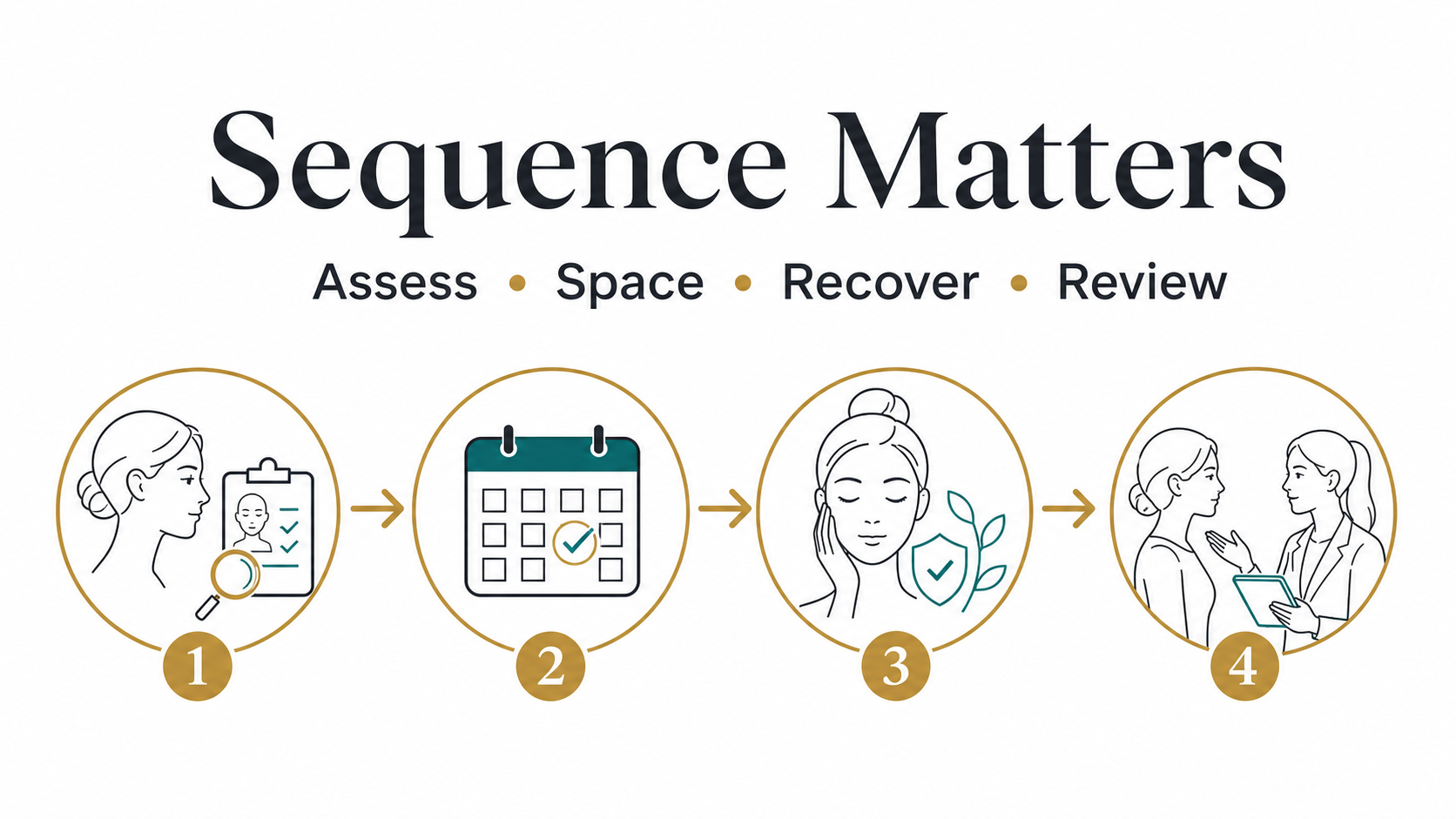
Published combination literature shows that sequence and spacing can matter, but recommendations are procedure-specific. One expert consensus on injectables and microfocused ultrasound suggested spacing some consecutive procedures to allow side effects to resolve and results to be assessed. Another consensus for fractional ablative laser recommended particular intervals for selected combinations. Neither document establishes a universal schedule for Trinity.
For a Trinity programme, the responsible professional should document:
- Assess: concern, skin condition, treatment history, medicines, products and risk factors.
- Select: the minimum set of components needed.
- Sequence: why one treatment occurs before another.
- Space: what recovery interval and objective gate are required.
- Recover: permitted skincare, sun protection and activity limits.
- Review: response, delayed effects and whether the next step remains appropriate.
Combination Categories
Trinity plus supportive skincare
This is usually the first category salons consider. Keep the plan simple: gentle cleansing, approved moisturising, sun protection and any product specifically allowed by the device and treating professional. "Repair" or "regeneration" claims need substantiation. Do not apply strong acids, retinoids, exfoliants or unverified actives simply to make the package feel more advanced.
Trinity plus non-invasive RF
Both involve energy and potential heating, but they are not interchangeable. The plan should account for treated area, tissue target, cumulative heat, sensation, recovery and device-specific restrictions. Do not place them together by default or use evidence from RF microneedling to justify non-invasive RF.
Trinity plus RF microneedling
RF microneedling is invasive and has a different risk profile. The FDA reported serious complications with certain uses in a 2025 safety communication. This combination requires appropriately licensed medical oversight, separate informed consent, aseptic practice, device-specific timing and a clear complication route. It should not be marketed as a routine salon add-on.
Trinity plus HIFU or MFU
Focused ultrasound and laser energy interact with tissue differently. Determine whether the client actually needs both and which concern each addresses. Anatomy, depth, energy, prior procedures and recovery must be reviewed by an appropriately qualified professional. Published HIFU timing from another protocol is not a Trinity instruction.
Trinity plus another laser or IPL
Combining optical procedures can increase complexity around chromophores, cumulative heat, pigment risk, eye protection and recovery. Identify the exact wavelengths, target and reason for each device. Avoid treating the same concern twice without a documented rationale.
Trinity plus injectables or medical procedures
Injectables are medical procedures in many markets and require qualified healthcare professionals. Sequencing depends on the product, anatomical area, aseptic considerations and device energy. A salon should not create a universal same-day bundle from a journal consensus that involved different technologies.
Do Not Stack by Default
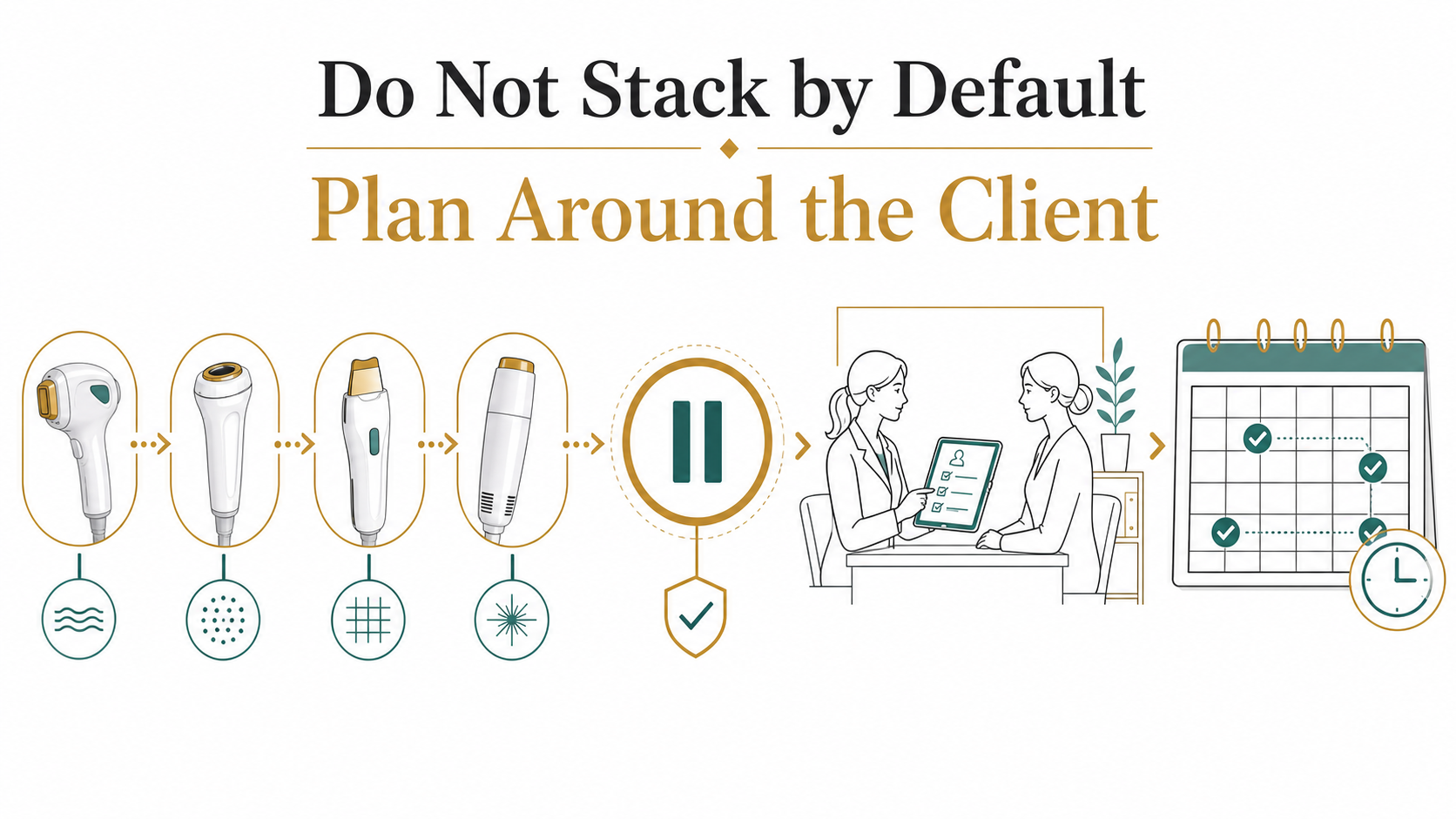
Stop and reassess when:
- the reason for the second treatment is "stronger results"
- no one can identify the cumulative thermal or tissue effect
- one procedure's expected response would hide the other's warning signs
- the client has not recovered from the previous treatment
- the second device has different operator or premises requirements
- the package was sold before eligibility was assessed
- staff cannot access both current manuals
- aftercare instructions conflict
A Planning Matrix
| Question | Required Answer Before Booking |
|---|---|
| What concern does each component address? | A distinct, documented role rather than duplicated marketing language |
| Who approves the plan? | A named professional operating within local scope |
| Which label supports each use? | Exact model, applicator, product and market record |
| What is the sequence? | Written rationale, not convenience |
| What is the recovery gate? | Defined skin condition, symptom and review criteria |
| What if recovery is delayed? | Cancellation, clinical review and escalation pathway |
| How is consent handled? | Separate risks and alternatives for each component |
| How are records linked? | One longitudinal plan with each device and product identified |
Client Communication
Explain that a combination is optional and may be staged. State the goal of each component, expected sensations, possible short-term responses, alternatives, total price and what happens if the next step is postponed. Avoid describing a longer package as automatically more effective.
Before-and-after photographs should use consistent conditions and appropriate consent. Do not use a combination result to imply that Trinity alone produced every change.
Records and Review
Keep one plan containing:
- baseline concern and photographs
- health, medicine, product and procedure history
- reason for each component
- exact device, applicator, settings and operator
- treatment date and sequence
- immediate response and aftercare
- recovery contact and photographs
- delayed effects or adverse events
- decision to proceed, modify, postpone or stop
Where more than one provider is involved, define who owns follow-up and who receives an urgent call.
Package Design
Sell a review-led programme, not an irreversible sequence. The contract should allow a component to be postponed or removed when it is no longer appropriate. State how unused value, expiry and refunds are handled. Avoid high-pressure prepayment while the client's suitability for later stages remains unknown.
Ask Before Pairing Products with Trinity
- Is the product intended for intact or recently treated skin?
- Are fragrance, alcohol, acids, retinoids or other actives present?
- Does the device manual permit immediate use?
- Is there product-specific evidence, or only ingredient marketing?
- Could the product mask redness, pain or another warning sign?
- Who is responsible if irritation occurs?
For product details, review the Trinity product page and the before and aftercare guide. Salons can use the contact page to ask about the current training and after-sales scope.
Frequently Asked Questions
Can Trinity and RF be performed on the same day?
There is no universal answer. The exact RF type, Trinity protocol, area, client, cumulative energy and local professional requirements must be reviewed.
Is skincare always safe after Trinity?
No. Use only products approved for the specific protocol and current skin response. "Soothing" on a label is not enough.
How long should treatments be spaced?
No generic interval can replace device-specific instructions and professional assessment. Use a recovery gate, not only a calendar date.
Does combining treatments improve results?
Some combination studies report benefits for specific technologies and indications, while others show added side effects or no additional improvement. Evidence must match the actual combination.
Can a salon sell a fixed six-step package?
Only if each stage remains subject to assessment and local requirements. A review-led plan with clear cancellation and unused-value terms is more cautious and transparent.
This article is a planning framework, not a combination protocol or medical advice. Invasive and medical procedures require appropriately qualified healthcare professionals.