
Trinity vs HIFU vs RF: Salon Treatment Platform Guide
Choosing between Trinity Liftoning, HIFU and radiofrequency is not a contest to find one universally "best" machine. The three platforms deliver different forms of energy, operate through different treatment logic and may be regulated for different intended uses. A salon should start with the client problem it wants to manage, the operator model it can support and the exact claims it is legally allowed to make.
This guide compares the categories for procurement and treatment-menu planning. It does not replace the product manual, manufacturer training, local regulatory advice or an individual clinical assessment.
The Short Answer
| Priority | Platform to Investigate First | Why |
|---|---|---|
| A diode-laser service built around the Trinity platform | Trinity | BLUECORE describes simultaneous 755, 808 and 1064 nm delivery, three contact-cooling levels and three preset treatment modes. |
| Focused treatment at selected tissue depths | HIFU or MFU | Focused ultrasound platforms are designed to concentrate acoustic energy at specified depths. Cartridge and imaging design matter. |
| Broad heating for firmness and skin-quality programmes | Non-invasive RF | RF creates controlled tissue heating through electrical energy; electrode design, temperature control and protocol vary widely. |
| A single machine that replaces every lifting platform | None | Wavelength, energy source, depth, indication, evidence and operator requirements are not interchangeable. |
The practical decision is often not "Which technology sounds strongest?" It is "Which platform matches our treatment objective, client profile, staff competence, service capacity and destination-market rules?"
How the Three Energy Pathways Differ
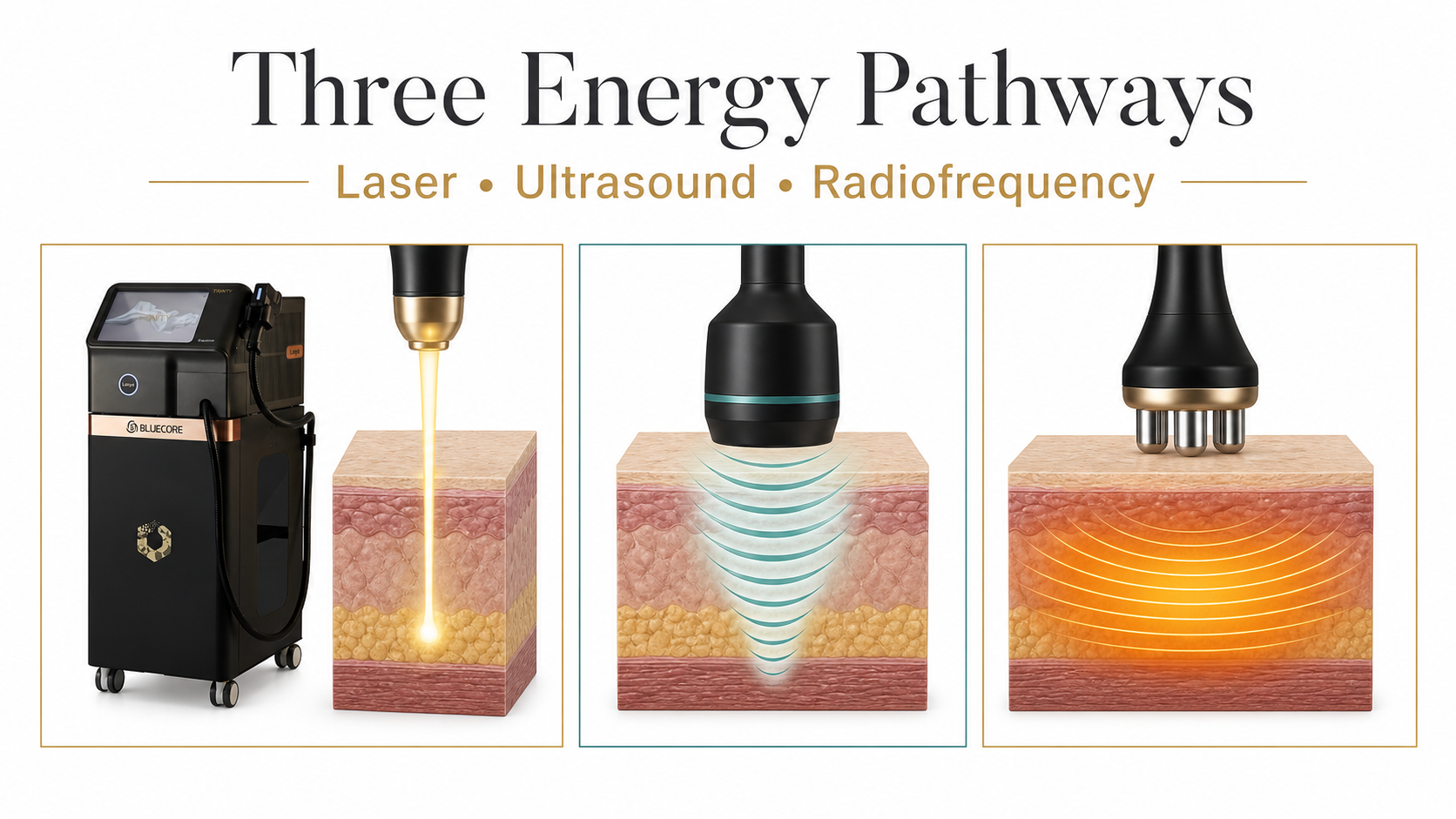
Trinity: a triple-wavelength diode laser platform
BLUECORE's current product information describes Trinity as delivering 755 nm, 808 nm and 1064 nm wavelengths simultaneously through a large contact area, with three cooling levels and three treatment modes. A wavelength label alone does not establish a treatment outcome. Results and risk also depend on fluence, pulse duration, repetition rate, spot size, contact, cooling, technique and the approved or permitted intended use in the market.
The United States FDA record is particularly useful for understanding that distinction. The cleared device is named Lasya-Trinity under 510(k) K241951. Its public summary lists the triple-wavelength applicator for benign vascular and vascular-dependent lesions and a separate 808 nm applicator for permanent reduction in hair regrowth. The FDA document does not list facial lifting or brightening as the cleared indications. Buyers operating in the United States should therefore review the exact model, applicator, label and permitted claims instead of relying on the word "Liftoning."
HIFU or MFU: focused acoustic energy
High-intensity or microfocused ultrasound systems concentrate acoustic energy at selected focal depths. Their buyer variables include transducer depth, line or shot delivery, imaging capability, treatment-map design, cartridge life and operator training. Published reviews report improvement in selected facial-tightening outcomes, but study protocols, devices and outcome measures are heterogeneous. Pain, swelling, tenderness, bruising and less common complications must be discussed honestly.
RF: controlled electrical heating
Radiofrequency devices create heat through tissue resistance to electrical current. The category includes monopolar, bipolar, multipolar and microneedle RF, which should not be treated as one identical technology. Non-invasive RF may suit broader heating and repeated skin-quality programmes, while RF microneedling is invasive and has a different risk and operator profile. In 2025 the FDA issued a safety communication about reported serious complications with certain uses of RF microneedling, reinforcing the need to identify the exact RF category.
Compare the Whole Treatment, Not the Headline Technology
| Buying Question | Trinity | HIFU / MFU | RF |
|---|---|---|---|
| Energy source | Diode laser | Focused ultrasound | Radiofrequency current |
| Main planning variable | Wavelengths plus fluence, pulse, frequency, contact and cooling | Focal depth, line pattern, energy, cartridge and visualization | Electrode configuration, temperature, impedance, duration and contact |
| Client sensation | Depends on settings, contact and cooling; never promise pain-free treatment | Can range from tolerable warmth to meaningful discomfort | Warmth to discomfort; invasive RF differs substantially |
| Consumables | Confirm handpiece life, gels, filters and service parts | Cartridges or transducers may be a material per-treatment cost | Tips, membranes or needle cartridges may apply by model |
| Operator workflow | Requires laser-safety controls, eye protection, skin assessment and trained operation | Requires anatomical knowledge, treatment mapping and depth selection | Requires temperature/contact control and category-specific training |
| Evidence transferability | Evidence for one laser or indication does not automatically validate another | Evidence is device- and protocol-dependent | Evidence cannot be transferred freely between non-invasive and microneedle RF |
| Claims | Must follow the exact market label and substantiation | Must follow the exact device indication and local rules | Must identify the RF type and exact indication |
Start with the Client Goal

Goal 1: improve the appearance of uneven tone while building a premium laser menu
Trinity may be the first platform to assess if the salon specifically wants BLUECORE's triple-wavelength system and is prepared to follow its training, cooling, laser-safety and documentation requirements. The salon should verify which indications and claims are permitted locally. It should not assume that three wavelengths guarantee a better result than a well-selected single-wavelength or non-laser platform.
Goal 2: target mild to moderate laxity at selected depths
A focused ultrasound platform may be a stronger category match when the treatment plan depends on delivering energy at mapped focal depths. The purchase decision should examine whether visualization is available, how anatomy is assessed and how the operator avoids inappropriate areas. Published MFU evidence should be read alongside the device's own indication and training material.
Goal 3: deliver broad, repeatable firming or texture programmes
Non-invasive RF may fit a salon that wants controlled heating, repeat-session programmes and a familiar treatment-room workflow. Confirm whether temperature feedback is real-time, what endpoint the protocol uses and how contact is maintained. Do not mix evidence for non-invasive RF with RF microneedling.
Goal 4: serve clients with several concerns
A multi-platform menu can be reasonable, but more energy is not automatically better. Combination planning should begin with assessment, sequencing, recovery and documentation. Avoid stacking devices on the same area by default. Where treatments involve medical indications, invasive procedures or higher-risk clients, refer to appropriately licensed healthcare professionals.
Five Procurement Tests Before Choosing
- Indication test: Obtain the product-specific intended-use statement for your market. Match the model and applicator, not just the brand.
- Evidence test: Ask which studies or regulatory records support the exact claim being presented. A study on another wavelength, device or RF category is not equivalent evidence.
- Workflow test: Time a complete appointment, including consultation, photographs, preparation, treatment, cleaning, records and room reset.
- Cost test: Calculate landed cost, consumables, staff time, maintenance, downtime and expected contribution per completed treatment.
- Support test: Confirm training language, refresher training, response times, spare parts, handpiece service, warranty exclusions and escalation contacts.
Questions to Ask During a Trinity Demonstration
- What is the exact model name and serial-number format?
- Which applicator is included, and which wavelengths does it deliver?
- What do the three modes control, and which settings remain operator-adjustable?
- How is contact cooling checked before each client?
- Which laser class, eyewear and treatment-room controls apply?
- Which claims are supported for Hong Kong and for any intended export market?
- Can the supplier provide the user manual, training syllabus, maintenance schedule and warranty before deposit?
- Does the quotation include installation, staff training, freight, accessories and initial service support?
Avoid These Comparison Mistakes
Mistake 1: comparing only maximum energy. Higher numerical output is not a universal proxy for better results. Delivery pattern, tissue target and operator endpoint matter.
Mistake 2: treating all "lifting" devices as equivalent. Laser, ultrasound and RF have different physical interactions and risk controls.
Mistake 3: promising painless, instant or permanent results. Comfort and response vary. Marketing should use qualified, supportable wording.
Mistake 4: using an FDA logo as a general quality badge. Verify the exact database record, device name, applicant, 510(k) number and indication. Establishment registration alone does not mean a product is approved.
Mistake 5: pricing before measuring capacity. A high treatment price does not guarantee a short payback if consultations, room turnover, rework, service interruptions or low rebooking reduce completed appointments.
A Practical Selection Scorecard
Score each candidate from 1 to 5, then require written evidence for every score.
| Criterion | Suggested Weight |
|---|---|
| Match to target client and treatment goal | 20% |
| Product-specific indication and documentation | 20% |
| Safety controls and operator training | 15% |
| Treatment capacity and room workflow | 10% |
| Total ownership cost | 10% |
| Warranty, parts and technical support | 10% |
| Evidence quality and claim discipline | 10% |
| Client comfort and aftercare burden | 5% |
Reject a platform even if its total score is high when a mandatory item fails, such as missing product identification, unsuitable voltage, unclear intended use, absent training or no workable service route.
Which Platform Should Your Salon Choose?
Choose Trinity when the triple-wavelength diode-laser platform, product-specific modes, cooling workflow and supplier support fit the salon's permitted service model.
Choose HIFU or MFU when mapped focal-depth treatment is central to the plan and the salon has the competence, local authority and cartridge economics to operate it properly.
Choose non-invasive RF when controlled broad heating and repeatable firming programmes fit the menu, while carefully distinguishing it from RF microneedling.
Choose more than one platform only when each has a defined role, separate protocol and clear client-selection rule. Do not buy overlapping machines merely to create a longer technology list.
Enquire About Trinity in Hong Kong
Asia Pacific Beauty Group was established in Hong Kong in 1998 and provides professional beauty-equipment agency, wholesale and consultancy services. Buyers can review the Trinity product page, compare its three manufacturer-named treatment modes, and request a demonstration, quotation, document checklist, training discussion and after-sales plan through the contact page.
Before ordering, state your destination, business type, intended service, operator profile and required support. Availability, documentation, training, warranty and permitted use must be confirmed for the exact model and market.
Frequently Asked Questions
Is Trinity the same as HIFU?
No. Trinity is described by BLUECORE as a diode-laser platform using 755, 808 and 1064 nm wavelengths. HIFU uses focused acoustic energy. They should not share one generic protocol.
Is RF always gentler than HIFU or laser?
No. Sensation and risk depend on the RF category, device, settings, contact, treatment area and operator. RF microneedling is materially different from non-invasive RF.
Does FDA clearance prove every Trinity marketing claim?
No. The public K241951 record applies to the named Lasya-Trinity device and the indications in its clearance. Buyers must compare any proposed claim with the exact regulatory record and destination-market rules.
Can a salon combine Trinity with RF or HIFU?
Possibly, but not as an automatic same-day bundle. Combination plans need individual assessment, a defined sequence, recovery criteria, records and appropriate professional oversight.
What should be confirmed before paying a deposit?
Confirm the exact model and applicators, product documents, local suitability, package contents, voltage, training, laser-safety requirements, warranty, parts route, delivery terms and total landed cost.
This article is for procurement and service-planning information. It is not medical advice, a treatment protocol or a representation that a device is authorized for every described use in every market.