
Buying Used Beauty Equipment: Ownership, Warranty and Acceptance Checks
A lower used-unit price does not necessarily mean a lower cost to enter service. Confirm the right to sell, exact identity, maintenance and safety status, consumable supply, warranty transfer and training. Resolve missing information before deciding whether the purchase fits the intended service.
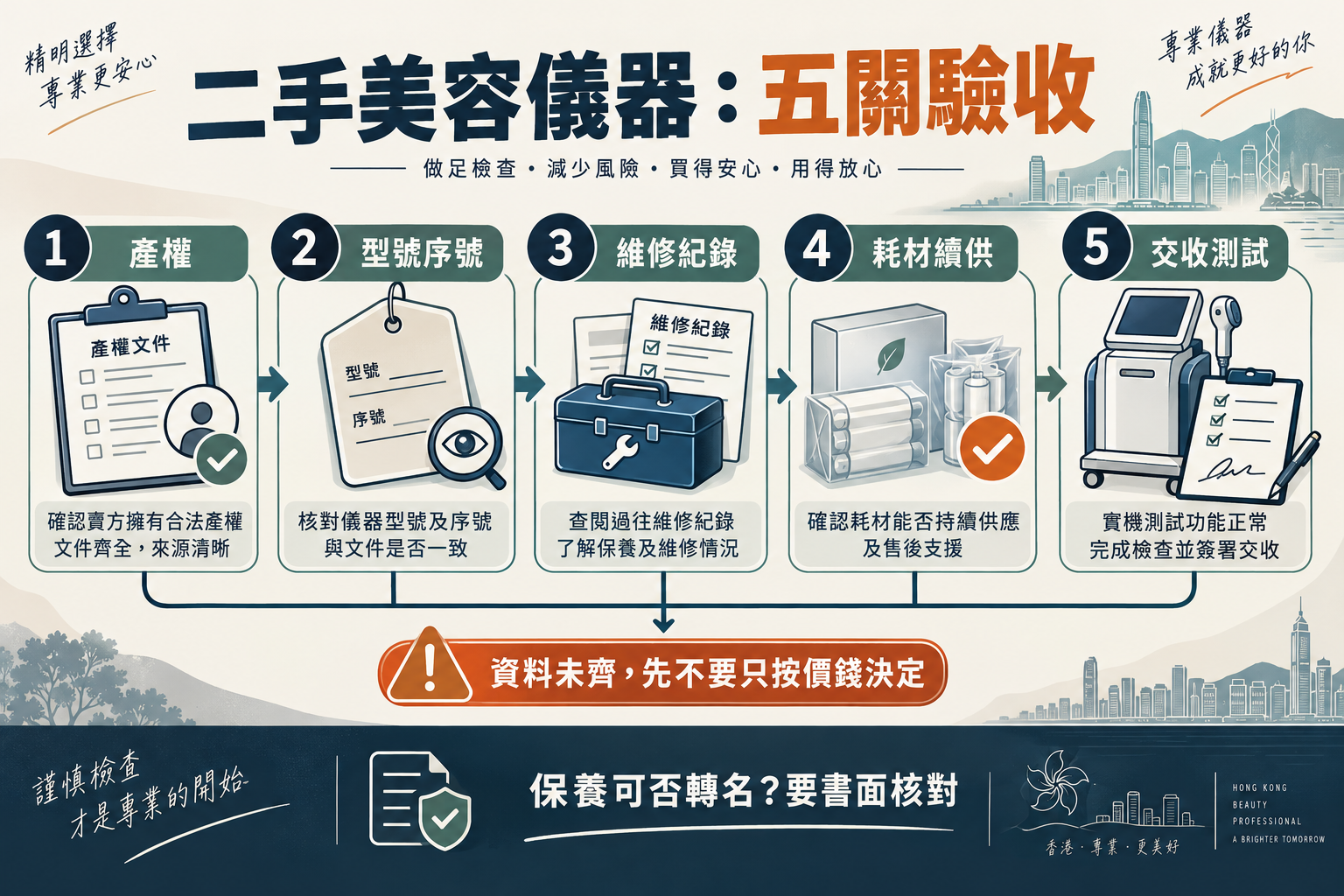
This AI-generated illustration uses Traditional Chinese labels and does not depict a particular manufacturer's unit.
Gate one: establish the right to sell
Request the purchase invoice, contract and relevant payment documents. Confirm whether lease, financing or other restrictions affect transfer. A salon takeover including equipment does not automatically transfer a lease or warranty. Obtain confirmation from the relevant contract holder where financing is involved.
Write down seller, unit, price, accessories and delivery conditions. Messages may support the record but should not replace clear transaction documents. The Consumer Council's secondhand-platform research highlights platform roles, checks and returns; a listing is not a condition guarantee. Consumer Council information
Gate two: match identity and documents
Inspect the main-unit label, serial, handpieces, software and electrical specification against the records. Similar housings or startup screens do not identify the complete supplied configuration.
Use verifiable manufacturer or local support channels to confirm servicing, consumables and instructions. A seller's genuine-product claim does not replace verification. Identity checks and technical safety checks are separate tasks.
Gate three: review servicing and modifications
Request faults, service dates, parts replaced, inspection results and technicians. Ask about impact, flooding, non-specified consumables and unauthorised changes. A shot or use counter may have been reset through servicing and does not establish a complete history.
Successful startup does not prove output, cooling, monitoring or electrical condition. Arrange manufacturer-designated or appropriately qualified checks and record their scope and limitations. EMSD electrical safety information is a starting point; applicable requirements depend on the category.
Gate four: confirm usable supplies and training
Check availability, ordering eligibility, minimum quantities and lead times for required probes, cartridges, contact parts, solutions and accessories. Included unused stock still needs packaging, batch, expiry and storage checks.
Training must fit the unit and new team. The previous owner's certificate does not establish current staff competence. An older IFU may not match updated hardware or software. Include training and preparation in the budget.
Gate five: agree acceptance and transfer
Obtain written warranty-transfer confirmation from the party actually providing support, including exclusions, inspections and fees. Agree tests, missing items, faults, returns and refunds before moving the unit into the salon.
| Record | Include |
|---|---|
| Transaction | Seller, ownership statement, price, payment and delivery |
| Identity | Main unit and handpiece models, serials, versions and photos |
| Condition | Inspection scope, findings, limitations and modifications |
| Supporting supplies | Accessories, consumable continuity and matching IFU |
| Support | Provider, transfer, fees and downtime arrangements |
| Acceptance | Tests, missing parts, acknowledgements and release conditions |
Compare the complete entry cost
A hypothetical calculation: HK$80,000 unit + HK$3,000 transport + HK$5,000 inspection + HK$12,000 necessary parts + HK$4,000 training = HK$104,000 before use. Unresolved major repairs are uncertain costs, not zero.
Compare a new unit's complete quote for the same intended use, support, consumables and expected usable life. A generic risk percentage cannot resolve unknown ownership or safety. A very low price may still buy a unit that cannot enter the planned service.
When to pause the transaction
- Identity, ownership or origin cannot be verified.
- Unit, documents and handpieces conflict without a written explanation.
- Necessary repairs or safety functions cannot be assessed.
- Support, consumables or transfer conditions cannot be confirmed.
- Full payment is demanded before agreed checks and documents.
These checks resolve unknowns rather than assume all used units are faulty. Seek suitable professional advice for contract, financing or liability questions.
Frequently asked questions
Does a low counter prove good condition?
No. Counter history, maintenance, storage and inspection also matter.
Can the new team rely on the previous team's training?
Historical records help, but current staff need applicable training and competence checks.
Does an invoice guarantee manufacturer warranty?
No. Verify transfer and scope with the actual service provider.
Can staff replace parts and start using it?
Do not independently dismantle or bypass safety functions. Obtain authorised technical support and release confirmation.
Can client records transfer with equipment in a takeover?
Treat equipment ownership and personal-data transfer separately, checking each arrangement's applicable requirements.
Related procurement guides
See the supplier framework, room checklist and maintenance/SLA guide. This framework does not replace legal advice or technical inspection.