
Buying EVE Titan from Hong Kong: Authorisation, Voltage, Customs and Service
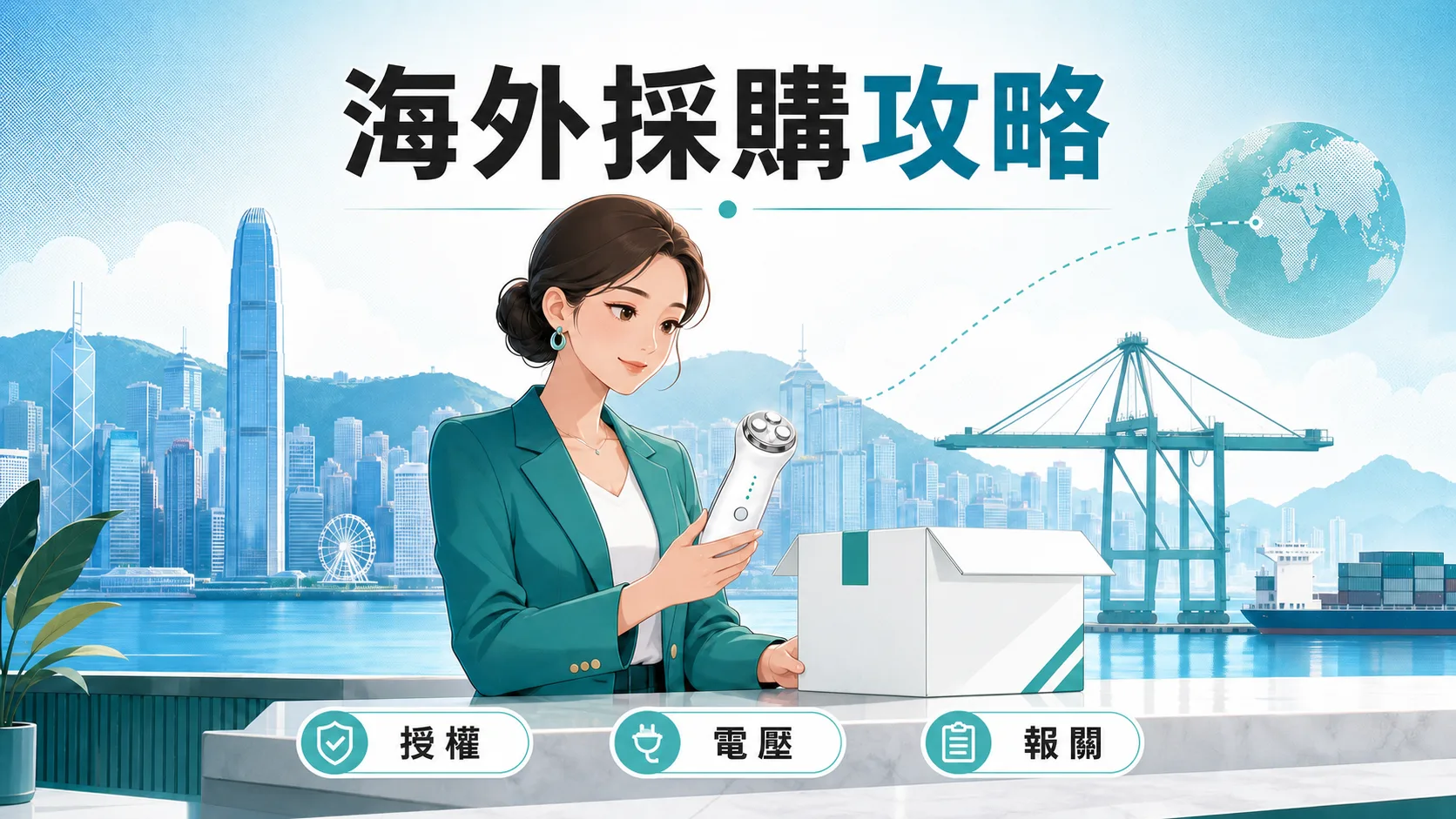
Hong Kong has long served as a transit point for Korean beauty devices entering Asia-Pacific — a free port with no import duty, mature logistics, and distributors who handle documentation in both Chinese and English.
Cross-border procurement, though, raises five issues a local buyer never encounters. This article works through each, for facial EMS devices including Titan.
1. Territorial authorisation: the first gate in cross-border buying
Manufacturer authorisation is territorial. A Hong Kong distributor authorised to sell in Hong Kong is not thereby authorised to export to Malaysia, Thailand or the Middle East.
This has to be settled before the quotation, not after payment. Three things need answering:
| Question | Why it matters |
|---|---|
| Does the authorisation letter cover your territory? | Cross-territory sales can void the warranty or leave you without manufacturer support locally |
| Is there already an exclusive distributor in your territory? | If so, buying through a third party may breach the manufacturer's distribution arrangements |
| Is the export handled by the distributor or directly by the manufacturer? | Determines where warranty responsibility sits and how parts are supplied |
If the seller cannot answer directly, the fastest check is with the manufacturer. EVE Titan is made by WEERO Co., Ltd., whose US FDA establishment registration number is 3016087653 — useful for confirming the manufacturer's legal identity. The full authorisation-chain method is in how to verify a genuine EVE Titan.
2. Voltage, frequency and plugs
This is the item that goes wrong most often in cross-border purchases, and the easiest to avoid.
| Territory | Voltage | Frequency | Plug type |
|---|---|---|---|
| South Korea (manufacturer's base) | 220V | 60Hz | C / F |
| Hong Kong | 220V | 50Hz | G |
| Singapore, Malaysia | 240V | 50Hz | G |
| Thailand, Vietnam | 220V | 50Hz | A / B / C / F |
| Taiwan, Japan | 110V / 100V | 60Hz / 50–60Hz | A / B |
| Much of the Middle East | 220–240V | 50Hz | G / C |
The same voltage does not mean plug-and-play. Korea runs 220V at 60Hz, while Hong Kong and most of Southeast Asia run 50Hz. Some electronics are indifferent to frequency; others show it in cooling fan or power module behaviour. When ordering, confirm the model's actual input specification range with the manufacturer — whether it is a wide-input 100–240V, 50/60Hz design — rather than assuming that "220V everywhere" settles it.
Plug type can be solved with an adapter. Voltage and frequency cannot. If the destination is a 110V market, confirm at order stage whether the manufacturer offers a corresponding version.
3. Local regulatory liability sits with the buyer
A common misconception is that if the manufacturer holds FDA or CE, the device may lawfully be used anywhere.
In practice, medical device registration liability in each jurisdiction usually falls on the local importer or user. Korean MFDS approval, US FDA 510(k) clearance and EU CE marking each carry meaning only within their own jurisdiction, and the approved intended use may differ between them.
Before purchase, confirm three things with your local authority or legal adviser: which risk class this type of device falls into in your market, whether pre-import registration is required, and whether operator qualifications apply to salon use.
How to verify regulatory records in each jurisdiction is covered in our guide to verifying Korean beauty device certifications.
4. Customs and shipping documents
Hong Kong is a free port and levies no duty on general imports and exports, but the paperwork still has to be complete, and clearance requirements at the destination are set by the destination.
| Document | Purpose | Commonly missed |
|---|---|---|
| Commercial invoice | Customs valuation | Declared value inconsistent with actual |
| Packing list | Checking accessories and treatment heads | Accessories not itemised |
| Certificate of origin | Preferential duty or registration in some markets | Not applied for in advance |
| Manufacturer authorisation letter | Required for clearance or registration in some markets | Chinese version only |
| Specification sheet and instructions for use | Local registration, clearance and later operation | Korean version only |
| Air or sea waybill | Collection | Consignee details not matching the registered entity |
| Battery or power-source declaration | Air freight restrictions | Not declared |
Request English instructions and specification sheets at order stage. These are frequently needed for clearance and local registration, and obtaining them afterwards usually means waiting for the manufacturer to reissue documents. The broader Hong Kong export procurement process is in our guide to importing beauty equipment from Hong Kong.
5. Cross-border service and parts
This is the most expensive part of cross-border procurement, and the part that most needs writing into the contract.
Five things to settle before ordering: whether warranty is carried by the Hong Kong distributor or the manufacturer; whether repairs return to Hong Kong, return to Korea, or can be handled by local technical support; the ordering route and expected lead time for parts; who bears shipping and duty; and insurance arrangements for cross-border transport during the warranty period.
Downtime is the real cost of cross-border buying. Locally a part might arrive in three days; cross-border it can take three weeks — and the obligation to deliver already-paid-for courses does not pause meanwhile. The cash-flow implications are in pricing and payback for course-based EMS treatments.
6. Training and language
Facial EMS performance depends heavily on anatomical electrode placement, so training is not optional. For a cross-border purchase, confirm: the format of training (travel to Hong Kong, online, or a trainer sent to you), the language, whether training materials are provided, and how staff who join later will be trained.
If training is delivered only in Korean or Chinese while your operating team works in another language, require English materials or translation arrangements in the contract. The full specification checklist is in 9 specification questions to ask before buying a facial EMS device.
Frequently Asked Questions
Can a Hong Kong distributor export to my country?
It depends on the territorial scope of the authorisation letter. Manufacturer authorisation normally carries explicit territorial limits, and being authorised to sell in Hong Kong does not mean being authorised to export elsewhere. Settle three points before the quotation: whether the letter covers your territory, whether an exclusive distributor already exists there, and whether export is handled by the distributor or the manufacturer. If no direct answer is available, verify with the manufacturer.
If the voltage matches, can I use it straight away?
Not necessarily. Korea runs 220V at 60Hz while Hong Kong and much of Southeast Asia run 50Hz. Some devices are indifferent to frequency; others show it in the power module or cooling performance. Confirm the model's actual input specification range with the manufacturer — for example whether it is a wide-input 100–240V, 50/60Hz design. Plug type can be handled with an adapter; voltage and frequency cannot.
If the manufacturer holds FDA or CE, can I use the device legally in my country?
Not necessarily. Medical device registration liability in each jurisdiction usually falls on the local importer or user, and FDA, CE and MFDS each carry meaning only within their own jurisdiction, with approved intended uses that may differ. Before purchase, confirm with your local authority or legal adviser which risk class the device falls into in your market, whether pre-import registration is required, and whether operator qualifications apply.
How should cross-border service be arranged?
Five points belong in the contract: whether warranty is carried by the Hong Kong distributor or the manufacturer, where repairs go or whether local technical support exists, the parts ordering route and expected lead time, who bears shipping and duty, and insurance for cross-border transport. Parts lead times are typically far longer across borders, and the obligation to deliver already-sold courses does not pause during downtime — the most underestimated cost in cross-border buying.
Conclusion: settle authorisation and specification before discussing price
In cross-border beauty equipment procurement, price is usually not the hard part. The hard part is settling five things before payment: territorial authorisation, electrical specification, local registration liability, customs documentation and cross-border service.
Once all five have written answers, comparing prices becomes meaningful — because at that point you are comparing like with like: a device that can be used lawfully, for which parts can be obtained, and which somebody is responsible for repairing.
For Titan export arrangements, English specification sheets, voltage variants or cross-border warranty terms, contact us.
This article is general procurement reference and does not constitute legal, customs or tax advice. Medical device registration and import requirements vary considerably between jurisdictions and should be confirmed with your local authority or professional adviser. The electrical specifications given are general reference; actual input specifications should follow the manufacturer's product documentation.