
EVE Titan Facial EMS Clinical Study: How Salons Should Read This Evidence
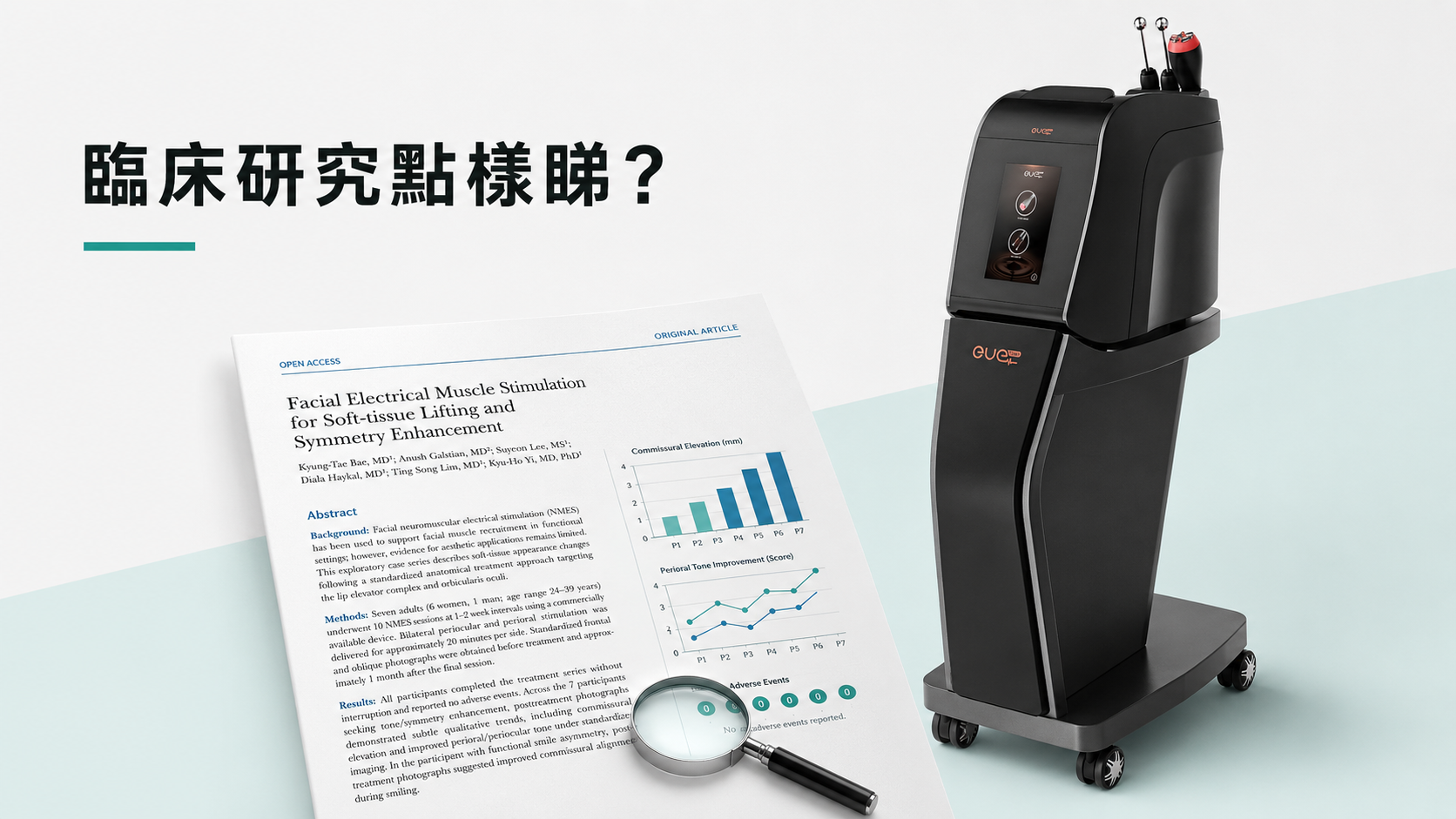
EVE Titan facial EMS clinical study published in PRS Global Open, showing the 7-participant 10-session design and its limitations
In the beauty equipment market, the phrase "backed by clinical research" appears far more often than the research itself. So when a facial EMS study using EVE Titan is genuinely published in a peer-reviewed journal, it deserves a careful read — but not the kind of read that a supplier's "international journal evidence" slide invites.
This article is not a press release. It has one purpose: to let you state precisely, in a purchasing meeting, what this study supports and what it does not — and to show you which sentences are safe in marketing material and which would expose you under Hong Kong's Trade Descriptions Ordinance.
1. What exactly is this study?
The paper is titled *Facial Electrical Muscle Stimulation for Soft-tissue Lifting and Symmetry Enhancement*, published online on 24 July 2026 in Plastic and Reconstructive Surgery – Global Open (PRS Global Open), the official open-access journal of the American Society of Plastic Surgeons (ASPS), under DOI 10.1097/GOX.0000000000007955.
There are six authors, based at clinical centres in South Korea, Ukraine, France and Malaysia. The corresponding author is Dr Kyu-Ho Yi of You and I Clinic, Seoul. The manuscript was received in November 2025 and accepted in May 2026, so it went through a full peer-review process.
Two things need to be stated at the outset:
First, this is an exploratory, descriptive case series. The authors themselves state in their conclusion that the findings are "hypothesis-generating" rather than confirmatory.
Second, the paper is published under a CC BY-NC-ND 4.0 licence. That means you may read, cite and link to it freely, but modification and commercial use are prohibited. The before-and-after patient photographs in the paper (Figures 1–3) may not be reproduced in marketing material, cropped, or overlaid with text. For that reason this article quotes only the written content and uses our own original diagrams instead.
2. What the study did
Parameter | Study setting |
|---|---|
Study design | Descriptive, exploratory case series; no control group, no sham group |
Participants | 7 adults (5 women, 2 men) |
Age range | 24–39 years |
Cohort composition | 6 seeking tone/symmetry enhancement; 1 man with long-standing functional smile asymmetry |
Number of sessions | 10 |
Interval | 1–2 weeks |
Session length | Approximately 20 minutes per side |
Treatment areas | Bilateral periocular and perioral regions |
Target muscles | Lip elevator complex (levator labii superioris, zygomaticus major and minor) and orbicularis oculi |
Device | EVE Titan (WEERO, Republic of Korea) facial NMES device |
Imaging system | Janus Pro (PIE Co., Ltd., Seoul); frontal and oblique views, neutral expression |
Follow-up | Approximately 1 month after the 10th session |
The procedure itself is unremarkable in a good way: skin cleansed, conductive gel applied, patient semi-reclined, periocular zone treated first and then the perioral area, one side at a time, with intensity raised gradually until visible but comfortable muscle contractions appeared. No topical anaesthesia or premedication was used at any point.
Electrode placement follows a clear anatomical rationale. Perioral electrodes were positioned along the nasolabial fold roughly 1–1.5 cm lateral to the alar base, overlying the course of levator labii superioris and the zygomaticus muscles. Periocular electrodes sat inferior to the infraorbital rim along the pretarsal–preseptal junction, deliberately avoiding direct stimulation of the globe. For the muscle anatomy behind this placement, see our guide to how facial EMS differs from RF and HIFU.
Participants had to meet exclusion criteria: free of systemic, dermatological and neurological disease, and no facial surgery, filler or botulinum toxin treatment within the preceding six months.
3. What the study observed
The results come down to three statements:
First, the safety record is clean. All 7 participants completed all 10 sessions without interruption, and no adverse events occurred — no erythema, no oedema, no persistent pain, no neurological symptoms. Participants generally described only a transient sensation of muscle contraction and warmth during treatment, resolving immediately afterwards, with no downtime and no post-procedure intervention required.
Second, the appearance changes are qualitative observations. Among the 6 participants seeking tone and symmetry enhancement, post-treatment photographs under standardised imaging showed subtle qualitative trends: a slightly higher resting oral commissure position and improved perioral and periocular tone.
Third, the asymmetry case showed the clearest direction. That participant received bilateral stimulation with intensity and emphasis preferentially increased on the weaker side. Post-treatment photographs suggested improved left-sided upper-lip elevation and commissural alignment during voluntary smiling.
Note that all three paragraphs above use words like "observed", "showed" and "trends". That is not rhetorical caution — it is because the study did not generate data capable of supporting any stronger statement.
4. What the study cannot prove — the five stated limitations
This section is the most useful part of the article. The authors list five limitations themselves, and each one directly constrains how you may use this paper.
Limitation (stated by the authors) | What it means for a salon |
|---|---|
Only 7 participants, no control and no sham group, no prespecified endpoints, no statistical testing | Treatment effect cannot be separated from natural variation, photographic differences or placebo. You cannot say "effective" |
Outcomes relied on qualitative photo comparison, with no objective measurement, no blinded assessment, no validated scoring instrument | The study produced no numbers at all. Any percentage or multiple-fold claim is fabricated |
A standardised imaging system was used, but no mandibular stabilisation | Minor variations in chin position and facial posture may themselves produce the apparent difference |
Narrow age range (24–39 years) | Cannot be extrapolated to older clients or to more advanced laxity — often precisely your core walk-in demographic |
Session-level stimulation outputs (voltage/current) were not uniformly archived | The 3–200 Hz, 60–75 V and 120–150 mA figures in the paper come from one case only; they are not general parameters |
The authors also explicitly recommend that future work use larger samples, sham-controlled designs, blinded independent assessment, objective measurement (3D imaging, electromyography) and validated patient-reported outcome instruments. In other words, the paper itself concedes that this is a starting point.
5. Where does a case series sit on the evidence ladder?
The beauty industry rarely discusses levels of evidence, but this is exactly what turns "there is a study" into information you can act on.
Level | Study type | Position of this paper |
|---|---|---|
Highest | Systematic review / meta-analysis | — |
High | Randomised controlled trial (RCT) | Kavanagh et al. (2012), the facial EMS RCT cited by this paper, sits here |
Moderate | Cohort and case-control studies | — |
Low | Case series | ← this study |
Lowest | Single case report, expert opinion | — |
It is worth noticing that reference 9 in the paper — the Kavanagh et al. 2012 facial EMS randomised controlled trial in the *Journal of Cosmetic Dermatology* — actually sits at a higher evidence level than this study. That tells you the evidence base for facial EMS does not rest on this paper alone. What this paper contributes is documentation of feasibility and tolerability for a specific anatomical protocol on a specific device.
One distinction must stay sharp. The paper also cites several studies of NMES in facial palsy, Bell's palsy and post-stroke facial dysfunction. Those are medical-use studies, cited to support biological plausibility of the mechanism. They cannot be restated as evidence that a salon may address such conditions.
6. What this means for procurement and marketing
Condensing the analysis into one table you can hand straight to whoever writes your copy:
❌ Do not write | ✅ You may write |
|---|---|
Clinically proven / proven to lift | An exploratory case series published in PRS Global Open documented qualitative trends |
30% improvement / twice the firmness | (The study made no objective measurement; no effect figure may be cited) |
Replaces a facelift / an alternative to fillers | A non-invasive approach whose mechanism is muscle stimulation |
Treats facial palsy / corrects nerve problems | Observation of appearance change for aesthetic purposes |
Suitable for all ages, works for everyone | The study cohort was adults aged 24–39; individual results vary |
FDA clearance proves superior results | A 510(k) is a premarket notification covering a specific intended use, not a performance rating |
That last row matters most. On how to verify certifications yourself — and why "the brand has clearance" and "this model has clearance" are two very different statements — we have written a separate guide to verifying Korean beauty device certifications, which walks through the full public-database lookup.
If you are evaluating whether to bring the device in, the full discussion of session counts and contraindications is in facial EMS treatment protocol and contraindications, the broader pre-purchase framework is in what to evaluate before introducing Eve Titan, and detailed wording guidance is in our salon marketing compliance guide.
Frequently Asked Questions
Is EVE Titan facial EMS supported by clinical research?
By one study. An exploratory case series using EVE Titan was published in PRS Global Open in July 2026 (DOI: 10.1097/GOX.0000000000007955). It documented that 7 adults who completed 10 sessions showed qualitative trends toward commissural elevation and improved perioral and periocular tone under standardised imaging, with no adverse events throughout. The research team also stressed that these are hypothesis-generating findings rather than confirmation of efficacy.
Can this study be used in marketing?
It can be cited, but only together with its limitations. The accurate phrasing is "an exploratory case series published in an international journal documented qualitative trends", not "clinically proven". Because the study contains no objective measurement, quoting any percentage or multiple-fold effect would be a fabricated statement and carries risk under the Trade Descriptions Ordinance in Hong Kong. Separately, the patient photographs are protected by the CC BY-NC-ND licence and may not be used in commercial material.
How many facial EMS sessions are needed?
In this study the protocol was 10 sessions at 1–2 week intervals, approximately 20 minutes per side. That is a research setting, not a manufacturer's treatment recommendation. Actual session counts, intensities and treatment areas should be assessed case by case by a trained operator, following the manufacturer's instructions for use and training content.
Is facial EMS painful, and is there downtime?
The study records that participants generally felt only a transient sensation of muscle contraction and warmth that resolved immediately after each session, with no erythema, oedema or persistent pain, no downtime, no post-procedure intervention and no topical anaesthesia required. That said, the study included only 7 people concentrated in the 24–39 age range, individual experience still varies, and a contraindication assessment should be completed before any treatment.
Conclusion: an honest study deserves honest citation
The most valuable thing about this paper is not what it observed, but how clearly it states its own limitations. Seven people, no control group, photographs only — the authors did not package it as proof of efficacy.
For a salon, that is good news. While competitors are still selling machines on the phrase "clinically proven", a business that can accurately say "this is an exploratory case series; it shows the approach is feasible and well tolerated, but it is not yet efficacy evidence" operates at a completely different level of credibility in front of a client. Evidence gets its value from being used accurately, not from which slide it appears on.
For EVE Titan configuration details, a manufacturer-document checklist, training arrangements or a demonstration, see the Titan skin tightening device page or contact us directly.
This article is general operational and procurement reference for beauty salons and does not constitute medical diagnosis, treatment or health advice. The study cited is an exploratory case series and is not sufficient to establish efficacy. Product functions, treatment areas, contraindications and operating requirements should follow the official product documentation, supplier training and the regulations applicable in your jurisdiction. Treatment sensations and appearance changes vary between individuals.