
How Many Facial EMS Sessions? Protocol, Electrode Placement and Contraindications
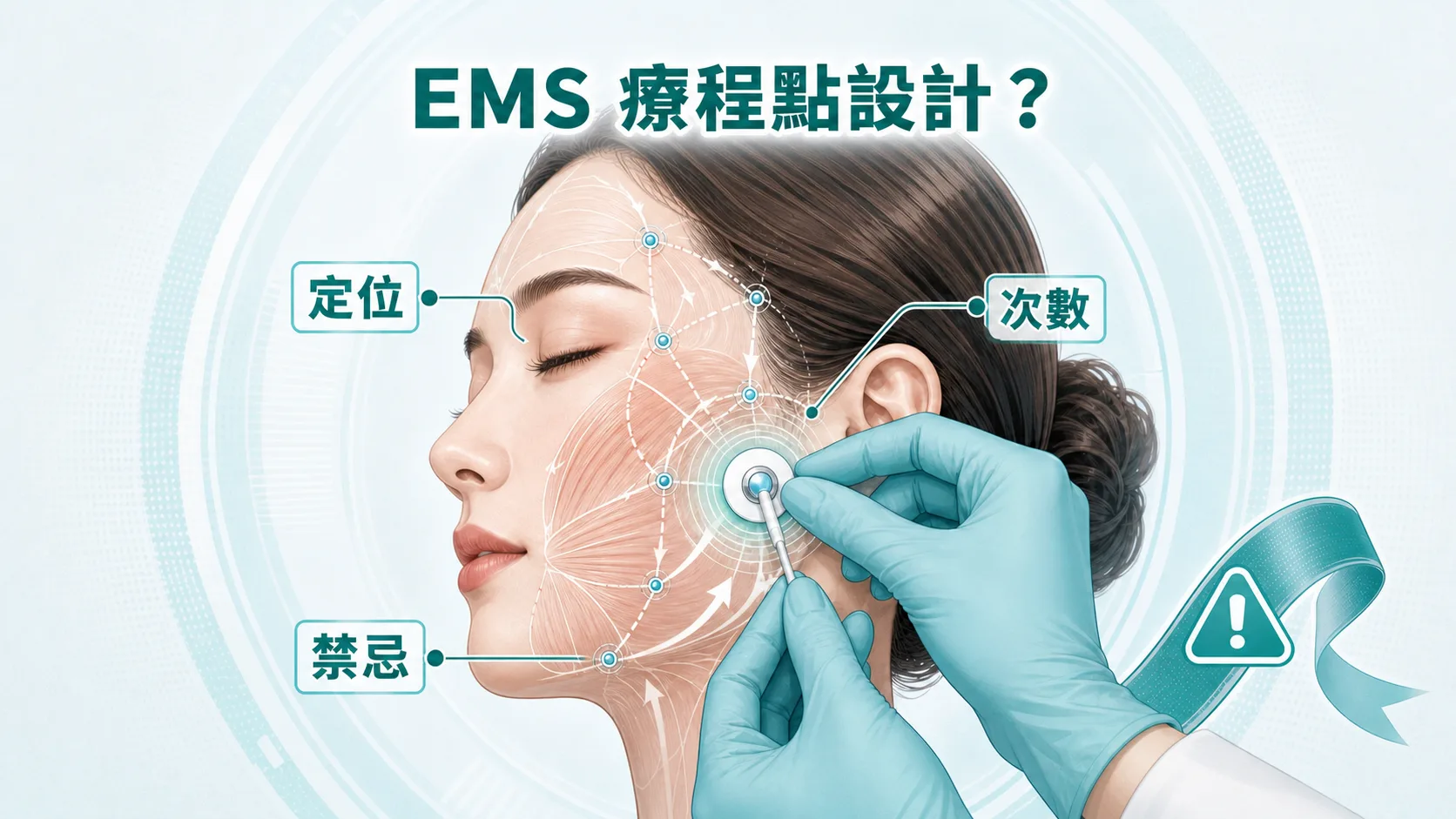
"How many facial EMS sessions before it works?" is the question clients ask most often in consultation, and the one most easily answered wrongly — because the usual mistake is not quoting the wrong number, it is treating a research protocol as a promise of results.
This article separates three things: what the study actually did, the anatomical logic behind electrode placement, and the contraindication assessment that must be completed before treatment.
1. First: a research protocol is not a manufacturer's treatment recommendation
The EVE Titan facial EMS case series published in PRS Global Open used a clearly defined treatment design. Three things are worth noting about it.
First, it is a protocol set for the sake of standardisation, so that all 7 participants received consistent treatment and the observations could be described coherently. It is not a manufacturer-recommended commercial treatment package.
Second, the study did not compare different session counts. There was no 5-session arm and no 15-session arm, so the claim that "10 is the optimal number" has no basis whatsoever in this research.
Third, the cohort was 7 people aged 24–39. Actual treatment planning should be assessed case by case by a trained operator, following the manufacturer's instructions for use and training content.
Once those three points are clear, the research protocol becomes genuinely useful as reference — it shows you what a peer-reviewed approach that produced no adverse events actually looks like.
2. The treatment design used in the study
| Parameter | Study setting |
|---|---|
| Total sessions | 10 |
| Interval | 1–2 weeks |
| Session length | Approximately 20 minutes per side |
| Treatment areas | Bilateral periocular and perioral regions |
| Sequence | Periocular first, then perioral, one side at a time |
| Intensity adjustment | Raised gradually until visible but comfortable contractions appeared |
| Preparation | Skin cleansed, conductive gel applied, semi-reclined position |
| Anaesthesia / premedication | None |
| Follow-up | Approximately 1 month after the 10th session |
| Adjustment in the asymmetry case | Bilateral stimulation, with intensity and emphasis increased on the weaker side |
Across the full course, 10 sessions at roughly 20 minutes per side amounts to around 400 minutes of stimulation time spread over 10 to 20 weeks. That arithmetic has direct consequences for scheduling and pricing — room-cost calculations for course-based treatments are covered in pricing and payback for course-based EMS treatments.
3. The anatomical basis for electrode placement
The biggest difference between facial and body EMS is that the cost of misplacement is far higher on the face. Motor nerve branches are dense there, so an electrode in the wrong position does not merely reduce the effect — it may stimulate muscles you did not intend to stimulate.
The placement used in the study has a clear anatomical rationale:
- Perioral electrodes: along the nasolabial fold, roughly 1–1.5 cm lateral to the alar base, overlying the course of levator labii superioris and the zygomaticus muscles
- Periocular electrodes: inferior to the infraorbital rim, along the pretarsal–preseptal junction, deliberately avoiding the direction of the globe
- Bilateral symmetry: placement must be symmetrical on both sides to maintain left–right balance
This is also why you should ask, at procurement, whether manufacturer training covers electrode placement. EMS performance depends heavily on anatomical placement, and that is not something device specifications can compensate for. For how each energy type maps to tissue layers, see facial EMS vs RF vs HIFU.
4. Contraindications and situations requiring assessment
The following are general contraindications and precautions for electrical stimulation devices, not a complete list for any specific model. The actual contraindications for any device must follow its manufacturer's instructions for use, and where there is doubt the client should be advised to consult an appropriate healthcare professional first.
| Category | Situation | Handling principle |
|---|---|---|
| Absolute | Cardiac pacemaker, implantable defibrillator or other implanted electronic device | Do not treat |
| Absolute | Pregnancy or suspected pregnancy | Do not treat |
| Absolute | Epilepsy or history of seizures | Do not treat; requires prior medical assessment |
| Absolute | Active skin infection, open wound or rash in the treatment area | Reassess once resolved |
| Assess first | Metal implants within the treatment area | Requires prior medical assessment |
| Assess first | Significant arrhythmia or other cardiac conditions | Requires prior medical assessment |
| Assess first | History of malignancy | Requires prior medical assessment |
| Assess first | Facial nerve disorders, facial palsy or altered sensation | Medical territory; refer |
| Assess first | Thrombosis or thrombophlebitis | Requires prior medical assessment |
| Timing | Recent filler or botulinum toxin injection | The study excluded anyone treated within the preceding 6 months; in practice, follow manufacturer and injector guidance on intervals |
| Timing | Recent facial surgery | As above |
| Site restriction | Anterior neck, over the carotid sinus | A general avoidance site for electrical stimulation |
Note the last three rows. How long to leave between recent injectables and facial EMS is a question the study does not answer — it simply excluded such cases. In practice this needs confirming with the manufacturer and with the healthcare professional who performed the injection; it should not be estimated independently.
5. The pre-treatment assessment flow
A process you can audit is more useful than a list you memorise. We suggest turning the following into a fixed form:
- History taking: work through the table above item by item, and record the client's answers rather than simply asking once verbally
- Treatment area inspection: confirm there is no active infection, wound or rash
- Injection history: establish the date and site of the most recent filler or botulinum toxin treatment
- Expectation setting: explain that this is appearance care rather than a medical procedure, and that results vary between individuals
- Written consent: covering the treatment, expected sensations, risks and image use where applicable
- Parameter record: note the day's settings as the basis for the next session
How to handle items 5 and 6 in practice — what a consent form should say, how to take standardised photographs — is covered in facial EMS pre- and post-treatment care and record-keeping.
6. What to record
This deserves its own section, because it solves two problems at once: treatment consistency, and how you handle any dispute later.
The study itself fell short here. The authors concede in their limitations that session-level stimulation outputs were not uniformly archived, which left them unable to reliably reconstruct cohort-wide parameter ranges. That is a neat demonstration of what happens without records.
We suggest recording at minimum: date and operator, treatment areas and sequence, the parameter settings actually used, session duration, the client's immediate response and any discomfort, and the intended adjustment for next time. If the device supports parameter export, use the export rather than transcribing by hand.
Frequently Asked Questions
How many facial EMS sessions are needed?
In the study published in PRS Global Open, the design was 10 sessions at 1–2 week intervals, approximately 20 minutes per side. That was a protocol set for standardisation rather than a manufacturer's treatment recommendation, and the study did not compare different session counts. Actual numbers should be assessed case by case by a trained operator, following the manufacturer's instructions for use and training content.
Is facial EMS safe? Are there side effects?
In that study, all 7 participants completed 10 sessions with no adverse events — no erythema, oedema, persistent pain or neurological symptoms, and no downtime. The only common sensations were transient muscle contraction and warmth during treatment. However, with only 7 participants concentrated in the 24–39 age range, the sample is not sufficient to establish safety conclusions, and a contraindication assessment must still be completed before treatment.
Can someone with a pacemaker or who is pregnant have this treatment?
No. Implanted electronic devices such as cardiac pacemakers and implantable defibrillators, along with pregnancy or suspected pregnancy, are general contraindications for electrical stimulation devices. A history of epilepsy or seizures is likewise a reason not to treat. Actual contraindications for any device follow its manufacturer's instructions for use, and where there is doubt the client should be advised to consult an appropriate healthcare professional first.
How long after filler or botulinum toxin can facial EMS be done?
The study does not answer this — it simply excluded anyone who had facial surgery, filler or botulinum toxin within the preceding 6 months. In practice the interval should be confirmed with the manufacturer and with the healthcare professional who treated the client, rather than estimated independently. Always establish the date and site of the most recent injection before treatment.
Conclusion: an auditable process matters more than remembering a number
"How many sessions" is hard to answer because the question assumes a standard answer exists. What is actually true is this: the research offers one documented approach that produced no adverse events, the manufacturer offers treatment guidance, and what you need is a process you can execute session by session, record session by session, and audit afterwards.
With that process in place, contraindication assessment does not depend on memory, parameters do not depend on impression, and when a client asks what was done last time you have an answer. That is considerably more useful than memorising a session count.
For the Titan instructions for use, the scope of manufacturer training or treatment design support, contact us to request the documentation.
This article is general operational reference for beauty salons and does not constitute medical diagnosis, treatment or health advice. The contraindications listed are general precautions for electrical stimulation devices rather than a complete list for any specific model; the applicable requirements are those in the official product documentation, supplier training and the regulations in your jurisdiction. Treatment sensations and appearance changes vary between individuals.