
LED Beauty Lights, IPL or Laser? Evidence, Dose and Selection
The term “whitening light” does not identify a technology. Check the complete model, light source, intended purpose and evidence before deciding whether a service fits your concern. Dull-looking skin, pigmentation and other skin problems need different assessment. More colours do not automatically mean broader benefits.
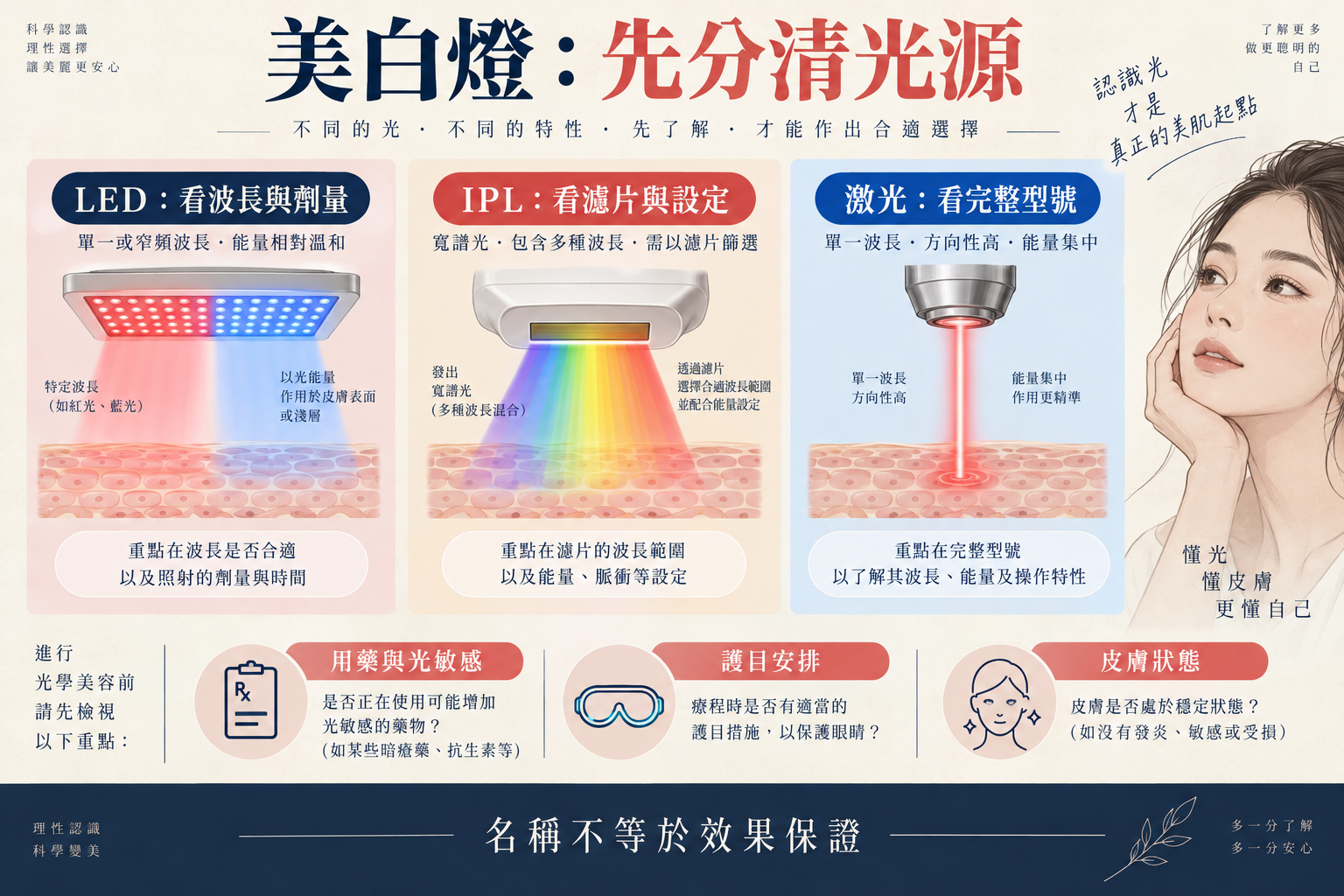
This AI-generated graphic uses Traditional Chinese labels. Light and skin illustrations do not show actual penetration depths or operating settings.
How LED, IPL and lasers differ
LEDs emit light; beauty applications commonly use selected visible or near-infrared bands. IPL uses filters to select part of a broad spectrum. Lasers have particular wavelengths and output characteristics. Their effects, protection and procedures are not interchangeable.
| Question | LED | IPL | Laser |
|---|---|---|---|
| Identify | Wavelength, dose and purpose | Filter, pulse settings and model | Wavelength, pulse type and mode |
| Service | Often an adjunct light procedure | Depends on spectrum and settings | Depends on platform and mode |
| Colour alone? | Does not establish output | Does not identify the filter range | Aiming light may differ from treatment light |
| Assess | Dose, distance, time, eyewear | Skin colour, sun exposure, testing, competence | Intended use, operator and safety arrangements |
This is a comparison framework, not a prescription. A home LED mask's instructions cannot be applied to an IPL platform.
Red, blue and near-infrared claims
Red and near-infrared light appear in photobiomodulation research; blue light also has specific skin applications. The American Academy of Dermatology describes potential appearance benefits while noting differences between devices and evidence. A study does not validate every salon or home device. AAD red-light information
Ask whether claims about collagen, pigmentation or repair refer to laboratory mechanisms, short-term ratings or controlled human outcomes. Check the model, participants and follow-up. Marketing terms such as “seven-colour care” do not answer these questions. Changing or unexplained lesions need medical assessment rather than a trial with a light.
More exposure is not automatically better
Dose depends on intensity, time, distance, coverage and output consistency. A teaching example: 10 milliwatts per square centimetre for 600 seconds equals 6 joules per square centimetre. This explains units only; it is not a recommended setting for any person or device.
Clients can ask which instructions justify the duration. Salons should retain the IFU, configuration, maintenance and training records. Do not compensate for weak or uneven output by arbitrarily extending exposure.
When to obtain advice or postpone
Disclose photosensitivity, potentially photosensitising medication, other treatment, inflammation and unexplained skin findings. Do not stop prescribed medication to attend an appointment. Discuss pigmentation concerns individually rather than assume all skin colours are equally suitable.
Use the protection required by the particular instructions. Closed eyes, sunglasses or cotton pads should not be assumed sufficient. Hong Kong's Department of Health advises understanding optical-procedure risks and safety arrangements. Cosmetic procedure information
Compare complete services and ownership costs
Compare the same goal, not LED counts. A quote may include only exposure or also consultation, cleansing, other care and reassessment. Home-device decisions should include intended use, instructions, warranty, light-source life and returns. Evidence for another brand cannot establish equivalent results.
Record baseline observations, current products, previous reactions and available time. Agree how to reassess and respond to irritation or no improvement before buying a long course.
Eight procurement questions
- What exact manufacturer, model, source and accessories are included?
- How do instructions define wavelength, intensity, distance and time?
- Is human evidence relevant to this configuration, and what are its limits?
- Are cleaning, eye protection and hygiene documented?
- How is output or source ageing checked?
- Does training cover screening and escalation?
- Are replacement parts, servicing and downtime support included?
- Can each advertising statement be traced to relevant evidence?
Frequently asked questions
Can an LED light replace sunscreen?
No. Light treatment and sun protection have different purposes; arrange aftercare for the actual skin condition.
Are more colours better?
Not necessarily. Output, evidence and intended use matter more than colour count.
Does stinging show that it is working?
No. Stop and contact the provider for unusual pain, eye symptoms or worsening reactions; seek assessment when needed.
Can I use a home mask immediately after a laser?
Ask the treating professional first. The procedure, recovery and mask instructions all matter.
Does an FDA document approve every use in Hong Kong?
No. Verify the product and scope; overseas documentation does not guarantee all uses, outcomes or local operating eligibility.
Further reading and enquiries
Compare cell-machine technologies, EMS, RF and HIFU, and the supplier assessment framework. Contact Asia Pacific Beauty for configuration documents. This is general education, not individual diagnosis or operating instructions.