
Skincare Batch Recalls: Salon Traceability, Quarantine and Drills
A skincare recall or safety notice requires identification of the exact product, batch and current location. Brand and expiry alone may not trace treatment use, sales, branch transfers or samples. This framework supports preparation; actual action follows the formal notice and applicable requirements.
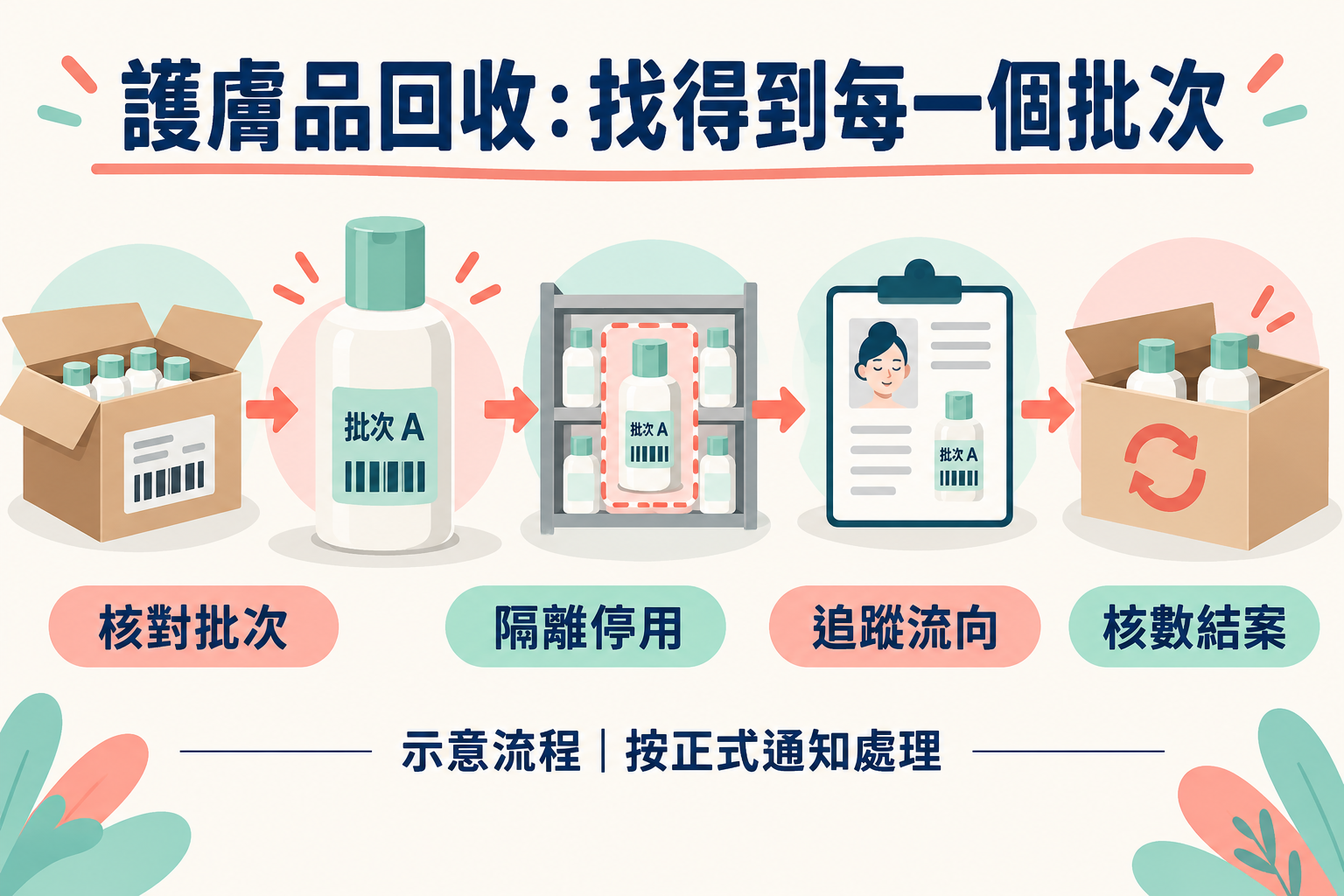
This AI-generated graphic has Traditional Chinese labels and a fictional batch. It is not a real brand recall.
Separate recalls, expiry and client reactions
Expired stock follows inventory policy. A formal recall follows its specified scope and disposition. A client reaction first needs health assessment and factual records, with investigation of any connection. One reaction does not establish a brand-wide problem; no observed reactions do not invalidate a notice.
An overseas recall may concern particular formulas, batches or markets. Confirm local applicability with the supplier. Similar packaging alone is insufficient. Quarantine reasonably suspected items while the responsible person checks details.
Begin traceability at receipt
| Stage | Suggested records | Question answered |
|---|---|---|
| Receipt | Product, size, batch, quantity, supplier, invoice, date | Where did it come from? |
| Storage | Branch, shelf, saleable/quarantine status | Where is remaining stock? |
| Opening | Bottle batch, opening date, owner | Which bottle remains in use? |
| Treatment | Case code, date, product and batch | Which services used it? |
| Sales/samples | Order or issue record, batch, quantity | Who may have received it? |
| Return/disposal | Batch, quantity, reason, authorisation, evidence | What has been recovered or handled? |
Separate batches even when the SKU is identical. Odoo's tracking documentation illustrates links between source, location and movement. A suitable spreadsheet can also support a small salon if records reconcile.
Obtain supplier traceability for unreadable or absent labels. An internal code can aid location but should not be presented as an invented manufacturer batch.
Verify six notice details
- Confirm the manufacturer, supplier or authority and reliable contact.
- Match name, size, packaging, batch and market.
- Identify the reason, possible risk and scope.
- Confirm stop-sale, stop-use, return, replacement or other action.
- Record deadlines, client instructions and required evidence.
- Assign an owner to resolve missing information.
Preserve the original notice and version. Retain corrections with timestamps and communicate which version branches must follow.
Block sales and service use together
Label and restrict quarantined stock. Update online listings, checkout, treatment preparation and transfers. Include opened bottles, gifts, travel sizes and other branches, not just the retail shelf.
Record batch, count, location, staff and time. Preserve labels and relevant items until authorised disposition; follow any specific safety instructions rather than independently empty bottles or destroy evidence.
Trace clients with controlled access
Search sales, samples and treatment records by batch. Use accurate notifications describing identification, stopping use and obtaining help, following formal templates where supplied. Do not diagnose clients or claim every recipient will be affected.
Limit personal data to authorised follow-up roles. Record received, pending, incomplete and completed statuses. A reaction also needs its own assessment and incident process.
A mock-recall reconciliation
Suppose a fictional batch contains 60 bottles: 22 unopened in stock, three opened for treatment, 30 sold and five sampled. The account totals 60, but returning only the 22 shelf bottles leaves 38 to trace.
Track opened-bottle disposition, contacts, actual returns and unresolved quantities. Sending a message is not recovery. Used-up items may have no physical return but still need recorded flow and applicable follow-up.
Run an internal drill using a fictional non-problem batch, without sending external messages. Test retrieval time, missing fields, branch searches and sales blocking. Timing targets are internal management choices, not legal deadlines.
Close with evidence and improvements
Retain the notice, affected counts, quarantine, flow list, contact results, disposition evidence, open tasks and approval. Release stock according to confirmed instructions rather than assume silence means clearance.
FDA cosmetics-recall information discusses batch identification, distribution records and effectiveness checks. It is a US management reference, not Hong Kong's legal procedure. Investigate record failures and improve them after the drill or event.
Frequently asked questions
Is an expiry date sufficient?
No. Different batches may share it; retain batch and movement information.
Does an overseas recall cover all local products?
Not automatically. Verify formula, batch, market and local supply.
Should opened bottles be traced?
Yes, as should samples and gifts in the affected scope.
Can a case close after contacting clients?
Not necessarily. Follow the notice's return, disposition and unresolved-item requirements.
Does a small salon need a large system?
Not necessarily. Searchable, reconciled, access-controlled records can begin in a suitable spreadsheet.
Related reading
Use expiry and stock management, incident records and skincare/device pairing alongside this process.