
Trinity Liftoning ROI: Pricing, Capacity and Payback
A Trinity purchase should be approved with a payback model, not a sales forecast built from the treatment price alone. The machine can only recover its investment through completed, paid appointments after variable cost, staff time, maintenance and downtime have been allowed for.
This guide provides a planning model. It does not state the price of Trinity, prescribe consumer pricing or guarantee a return. Request a current, product-specific quotation before using the formulas.
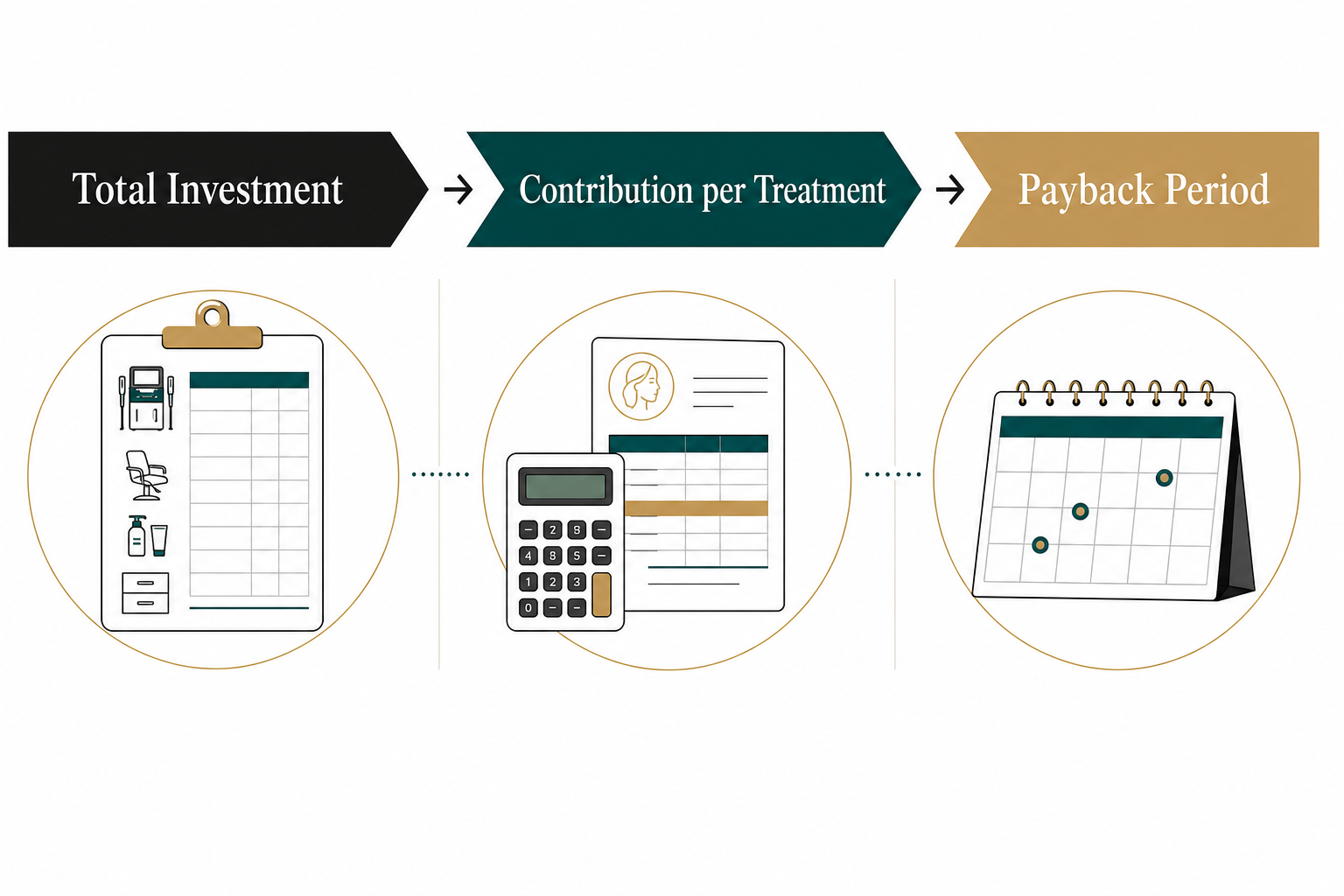
The Three Numbers That Matter
- Total investment: every cost required to place the device into service.
- Contribution per completed treatment: collected price minus costs caused by that treatment.
- Realistic completed treatments per month: bookings adjusted for cancellations, no-shows, training, room limits and downtime.
Calculate Total Investment
Include more than the console price:
| Cost Group | Examples |
|---|---|
| Acquisition | Device, applicators, accessories and optional package items |
| Delivery | Packing, freight, insurance, duty, tax, brokerage and local transport |
| Launch | Installation, training, photography, consultation materials and opening promotion |
| Compliance | Local registration, professional advice, labels, laser-safety controls and eyewear |
| Working capital | Initial consumables, spare parts and cash buffer |
| Finance | Interest, fees and foreign-exchange exposure where applicable |
Calculate Contribution per Treatment
Use collected revenue, not the list price.
Contribution per treatment = collected treatment revenue - variable treatment costs - allocated operator and room cost
Variable costs can include gel, disposables, laundry, payment fees, commission, client aftercare, photography storage and any handpiece or service reserve linked to use. Operator time should include consultation, preparation, treatment, cleaning, records and room reset.
Do not call gross sales "profit." Rent, management, marketing, insurance, software, finance, tax and general overhead still have to be paid.
Break-Even Treatment Count
The US Small Business Administration uses the standard relationship:
Break-even units = fixed investment or fixed cost / contribution per unit
For a device project:
Treatments to recover investment = total project investment / contribution per completed treatment
This is a simple cash-payback view. Accounting depreciation, tax treatment, financing and residual value need separate professional review.
A Hypothetical Example
The following figures are illustrative and are not a Trinity quotation or recommended treatment price.
| Input | Illustrative Amount |
|---|---|
| Device, delivery, training and launch | HK$360,000 |
| Collected revenue per treatment | HK$2,200 |
| Consumables, fees and aftercare | HK$300 |
| Allocated operator and room time | HK$350 |
| Contribution per completed treatment | HK$1,550 |
Simple treatment count to recover the investment:
HK$360,000 / HK$1,550 = approximately 233 completed treatments
At 20 completed treatments per month, simple payback is about 11.6 months. At 35, it is about 6.6 months. At 50, it is about 4.6 months. These figures still exclude general overhead, finance, tax and unplanned downtime, so the business case should use a longer conservative estimate.
Capacity Comes Before Demand
Calculate practical monthly capacity:
Available treatment hours / total appointment cycle time = theoretical appointments
Then reduce it for consultations, staff breaks, room conflicts, no-shows, maintenance, public holidays and training. If a full cycle takes 75 minutes and the room is genuinely available for 60 hours per month, the theoretical capacity is 48 appointments, not an unlimited booking target.
Build Three Scenarios
| Scenario | Assumptions to Use |
|---|---|
| Conservative | Slow lead generation, higher cancellation, introductory discounts, one maintenance interruption |
| Base | Demand from existing clients, stable conversion, normal service reserve and moderate rebooking |
| Strong | Higher utilization without compromising consultation, safety, records or recovery criteria |
Do not approve the purchase only because the strong scenario looks attractive. The conservative case should show that the salon can carry the investment without unsafe sales pressure or excessive prepayment.
Count Every Cost
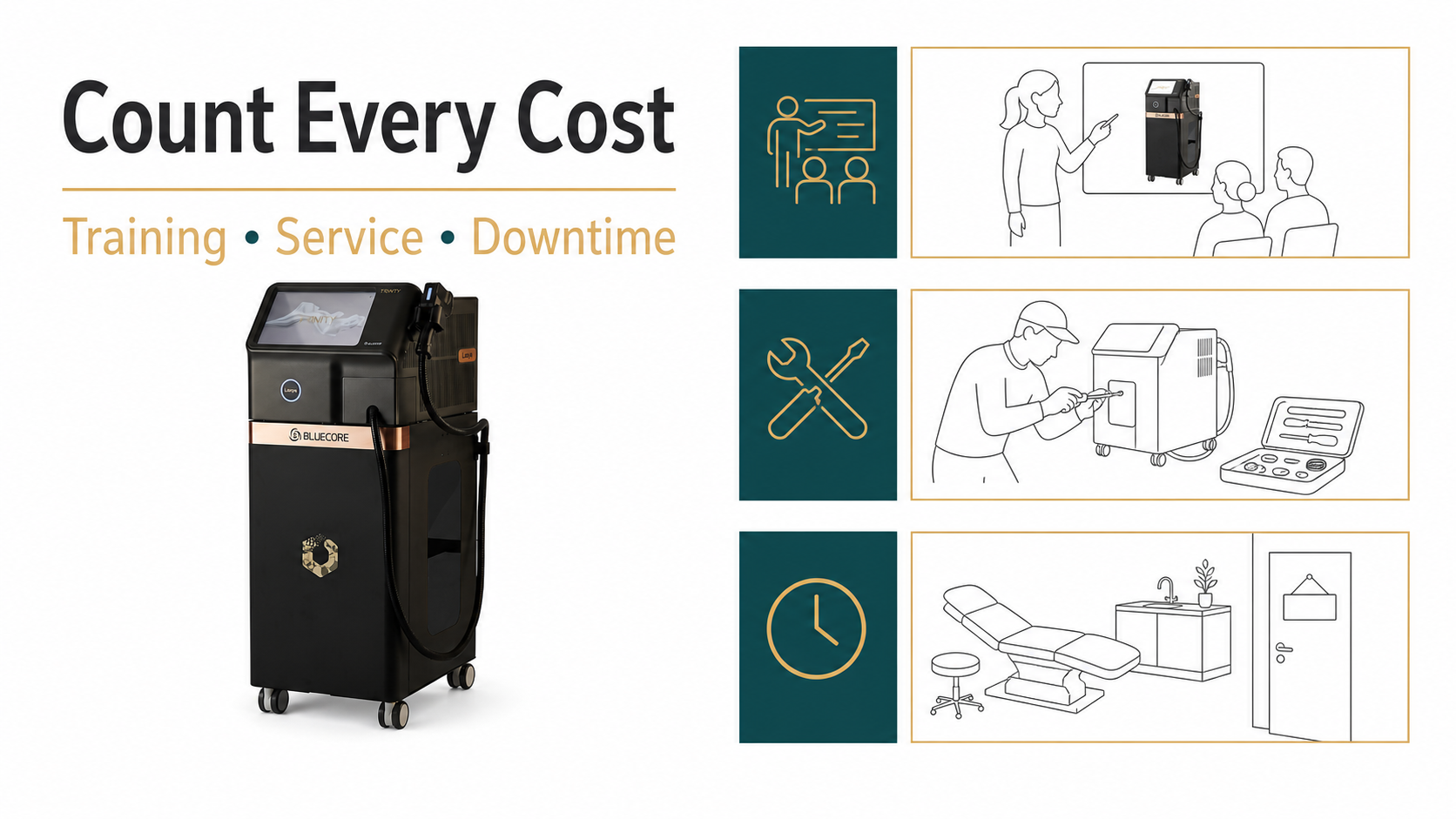
Training cost
Include staff hours, model treatments, refresher sessions and productivity loss while the team learns. A short demonstration is not the whole cost of competence.
Maintenance reserve
Ask for preventive-maintenance frequency, expected service items, travel charges and common out-of-warranty costs. Build a monthly reserve even during warranty.
Downtime
Model at least one interruption. Include diagnosis, parts lead time, international freight, rescheduling and refunds. A machine with a lower purchase price but no local support may have a higher ownership cost.
Client acquisition
Separate launch leads from retained clients. Calculate cost per consultation, consultation-to-paid-treatment conversion and rebooking. Social reach is not revenue.
Discounts and packages
Model the collected price after discounts, staff incentives, card fees and refunds. Avoid financing the equipment with large, high-pressure prepaid packages. Hong Kong consumer guidance repeatedly highlights risk around excessive prepayment and unclear service terms.
Price the Service, Not the Machine
Treatment pricing should reflect:
- consultation and assessment time
- operator competence and supervision
- appointment length and room use
- consumables and aftercare
- maintenance and support reserve
- local demand and positioning
- permitted claims and realistic expectations
- rescheduling and adverse-event escalation capacity
Avoid setting a price by dividing the machine cost by an arbitrary number of clients. The result may ignore value, capacity and actual variable cost.
Monthly Dashboard
Track these figures from launch:
| Metric | Why It Matters |
|---|---|
| Qualified enquiries | Measures relevant demand, not total messages |
| Consultations attended | Exposes no-show and scheduling loss |
| Paid treatments completed | The revenue-producing unit |
| Average collected revenue | Captures discounts and refunds |
| Contribution per treatment | Shows whether volume creates value |
| Room utilization | Identifies real capacity |
| Rebooking rate | Tests client fit and service quality |
| Adverse events and escalations | A mandatory safety measure, never a sales KPI |
| Downtime hours | Quantifies support quality |
| Cumulative recovered investment | Shows progress to payback |
Approval Checklist
- Current written quotation and package scope
- Conservative, base and strong demand scenarios
- Verified treatment-cycle time
- Written consumable and service assumptions
- Staff and room capacity
- Compliance and training budget
- Warranty and downtime plan
- Marketing claims reviewed against actual intended use
- Cash buffer that does not rely on excessive prepayment
- Monthly owner assigned for financial and safety review
Request a Product-Specific ROI Discussion
Buyers can review the Trinity product page and use the 30-day salon launch plan to identify implementation costs. Asia Pacific Beauty Group can provide a current quotation and discuss package contents, training, delivery and after-sales planning through the contact page. Buyers should combine that information with their own rent, labour, pricing, capacity and tax assumptions.
Frequently Asked Questions
How fast can Trinity pay for itself?
There is no universal period. Payback depends on total investment, contribution per completed treatment, monthly utilization, downtime and overhead.
Should salon rent be included?
Yes, at least as an allocated room or overhead cost in the full profitability model. A simple device payback can be shown separately, but it should not be confused with net profit.
Should tax depreciation be counted as cash payback?
No. Tax allowances and accounting depreciation are separate from operating cash flow. Obtain local accounting advice.
Is a package price better than pay-per-treatment?
It depends on client need, contract terms and consumer law. Model refunds, expiry, capacity and ethical sales practice. Avoid using high-value prepayments to hide weak operating cash flow.
What is the most conservative forecast?
Use a conservative scenario based on completed paid appointments, not enquiries, follower counts or full theoretical room capacity.
All financial examples are hypothetical. This article is not accounting, tax, investment, legal or medical advice.